



California's AC Transit Expands Bus Lane Enforcement Program
The agency is expanding its use of automated cameras equipped with artificial intelligence after evaluating their effectiveness in detecting illegal stopping and parking at Tempo Line stations and bus only lanes.

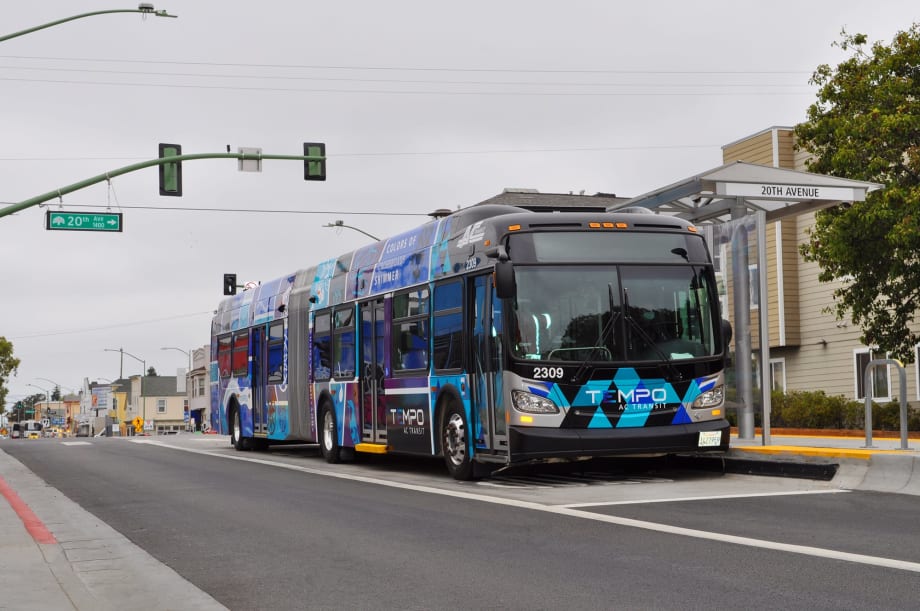
The AC Transti upgrade follows four years of issuing citations for station and bus only lane violations along the Tempo Line 1T corridor.
Photo: AC Transit
Oakland, Calif.’s Alameda-Contra Costa Transit District (AC Transit) is expanding automated camera citations for illegally parked or stopped vehicles to cover bus stops on all bus lines throughout its service area.
AC Transit is expanding its use of automated cameras equipped with artificial intelligence (AI) after evaluating their effectiveness in detecting illegal stopping and parking at Tempo Line stations and bus only lanes. Tempo Line 1T is AC Transit's highest ridership bus line.
AC’s Expanded Automated Camera Program
Like Tempo, the AI-powered cameras will detect and issue citations to any vehicle, including taxis, Uber and Lyft, and delivery trucks, which are stopped or parked at AC Transit bus stops.
During the initial 60 days, motorists identified by law enforcement as violating the bus stop law will receive a warning notice that will be sent to the vehicle’s registered owner by USPS mail.
Starting October 7, warnings will be replaced with a $110 citation, which will also be issued via USPS mail.
How Enforcement Works
AC Transit has equipped 100 buses with two small forward-facing cameras mounted on the front windshield to detect potential bus stop violations.
Developed by Bay Area-based Hayden AI, its AI technology employs innovative computer vision to monitor bus stops for potential parking violations. Instead of sending the data to a central server, an onboard processor analyzes the information in real-time.
When a violation is suspected, the system produces an evidence package, which includes:
A 10-second video of the violation, a photo of the license plate, and the time and location of the incident.
The evidence package is transmitted to a secure cloud accessible only by transit law enforcement.
Trained law enforcement, and not the AI software, review the evidence packages and determine if a citation should be issued to the registered vehicle owner.
Automated Enforcement Background
AC Transit played a central role in passing AB 917, which now permits transit agencies statewide to use forward-facing cameras to issue citations for vehicles illegally parked at bus stops and in transit-only lanes.
In June 2024, AC Transit upgraded from its legacy software on Tempo buses to more advanced AI hardware and software designed to recognize lane lines, bus lanes, bus stop dimensions, and bus sizes, ensuring accurate violation detection.
The upgrade follows four years of issuing citations for station and bus only lane violations along the Tempo Line 1T corridor.
From the activation of AI cameras on June 16 through July 25, 2024, along the 9.5-mile Tempo corridor, onboard AI cameras documented 1,102 potential illegal parking evidence packages for review by the Alameda County Sheriff's Department, resulting in 787 citations to date.
In comparison, during June and July 2023, the legacy system, which required manual camera activation, produced 879 evidence packages, leading to 22 citations. This represents a 34.4-fold increase in citation efficiency with the AI cameras compared to the legacy system.
More Technology

From Hardware to Digital Partner: Luminator Charts Its Next Chapter
CEO Magnus Friberg discusses Luminator’s shift toward becoming a digital partner, the growing importance of software and interoperability, and how AI can help agencies improve operations and passenger experience.
Read More →
Beyond the Checklist: A Structured Approach to Transit Maintenance
Reliability-Centered Maintenance helps transit agencies move beyond routine checklists to focus limited resources on the assets and failures that have the greatest impact on safety, reliability, and service.
Read More →
NJ TRANSIT Advances Bus Technology Upgrades Across Statewide Fleet
More than 1,500 buses now feature upgraded technology designed to improve arrival predictions and provide free Wi-Fi, with deployment expected to reach nearly 2,000 buses by the end of 2026.
Read More →

Building a Flexible Path to Transit Electrification
John Hroncich discusses BAE Systems’ modular and scalable approach, lessons learned from decades of real-world operations, and how agencies can identify electrification strategies that fit their fleets.
Read More →
Biz Briefs: Alstom Lands Canadian Contract, LYT to Supply California TSP, and More
In METRO's latest installment, we take a look at recent news from Complete Coach Works, Beep, FlixBus, and more partnerships making headlines across the transportation sector.
Read More →
From Legacy Silos to Conversational Intelligence
What if transit leaders could ask any operational question and get a trusted answer in seconds? Conversational AI is transforming how agencies use their data.
Read More →
USDOT Announces Rail Vehicle Replacement Grants, Chattanooga AV Shuttle Funding
More than $191 million in federal funding will help three transit agencies replace aging rail vehicles and support a new autonomous shuttle service in Chattanooga.
Read More →
Bus Tech Talk: Keeping Transit Technicians Ahead of the Technology Curve
LA Metro’s Obed Mejia discusses technician training, evolving maintenance technology, fleet replacement, and strategies for getting the most out of today’s transit fleets.
Read More →
Biz Briefs: RIPTA Unveils New Frontrunners, Clevland RTA Adds New Siemens, and More
In METRO's latest installment, we take a look at recent news from Siemens, Prevost, Dodge, and more partnerships making headlines across the transportation sector.
Read More →
Why Simulating Pedestrian Movement Has Become Essential for Modern Rail Stations
Pedestrian microsimulation is helping rail planners identify bottlenecks, test station designs, and prepare complex transit hubs for growing passenger volumes.
Read More →