



California's OCTA Unveils First Siemens S700 Streetcar
The vehicle, manufactured in Sacramento, Calif., is the first of eight to be delivered for the OC Streetcar.

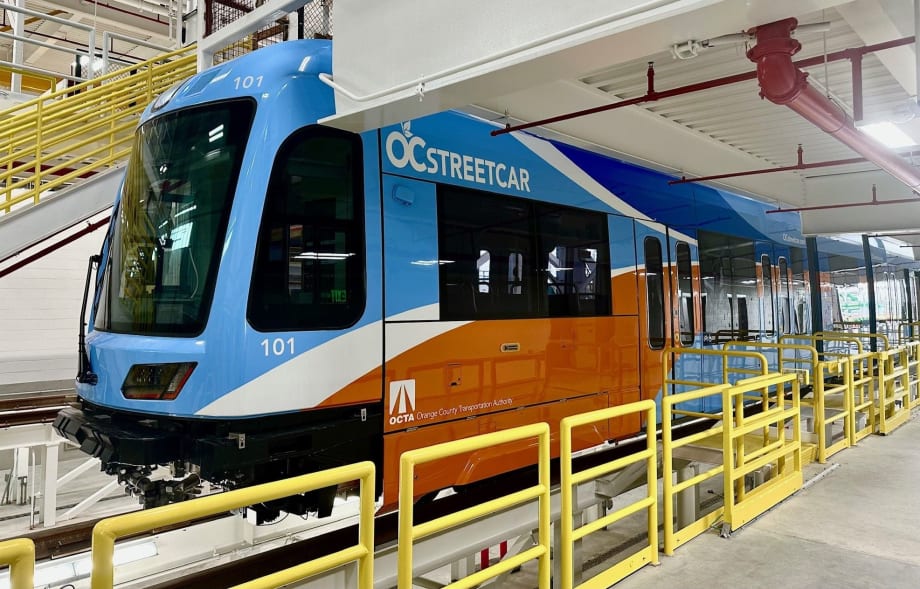
The OC Streetcar will run on a four-mile route between the Santa Ana Regional Transportation Center and Harbor Boulevard in Garden Grove.
Photo: OCTA
Calif.’s Orange County Transportation Authority (OCTA) unveiled the first vehicle that will operate on the OC Streetcar system, giving OCTA board members and elected officials a first look at what will be the county’s first modern, electric streetcar.
The vehicle, manufactured by Siemens Mobility in Sacramento, Calif., is the first of eight to be delivered for the OC Streetcar.
Event attendees, which was held at the streetcar’s base in Santa Ana, were invited to walk through the vehicle and learn about its design and features from OCTA staff.
“The arrival of the first OC Streetcar vehicle is an exciting moment for Orange County and a clear sign of the strong progress we’re making toward getting the system running,” said OCTA Chair Doug Chaffee. “We’re looking forward to beginning testing and ultimately launching a safe, reliable transit option that will better connect people to where they live, work, and spend time.”
Features of the New Siemens S700s
The features of the Siemens S700 vehicle include:
A length of 90 feet, weighing just over 100,000 pounds.
Designed to carry up to 211 passengers, including 62 seated and 149 standing.
A 70% low-floor vehicle, designed for accessibility and rider comfort.
Four sets of double doors on each side for efficient boarding.
Articulated with three sections, to allow for easier turning.
The vehicle meets all ADA requirements and includes hydraulic level boarding to improve access for passengers using mobility devices, strollers, and bicycles.
OC Streetcar in Operation
The vehicle’s maximum operating speed is 44 mph, which will be reached along the former Pacific Electric (PE) right of way.
Street-running segments will operate at or below the speed limit to ensure safe and predictable travel while operating alongside other cars, cyclists, and pedestrians.
The OC Streetcar will run on electricity from an overhead catenary system, producing zero emissions as it runs along the track.
Additional features include:
Energy-absorbing bumper for added safety.
Emergency Battery Drive, powered by lithium-ion batteries, allowing the vehicle to move at least 300 feet under its own power in the event of power disruption.
The OC Streetcar will run on a four-mile route between the Santa Ana Regional Transportation Center and Harbor Boulevard in Garden Grove.
It will serve some of the most densely populated neighborhoods in the county, Downtown Santa Ana, and the Civic Center, and connect with Metrolink rail service, regional and international bus services, and OCTA’s busiest local bus routes.
Up to six vehicles will be in service daily, with two spares rotating in as needed, and stops will occur every 10 to 15 minutes at 10 stations in each direction.
The OC Streetcar is being constructed in coordination with the cities of Santa Ana and Garden Grove, the California Department of Transportation, and the Federal Transit Administration. The $649 million project is funded with federal, state, and local dollars, including Measure M, the county’s half-cent sales tax for transportation improvements.
Following months of testing, the public operations are slated to begin in spring 2026.
More Rail

New York MTA Advances Final Contract for Second Avenue Subway Expansion
Contract Four is the largest in the Second Avenue Subway Phase 2 project and includes construction of station infrastructure, tracks, and signals for the subway expansion, MTA officials said. Work on Contract Four will begin in 2027.
Read More →
San Diego MTS Breaks Monthly Trolley Ridership Record
Agency officials said July’s ridership indicates MTS’s continued recovery from the pandemic.
Read More →
Report Examines NJ TRANSIT Reliability, Funding Challenges
The Garden State Initiative analysis examines the roles of Amtrak infrastructure, fleet management, and agency operations while recommending a more performance-based approach to improving reliability.
Read More →
Stadler, CapMetro Sign Long-Term Rail Fleet Support Agreement
Beginning in 2027, Stadler will provide on-site technical expertise, spare parts support, training, and obsolescence management to help extend the reliability and longevity of CapMetro’s GTW fleet.
Read More →
Biz Briefs: Alstom Lands Canadian Contract, LYT to Supply California TSP, and More
In METRO's latest installment, we take a look at recent news from Complete Coach Works, Beep, FlixBus, and more partnerships making headlines across the transportation sector.
Read More →
CATS Gold Line Marks 5 Years of Service, 2.8M Passenger Trips
With a six-mile expansion planned, the Charlotte streetcar is positioned to connect more neighborhoods and major transit hubs across the region.
Read More →
Why Simulating Pedestrian Movement Has Become Essential for Modern Rail Stations
Pedestrian microsimulation is helping rail planners identify bottlenecks, test station designs, and prepare complex transit hubs for growing passenger volumes.
Read More →
Amtrak Begins Major Construction at New York’s Sunnyside Yard
The new maintenance facility will support Amtrak’s Airo trainsets while improving maintenance efficiency and turnaround times in New York.
Read More →
Chicago Leaders Unveil Plans for O’Hare Airport Express Train
The privately developed project would offer a 15-minute trip between downtown and O’Hare’s Terminal 2, with trains operating every 15 minutes on a dedicated track. The service would use battery-electric trains and three existing freight rail rights-of-way.
Read More →
OCTA Maps Out 30-Year Strategy to Protect Coastal Rail Corridor
The draft feasibility report identifies strategies to protect the coastal rail line for decades as the agency continues near-term stabilization and sand placement efforts.
Read More →