



Caltrain Board Approves FY27 Budget, Endorses Efficiency Measures
The move ensures Caltrain service will continue operating as usual in the near term, but long-term financial challenges remain for the rail agency absent a new revenue source.

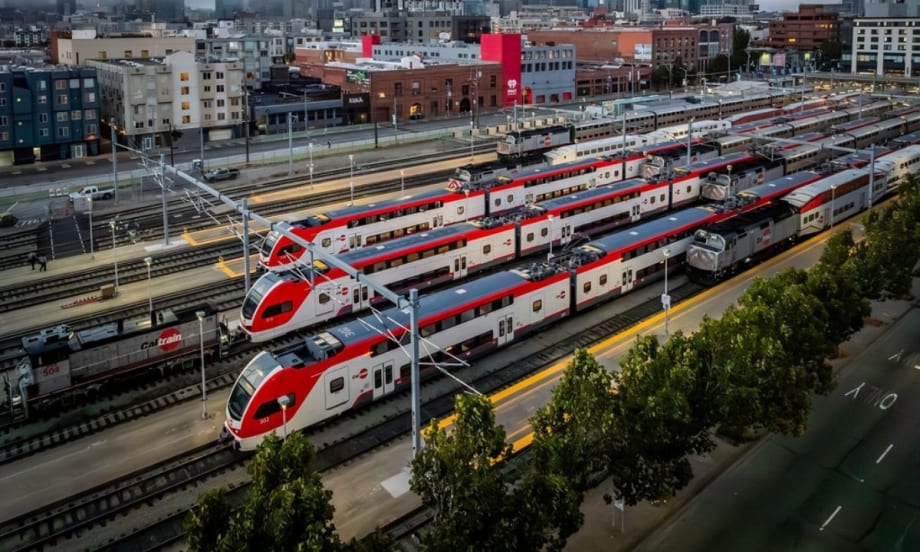
With a balanced budget, Caltrain can continue its popular electric service, running trains every 15 minutes at most stations during peak hours and half-hourly service at all other times, including weekends, said officials.
Photo: Caltrain
- Caltrain's board approved a $270 million operating budget for Fiscal Year 2027, funded by diverse sources including fares and state assistance.
- The board also endorsed efficiency measures recommended by an oversight committee to address long-term financial challenges.
- The approved budget allows Caltrain to maintain its frequent electric service, ensuring 15-minute intervals at most stations during peak times.
*Summarized by AI
San Carlos, California’s Caltrain approved its operating budget for Fiscal Year (FY) 2027 at the rail agency’s monthly board meeting, as well as all recommendations for early action strategies recommended by the SB 63 Financial Efficiency Review Independent Oversight Committee’s final Phase 1 report.
The move ensures Caltrain service will continue operating as usual in the near term, but long-term financial challenges remain for the rail agency absent a new revenue source.
Caltrain’s FY27 Budget
The FY27 operating budget is nearly $270 million, with funds coming from multiple sources, including fares, GoPass, Measure RR, parking and rental income, State Transit Assistance, and a one-time loan from the state through the Metropolitan Transportation Commission (MTC), which is intended to help address transit agency operations shortfalls in the Bay Area.
With a balanced budget, Caltrain can continue its popular electric service, running trains every 15 minutes at most stations during peak hours and half-hourly service at all other times, including weekends, said officials.
The agency said Caltrain managed to adopt a balanced budget by limiting cost increases across its operations, reducing professional services, benefiting from stronger-than-anticipated fare revenue, and receiving a one-time state loan.
Officials added that the agency continues to break ridership records, shattering previous records in March of this year, and again in April, and was named the fastest-growing transit agency in the US in 2025.
The Oversight Committee’s Efficiency Report recognized Caltrain’s $76 million in savings due to recent cost-saving measures.
Since 2020, Caltrain has achieved over $76 million in cost savings, approximately 7% of the agency’s operating budget over the last five years. Caltrain’s cost savings were measured by MTC as required by Senate Bill (SB) 63, the Connect Bay Area Act. The MTC report, issued earlier this month, showed that Caltrain’s cost savings were achieved primarily through workforce controls, service optimization, and operating efficiencies.
Ongoing cost-reduction measures include a targeted hiring freeze saving $17 million; 30-minute service reducing the need for special trains; improved operator crew efficiency and reduced overtime saving $37 million; and the integration of maintenance of new infrastructure into existing operating contracts, saving approximately $2.1 million.
Other measures include reducing professional services, temporarily deferring service increases, and efforts to reduce fuel and electricity costs.
Finding Efficiencies
Since Caltrain began its electrified service, cost-saving measures have slowed the growth of operating costs, offsetting some of the inflationary pressures that many transit agencies continue to face. Caltrain has also been actively pursuing additional avenues to monetize assets through a non-fare revenue strategy, the agency said.
The Efficiency report highlighted Caltrain's efforts and opportunities to grow parking revenue, leasing fiber and communications assets, pursuing an energy storage project to optimize power use further, and finding new customers for Clipper BayPass and GoPass, studying ways to activate and enhance retail at stations, in addition to monetizing Caltrain’s real estate holdings.
The Caltrain board voted to approve and move forward with each of the independent financial review committee's “early action strategy” recommendations.
“Ensuring we are responsible stewards of taxpayer money is vitally important to any public agency, regardless of the economic climate,” said Michelle Bouchard, executive director of Caltrain. “We are hard at work finding ways to be more efficient than ever before, while still providing a safe, world-class service for the people who rely on us.”
Despite the important steps Caltrain is taking to control costs, generate revenue, and grow ridership, Caltrain still faces an average $75 million deficit that would start in FY28.
Absent a new, reliable funding source — through a regional measure or other external support — Caltrain will be forced to make significant service and staffing cuts, with potentially long-lasting consequences for the tens of thousands of people and businesses that depend on — and have begun to benefit from — the newly electrified system, said the agency.
Quick Answers
Caltrain's board approved the operating budget for Fiscal Year 2027 and endorsed efficiency measures recommended by the SB 63 Financial Efficiency Review Independent Oversight Committee.
*Summarized by AI
More Rail

New York MTA Advances Final Contract for Second Avenue Subway Expansion
Contract Four is the largest in the Second Avenue Subway Phase 2 project and includes construction of station infrastructure, tracks, and signals for the subway expansion, MTA officials said. Work on Contract Four will begin in 2027.
Read More →
San Diego MTS Breaks Monthly Trolley Ridership Record
Agency officials said July’s ridership indicates MTS’s continued recovery from the pandemic.
Read More →
Report Examines NJ TRANSIT Reliability, Funding Challenges
The Garden State Initiative analysis examines the roles of Amtrak infrastructure, fleet management, and agency operations while recommending a more performance-based approach to improving reliability.
Read More →
Stadler, CapMetro Sign Long-Term Rail Fleet Support Agreement
Beginning in 2027, Stadler will provide on-site technical expertise, spare parts support, training, and obsolescence management to help extend the reliability and longevity of CapMetro’s GTW fleet.
Read More →
Biz Briefs: Alstom Lands Canadian Contract, LYT to Supply California TSP, and More
In METRO's latest installment, we take a look at recent news from Complete Coach Works, Beep, FlixBus, and more partnerships making headlines across the transportation sector.
Read More →
CATS Gold Line Marks 5 Years of Service, 2.8M Passenger Trips
With a six-mile expansion planned, the Charlotte streetcar is positioned to connect more neighborhoods and major transit hubs across the region.
Read More →
Why Simulating Pedestrian Movement Has Become Essential for Modern Rail Stations
Pedestrian microsimulation is helping rail planners identify bottlenecks, test station designs, and prepare complex transit hubs for growing passenger volumes.
Read More →
Amtrak Begins Major Construction at New York’s Sunnyside Yard
The new maintenance facility will support Amtrak’s Airo trainsets while improving maintenance efficiency and turnaround times in New York.
Read More →
Chicago Leaders Unveil Plans for O’Hare Airport Express Train
The privately developed project would offer a 15-minute trip between downtown and O’Hare’s Terminal 2, with trains operating every 15 minutes on a dedicated track. The service would use battery-electric trains and three existing freight rail rights-of-way.
Read More →
OCTA Maps Out 30-Year Strategy to Protect Coastal Rail Corridor
The draft feasibility report identifies strategies to protect the coastal rail line for decades as the agency continues near-term stabilization and sand placement efforts.
Read More →