




Related: Caltrain Celebrates Anniversary of Electrified Service with Record Ridership
Caltrain's Electric Trains Now Earn Money While Powering the Grid
Due to a new state policy and clean energy partnerships, Caltrain will be compensated for the renewable electricity its trains generate through regenerative braking.
October 9, 2025
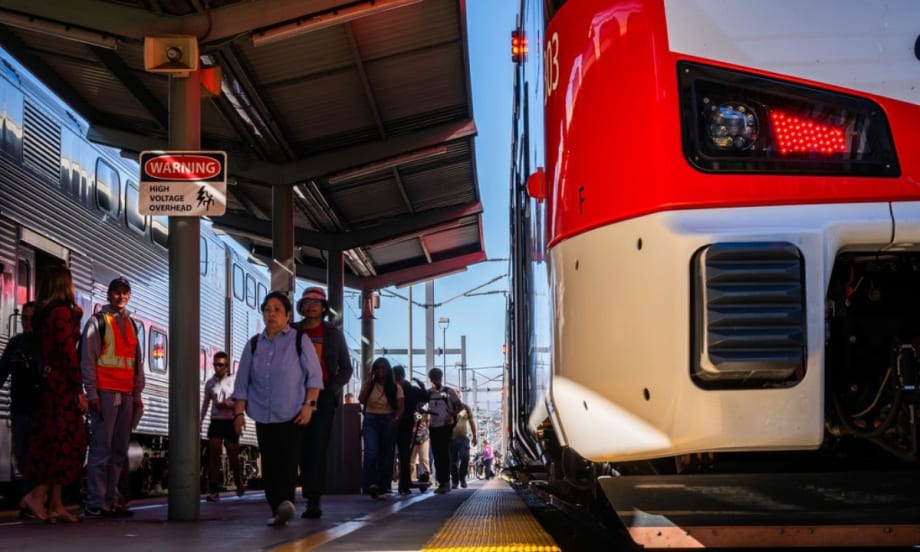
Caltrain's all-electric fleet not only runs on 100% renewable energy but also sends power back to the grid, further boosting sustainability along its corridor.
Photo: Caltrain
3 min to read
Caltrain will now be compensated for the power its new electric trains return to the grid through regenerative braking due to policy changes by its clean energy partners, Peninsula Clean Energy (PCE) and San José Clean Energy (SJCE).
According to an agency release, Caltrain runs on 100% renewable energy supplied by PCE and SJCE, mostly solar and wind. Currently, Caltrain returns approximately 23% of the power it uses back to the power grid, providing power to residents and businesses along its corridor.
SJCE and PCE will now allow Caltrain to qualify for a Net Billing Rate starting in April 2026, enabling Caltrain to receive approximately $1 million annually in compensation for the clean power it sends back to the grid.
"Caltrain's new electric trains don't just use electricity — they also give some back," said Director of San José Clean Energy Lori Mitchell. "Our Green Transportation program is the first in the state and one of the few in the country to give credit to public transit systems like Caltrain for the energy they return to the grid, helping them save money and reduce pollution."
"Our partnership with Caltrain and its bold move to all-renewable and carbon-free electric rail service has already improved the quality of life for our communities and illustrates how powerful local, community-driven leadership can be in better meeting customer needs," said Peninsula Clean Energy CEO Shawn Marshall. "And now with the new regenerative braking, their cleaner, quieter, and more efficient travel will send even more emission-free power back to the larger regional grid."
New California Law Rewards Regenerative Energy Returns
Assemblymember Diane Papan authored AB 1372 to include regenerative braking from electric trains as a renewable electrical generation facility, requiring power providers to compensate railroads that return power to the grid. Now that Caltrain's clean energy suppliers have approved net billing, the passage of this bill is likely to result in Caltrain receiving an additional 20% in compensation from its energy distributor, PG&E.
"I'm pleased to see that the renewable energy that Caltrain is sending back to the grid is being recognized and fairly compensated," said Papan. "This is the right thing for supporting public transit and highlighting the incredible benefits of electrification."
"Caltrain running train service on 100% renewable energy for the first time in 161 years is a victory in and of itself," said Caltrain Executive Director Michelle Bouchard. "But now that our partners at PCE and SJCE have agreed to compensate us for the power we return to the grid, we have yet another reason to celebrate our transition to the electric fleet."
Originally estimated at approximately $19.5 million annually, Caltrain's electricity use since the launch of electric service averages 207 MWh on weekdays and 175 MWh on weekends, revising the cost estimate to $15.3 million.
PCE and SJCE 100% renewable energy products also allow Caltrain to generate revenues from the California Low Carbon Fuel standards program, further lowering Caltrain's electric fuel costs.
According to Caltrain, regenerative braking was first introduced in electric trains in 1886. They work by driving an electric motor in reverse to recapture energy rather than losing it as heat during braking. Caltrain's fleet is designed to return that power to the Overhead Contact System (OCS), which feeds it to the nearest traction power facility. From there, it can be used to power other trains on the system or returned to the grid.
More Management

METRO Opens Submissions for 2026 Motorcoach Awards
Nominations are now being accepted for METRO Magazine’s Operator of the Year and Innovative Operator of the Year awards.
Read More →
New York MTA Advances Final Contract for Second Avenue Subway Expansion
Contract Four is the largest in the Second Avenue Subway Phase 2 project and includes construction of station infrastructure, tracks, and signals for the subway expansion, MTA officials said. Work on Contract Four will begin in 2027.
Read More →
Transit Agencies Highlight Safety Gains at National Summit
Leaders from 15 major transit systems shared crime-reduction results and safety initiatives while discussing the role of continued federal support.
Read More →

NITA Names New Leadership, Expands Reduced-Fare Program at First Board Meeting
The new regional transit authority appointed its first board chair and interim executive director while extending reduced fares across CTA, Metra, and Pace for eligible riders.
Read More →
Beyond the Checklist: A Structured Approach to Transit Maintenance
Reliability-Centered Maintenance helps transit agencies move beyond routine checklists to focus limited resources on the assets and failures that have the greatest impact on safety, reliability, and service.
Read More →
APTA 2026 Nominating Committee Selects Leadership Slate, Names Chair and Vice Chair Nominees
Leadership changes will help shape the association’s priorities and its representation of the transportation industry during the 2026–2027 term.
Read More →
DART Launches Major Security, Fare Enforcement Initiative
The 90-day demonstration will deploy coordinated security teams at five light rail stations while testing controlled access and gathering data to guide future investments.
Read More →
Sponsored•September 9, 2026
Advancing Fare Collection Through Technology and Innovation
Learn about delivering 1300 gates at 91 stations while managing fare evasion. Explore the large scale deployment, solution customization and real-world results that affect the region. Prepare for deployment in your region now.
Read More →
Game Day in Motion: Moving Millions During the 2026 World Cup
Between packed transit stations and team motorcoaches, see how agencies and operators across North America tackled the transportation demands of the 2026 FIFA World Cup.
Read More →
Surface Transportation Extension Averts Shutdown, Leaves Transit Funding Gap
The stopgap keeps federal transportation programs moving, but missing advance funding could complicate the transit and rail projects agencies are planning next.
Read More →