




RELATED: RTA partners with medical group to rebrand key route
Cleveland RTA lands $5.8M to upgrade bus, rail communications
Reliable real-time information will be available to customers, with live tracking and departure data from specific stop locations on bus and rail.
September 29, 2017
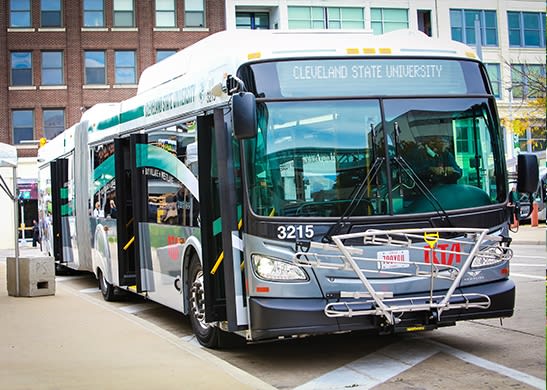
The communications system services GCRTA’s entire bus and rail fleet of more than 500 bus, bus rapid transit, and paratransit vehicles, and more than 100 heavy and light rail trains.
Cleveland RTA
2 min to read
The communications system services GCRTA’s entire bus and rail fleet of more than 500 bus, bus rapid transit, and paratransit vehicles, and more than 100 heavy and light rail trains.
Cleveland RTA
U.S. Sen. Sherrod Brown (D-OH) — ranking member of the Senate Banking, Housing, and Urban Affairs Committee, which oversees public transit — announced $5,850,000 in new federal funding for the Greater Cleveland Regional Transit Authority (GCRTA) to help GCRTA update the radio communications system that connects its bus, paratransit, and rail systems.
“Greater Cleveland goes to work, school and the doctor’s office on RTA’s buses and trains. To get Ohioans there safely and efficiently, RTA needs the most up-to-date communications system possible,” said Brown. “This significant award will improve direct communication between customers, RTA and its operators throughout Cuyahoga County.”
“We’re finally able to throw away the Campbell soup can and string,” said GCRTA CEO/GM Joe Calabrese. “Our current system is obsolete and parts availability has been so difficult that we were sometimes shopping on Ebay for discontinued parts. We’ll be replacing a DOS-based communications system with 21st century technology. This grant will allow us to update our entire communications system and bring it into the 21st century to improve the quality of our service and the safety of our customers.”
Reliable real-time information will be available to customers, with live tracking and departure data from specific stop locations on bus and rail. Plus updates will be every 15 seconds instead of the current three minutes.
The accuracy of apps will be improved, and on site updates at bus and rail stops will be real time. Operators will also be able to use reliable navigations services and interact more quickly with public safety forces and RTA headquarters.
The U.S. Department of Transportation’s (U.S. DOT) Advanced Transportation and Congestion Management Technologies Deployment Program awarded the funding, which will make sure GCRTA can maintain safe bus and rail service and replace its obsolete radio system. The U.S. DOT share is $5.8 million, and with additional local and federal matches, the total project will cost $18 million.
The communications system services GCRTA’s entire bus and rail fleet of more than 500 bus, bus rapid transit, and paratransit vehicles, and more than 100 heavy and light rail trains. GCTRA serves Cuyahoga County’s 1.26 million residents, with 47 million annual trips covering 457 square miles throughout northeast Ohio.
More Management

METRO Opens Submissions for 2026 Motorcoach Awards
Nominations are now being accepted for METRO Magazine’s Operator of the Year and Innovative Operator of the Year awards.
Read More →
New York MTA Advances Final Contract for Second Avenue Subway Expansion
Contract Four is the largest in the Second Avenue Subway Phase 2 project and includes construction of station infrastructure, tracks, and signals for the subway expansion, MTA officials said. Work on Contract Four will begin in 2027.
Read More →
Transit Agencies Highlight Safety Gains at National Summit
Leaders from 15 major transit systems shared crime-reduction results and safety initiatives while discussing the role of continued federal support.
Read More →

NITA Names New Leadership, Expands Reduced-Fare Program at First Board Meeting
The new regional transit authority appointed its first board chair and interim executive director while extending reduced fares across CTA, Metra, and Pace for eligible riders.
Read More →
Beyond the Checklist: A Structured Approach to Transit Maintenance
Reliability-Centered Maintenance helps transit agencies move beyond routine checklists to focus limited resources on the assets and failures that have the greatest impact on safety, reliability, and service.
Read More →
APTA 2026 Nominating Committee Selects Leadership Slate, Names Chair and Vice Chair Nominees
Leadership changes will help shape the association’s priorities and its representation of the transportation industry during the 2026–2027 term.
Read More →
DART Launches Major Security, Fare Enforcement Initiative
The 90-day demonstration will deploy coordinated security teams at five light rail stations while testing controlled access and gathering data to guide future investments.
Read More →
Sponsored•September 9, 2026
Advancing Fare Collection Through Technology and Innovation
Learn about delivering 1300 gates at 91 stations while managing fare evasion. Explore the large scale deployment, solution customization and real-world results that affect the region. Prepare for deployment in your region now.
Read More →
Game Day in Motion: Moving Millions During the 2026 World Cup
Between packed transit stations and team motorcoaches, see how agencies and operators across North America tackled the transportation demands of the 2026 FIFA World Cup.
Read More →
Surface Transportation Extension Averts Shutdown, Leaves Transit Funding Gap
The stopgap keeps federal transportation programs moving, but missing advance funding could complicate the transit and rail projects agencies are planning next.
Read More →