



Dallas' DART launches downtown circulator route
D-Link links such downtown destinations as the American Airlines Center, Perot Museum of Nature and Science, Dallas Arts District, and Main Street hotels and restaurants. It is also designed to complement other current and future transit services, including Dallas Area Rapid Transit, Trinity Railway Express and Amtrak.

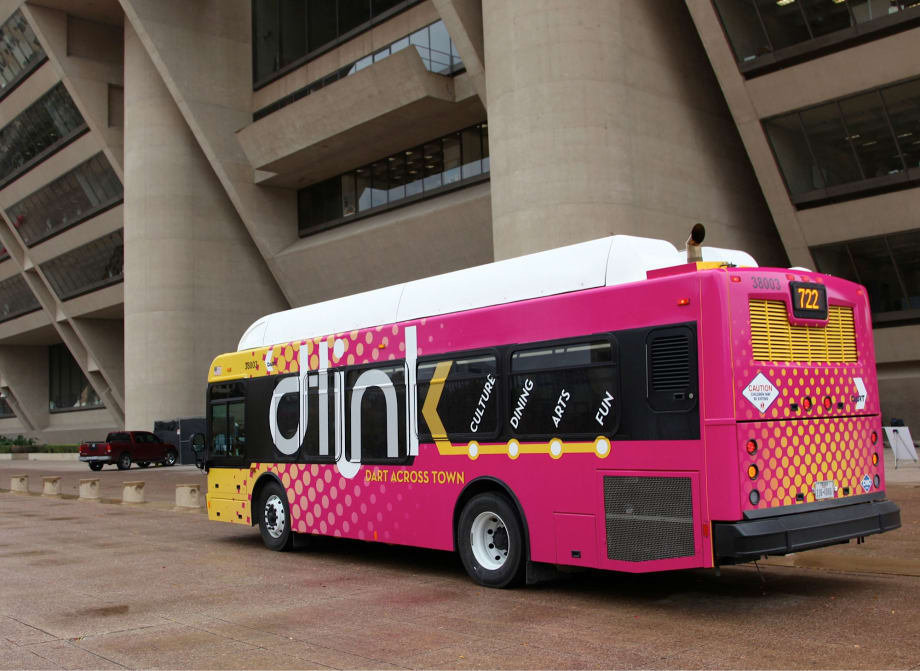
Photo courtesy DART
Photo courtesy DART
Dallas Area Rapid Transit’s (DART) D-Link buses began circulating through downtown Dallas and neighboring districts on Monday. The free shuttle — a partnership among DART, the city of Dallas and Downtown Dallas Inc. — connects major tourist attractions and employment centers in the city center.
D-Link buses, identified by a vibrant magenta and yellow bus wrap, arrive every 15 minutes from 11 a.m. to 11:30 p.m., Monday through Saturday. More than 30 matching signs and ground graphics identify key bus stops, with nearly 70 stops total along the route.
"Rail brings people into downtown; D-Link takes them to the doorstep of their destination,” said DART president/executive director Gary Thomas.
The circulator route links such downtown destinations as the American Airlines Center, Klyde Warren Park, Perot Museum of Nature and Science, The Sixth Floor Museum, Dallas Arts District, Main Street hotels and restaurants, Omni Dallas Hotel and Kay Bailey Hutchison Convention Center.
“This circulator represents another advance in our ongoing efforts to revitalize downtown and provides a much-needed link to southern Dallas,” Mayor Mike Rawlings said. “I am excited about the potential of new stops being added in the future as our city continues to grow south.”
To encourage ridership, project partners are offering the D-Link service for free, eliminating the need to figure out fares or locate a ticket machine. Passengers still must purchase a DART pass to transfer to other bus and rail services. DART Police will have a regular presence on the buses to safeguard passengers.
The entire route takes approximately 45 minutes and crosses 10 of Dallas' districts.
While D-Link is a tourist and convention visitor resource, the frequency and route also make it easier to reach employers located in and near downtown, including hospitals, restaurants, hotels, office buildings, cultural attractions and retail. Employees gain greater options for lunch and after-hours dining; urban residents can get around without driving.
D-Link is designed to complement other current and future transit services, including the DART system, Trinity Railway Express and Amtrak. The Union Station to Oak Cliff Dallas Streetcar and the M-Line Urban Circulator projects both will be complete by 2015, and the D-Link route will adapt accordingly.
The opening of the Orange Line extension to DFW Station in December 2014, combined with D-Link, will enable travelers to work or play in Dallas without renting a car. Local North Texas residents also will be able to explore more areas of the city without driving.
View a timelapse video of the new buses getting wraps here.
More Bus

People Movement: Dan Dipert Coaches Adds Third-Generation Leader, Keolis Names New Valley Metro VP/GM, and More
In this edition, we also cover recent appointments and announcements at the Wabtec, SilverRide, HNTB, and more, showcasing the individuals helping to shape the future of transportation.
Read More →
New York MTA Plans Largest Bus Fleet Upgrade in More Than a Decade
The agency is seeking manufacturers for 650 new CNG buses to replace aging vehicles, improve reliability, and advance its broader fleet modernization strategy.
Read More →
Building a Flexible Path to Transit Electrification
John Hroncich discusses BAE Systems’ modular and scalable approach, lessons learned from decades of real-world operations, and how agencies can identify electrification strategies that fit their fleets.
Read More →
Bus Tech Talk: Keeping Transit Technicians Ahead of the Technology Curve
LA Metro’s Obed Mejia discusses technician training, evolving maintenance technology, fleet replacement, and strategies for getting the most out of today’s transit fleets.
Read More →
Biz Briefs: RIPTA Unveils New Frontrunners, Clevland RTA Adds New Siemens, and More
In METRO's latest installment, we take a look at recent news from Siemens, Prevost, Dodge, and more partnerships making headlines across the transportation sector.
Read More →
People Movement: Holly Arnold Joins Transdev and More
In this edition, we also cover recent appointments and announcements at Pace, CamTran, MCI, and more, showcasing the individuals helping to shape the future of transportation.
Read More →
The High Cost of Transit Buses: Industry Leaders Look to Procurement Reform
Transit leaders and policymakers examine how standardized bus designs, streamlined procurement, and predictable funding could help agencies stretch budgets and deliver better service.
Read More →
The Business Voice Behind Public Transportation
As chair of APTA’s Business Members Board of Governors, Ray Melleady explains how more than 850 business members are partnering with transit agencies to advance funding, innovation, and industry-wide collaboration.
Read More →
From Surviving to Thriving: Building Stronger Transportation Organizations
Bus Business Consultants founder Brian Dickson shares lessons on leadership, organizational health, and creating options for long-term success in a changing transportation industry.
Read More →
Finding the ‘Happy Medium’: Optimizing Maintenance Without Sacrificing Reliability
The key to maintenance optimization isn’t doing less work—it’s doing the right work at the right time on the right assets.
Read More →