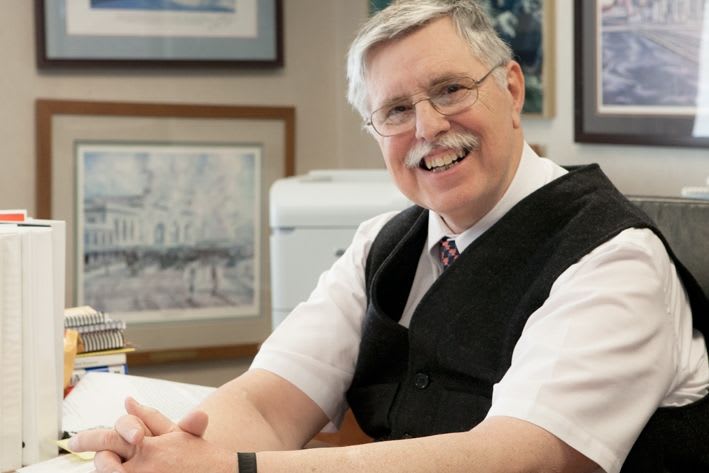
Joseph Boardman served as president/CEO of Amtrak from 2008 to 2016. Photo: Amtrak
2 min to read
Joseph Boardman served as president/CEO of Amtrak from 2008 to 2016. Photo: Amtrak
Former Amtrak President/CEO Joseph Boardman has died, according to a statement issued by the rail network. He served as head of Amtrak from 2008 until 2016, when he retired.
“We are deeply saddened to learn of the passing of Joe Boardman,” said Amtrak Board Chair Tony Coscia and Amtrak president/CEO Richard Anderson in a joint statement.
“Joe, during his tenure as FRA Administrator, Amtrak Board Member and Amtrak President & CEO, was a tireless advocate for passenger rail and the nation’s mobility," Coscia and Anderson said. "During his eight years at the helm, Joe helped the company make significant progress in reducing our debt, improving our infrastructure and raising our cost recovery performance.”
Ad Loading...
Boardman, who had more than 40 years of experience in the transportation industry, previously served as administrator of the Federal Railroad Administration (FRA) and was the Department of Transportation designee on the Amtrak board of directors.
“He leaves a lasting legacy that includes public service and making passenger rail transportation better for millions of people,” Coscia and Anderson said.
Prior to his tenure at FRA, Boardman served as commissioner of the New York State Department of Transportation, where he led a transformation effort that better enabled the agency to respond to the challenges associated with an expanding global marketplace.
On his first day at Amtrak during the 2008 Thanksgiving holiday travel period, Boardman walked the platforms at Washington Union Station greeting passengers and talking with employees and continued that practice whenever and wherever he traveled. It was not uncommon to see him see speaking to passengers aboard a train or visiting with employees out on the railroad at crew bases, rail yards, stations and other locations.
He logged over 200,000 miles traveling on Amtrak trains during his tenure, according to an Amtrak statement.
Under Boardman’s leadership, Amtrak experienced many accomplishments including: record ridership and revenue, continued reductions in the need for federal operating support, a significant pay down of debt, the best ever system-wide on-time performance, expansion of state-supported services, the introduction of Wi-Fi service and eTicketing, and the creation and implementation of a corporate strategic plan.
In addition, Boardman managed new equipment orders for Northeast Corridor (NEC) and long-distance services, a major planning effort for the development of next-generation high-speed rail, a comprehensive employee safety program, enhanced security initiatives, and numerous capital projects to improve Amtrak infrastructure, stations, maintenance shops and other facilities.
Hosted by the COTA from September 10 to 13, the Summit carried the theme “Celebrating 10 Years of Excellence, Leadership, and Impact,” with every part of the program honoring the people, agencies, and partners who built LIT over its first decade.
In this edition, we also cover recent appointments and announcements at the Wabtec, SilverRide, HNTB, and more, showcasing the individuals helping to shape the future of transportation.
Contract Four is the largest in the Second Avenue Subway Phase 2 project and includes construction of station infrastructure, tracks, and signals for the subway expansion, MTA officials said. Work on Contract Four will begin in 2027.
The new regional transit authority appointed its first board chair and interim executive director while extending reduced fares across CTA, Metra, and Pace for eligible riders.
Reliability-Centered Maintenance helps transit agencies move beyond routine checklists to focus limited resources on the assets and failures that have the greatest impact on safety, reliability, and service.
The 90-day demonstration will deploy coordinated security teams at five light rail stations while testing controlled access and gathering data to guide future investments.
Learn about delivering 1300 gates at 91 stations while managing fare evasion. Explore the large scale deployment, solution customization and real-world results that affect the region. Prepare for deployment in your region now.