



Gov.'s MBTA legislation includes 3-year fiscal control board
"The T failed its stress test this winter when we needed it most, exposing the deep operational problems and lack of planning. We simply cannot afford a repeat and this legislation sets in motion significant reforms to once again deliver accountability, reliability and the world-class transportation system Massachusetts deserves," Gov. Baker said during a press conference announcing the legislation.

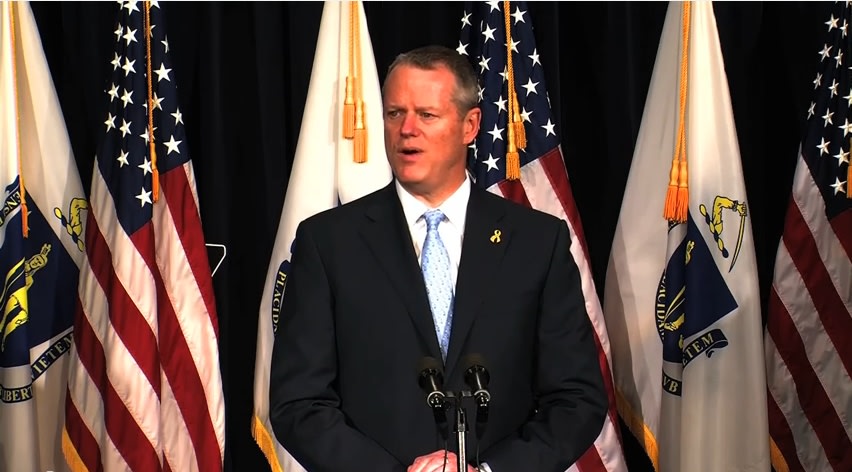
VIdeo screenshot courtesy MassGovernor
VIdeo screenshot courtesy MassGovernor
BOSTON — Massachusetts Governor Charlie Baker filed new MBTA reform legislation Wednesday, acting on many of the recommendations made by the special panel that reported their findings earlier this month. The legislation, An Act for a Reliable, Sustainable MBTA, would establish a Fiscal Management and Control Board (FMCB) and Chief Administrator to oversee operations and finances through 2018, create capital plans, introduce reporting and audit requirements and lift procurement restrictions for the MBTA. Together the FMCB and Chief Administrator would be charged with establishing a safe, reliable, financially sound and sustainable customer-oriented public transit system.
RELATED:Mass. Gov. to unveil sweeping MBTA reforms
“This bill directly responds to the special panel's recommendations. We look forward to the Legislature's swift action on the reforms necessary to restore the public’s faith in the Commonwealth’s transit system,” said Governor Baker. “The T failed its stress test this winter when we needed it most, exposing the deep operational problems and lack of planning. We simply cannot afford a repeat and this legislation sets in motion significant reforms to once again deliver accountability, reliability and the world-class transportation system Massachusetts deserves.”
“The special panel concluded that a strong fiscal and management control board is vital to solving the MBTA’s chronic and pervasive failures,” said Secretary Pollack. “The legislation would give the MBTA many new tools that are essential if we are to succeed in transforming the MBTA organizationally and rebuilding and modernizing its assets.”
“At the MBTA we are already hard at work implementing the Special Review Panel’s recommendations, but this legislation and the fiscal and management control board that it creates are essential to ensuring that we can correct longstanding problems at the T so that it can provide the reliable transit services that our riders want and deserve,” said Frank DePaola, interim executive director of the MBTA.
More about An Act for a Reliable, Sustainable MBTA:
Effective Oversight and Management: A Fiscal Management Control Board (FMCB) will function as the board of the MBTA, consisting of 5 members, 3 appointed by the Governor, and 1 each referred to the Governor by the Senate President and Speaker of the House, through June 30, 2018. The daily operational, budgeting and planning duties would lie with a Chief Administrator appointed by the Governor.
Reconstitute the MassDOT Board: Chaired by the Secretary of Transportation, the MassDOT Board will consist of 11 members, eight serving four-year terms coterminous with the Governor, and three serving three-year terms. Members will include a representative from an MBTA core community, an outer MBTA community and a city or town served by a regional transit authority.
Financial Accountability and Transparency: The FMCB will immediately develop one and five year operating budgets with a focus on improving productivity and increasing revenues. A clear separation of the operating and capital budgets will be implemented and improved procurement practices will move the MBTA to assuring that its capital funds are timely and well spent. The MBTA Retirement Fund would be frozen for payouts to new hires until an independent audit is completed within 180 days and would be subjected to annual audits and public record law.
Operations, Personnel and Contracting: The FMCB will have the ability to restructure the organization of the MBTA and install rigorous performance management metrics while altering existing procurement requirements and lifting the Pacheco Law’s application to the MBTA.
More Management

METRO Opens Submissions for 2026 Motorcoach Awards
Nominations are now being accepted for METRO Magazine’s Operator of the Year and Innovative Operator of the Year awards.
Read More →
New York MTA Advances Final Contract for Second Avenue Subway Expansion
Contract Four is the largest in the Second Avenue Subway Phase 2 project and includes construction of station infrastructure, tracks, and signals for the subway expansion, MTA officials said. Work on Contract Four will begin in 2027.
Read More →
Transit Agencies Highlight Safety Gains at National Summit
Leaders from 15 major transit systems shared crime-reduction results and safety initiatives while discussing the role of continued federal support.
Read More →

NITA Names New Leadership, Expands Reduced-Fare Program at First Board Meeting
The new regional transit authority appointed its first board chair and interim executive director while extending reduced fares across CTA, Metra, and Pace for eligible riders.
Read More →
Beyond the Checklist: A Structured Approach to Transit Maintenance
Reliability-Centered Maintenance helps transit agencies move beyond routine checklists to focus limited resources on the assets and failures that have the greatest impact on safety, reliability, and service.
Read More →
APTA 2026 Nominating Committee Selects Leadership Slate, Names Chair and Vice Chair Nominees
Leadership changes will help shape the association’s priorities and its representation of the transportation industry during the 2026–2027 term.
Read More →
DART Launches Major Security, Fare Enforcement Initiative
The 90-day demonstration will deploy coordinated security teams at five light rail stations while testing controlled access and gathering data to guide future investments.
Read More →
Advancing Fare Collection Through Technology and Innovation
Learn about delivering 1300 gates at 91 stations while managing fare evasion. Explore the large scale deployment, solution customization and real-world results that affect the region. Prepare for deployment in your region now.
Read More →
Game Day in Motion: Moving Millions During the 2026 World Cup
Between packed transit stations and team motorcoaches, see how agencies and operators across North America tackled the transportation demands of the 2026 FIFA World Cup.
Read More →
Surface Transportation Extension Averts Shutdown, Leaves Transit Funding Gap
The stopgap keeps federal transportation programs moving, but missing advance funding could complicate the transit and rail projects agencies are planning next.
Read More →