



Intercity bus lines rolling out new services, DePaul study finds
Greyhound, Megabus, and FlixBus made notable strategic moves last year, with the latter launching service in 22 states.

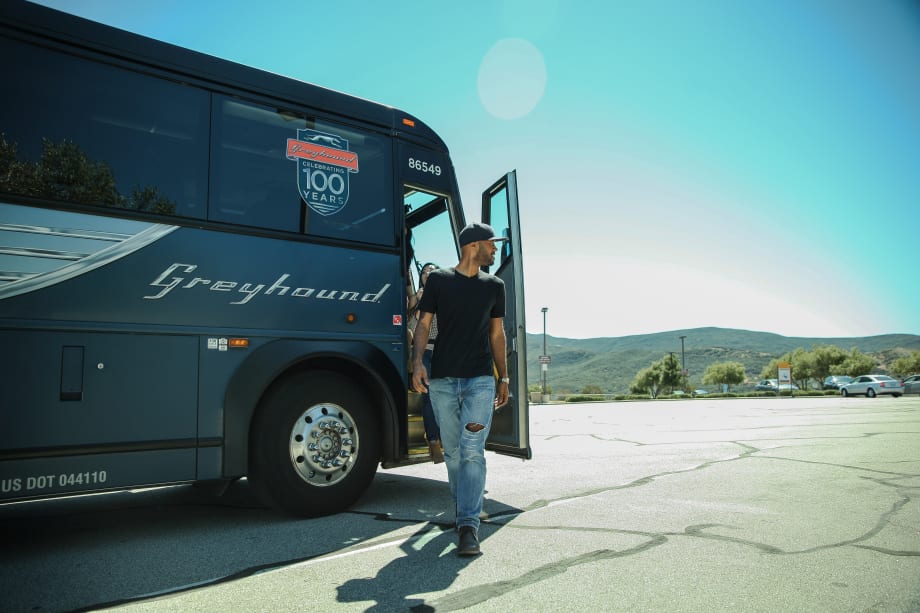
Many of the big stories in the intercity motorcoach industry revolved around biggest players, such as FirstGroup LLC announcing its intention to sell Greyhound.

Many of the big stories in the intercity motorcoach industry revolved around biggest players, such as FirstGroup LLC announcing its intention to sell Greyhound.
A newly released report by DePaul University’s Chaddick Institute describes an intercity bus industry having for the first time three carriers with large-scale route networks that cover larger parts of the U.S. mainland: Greyhound, Megabus, and the newcomer FlixBus. All made notable strategic moves last year, with FlixBus announcing new routes almost every couple weeks, putting it in 22 states.
The report, Making Connections: 2020 Outlook for the Intercity Bus Industry in the United States, is the latest installment in DePaul’s reviews the changes in scheduled motorcoach service. Many of the big stories revolved around biggest players, such as FirstGroup LLC announcing its intention to sell Greyhound and Megabus coming under new U.S. ownership. Yet, the report also provides insights into how state governments stepped up their game creating branded networks to reach underserved points.
The Commonwealth of Virginia is having particular success with its Virginia Breeze, a branded service operating with state financial support between Blacksburg, Va., and Washington, D.C., via Christiansburg, Va., offered in cooperation with Megabus. The Breeze enjoyed a 28% ridership increase in the third quarter of 2019 over the second quarter of 2018 and an impressive 79% farebox recovery. Significant expansion to this state-supported system is in the works. In December, the department announced its intention to launch a pair of new Virginia Breeze routes in 2020. The first would cover the roughly 250-mile distance between Danville, Va., and Washington, D.C., with likely stops in Lynchburg, Charlottesville, and other points. The second, shorter at 190 miles, would link Martinsville and Richmond via Farmville.

FlixBus' most recent expansions have included the deep south and Florida.
FlixBus
The expansion of Colorado’s Bustang is another success story. Managed by the Colorado Department of Transportation, Bustang served 21,184 passengers monthly in January 2019, up from around 17,500 the previous year, and has continued to grow since then. Early last year, Bustang added a sixth weekday Denver–Ft. Collins trip, while December saw the introduction of Snowstang, a direct service from Denver Union Station to the Loveland Ski Area, Arapahoe Basin, and Steamboat Resort/Howelsen Hill. The service is available on weekends and select holidays. The schedule allows Arapahoe Basin and Loveland Ski Area skiers to make day trips. The program helps ease traffic congestion on roads leading to resorts and constitutes one of the most notable statewide initiatives to coordinate and support intercity bus service with both tourism and economic development in mind.
Oregon remains a frontrunner in enhancing rural mobility. In July, the state announced new funding to sustain and expand service as well as commission a planning feasibility study for service from Klamath Falls to Redmond, a distance of 154 miles. Results publicized in September indicate that bus ridership in Central Oregon provided by Cascades East Transit has more than doubled since 2014, reaching more than 674,000 annually, in part due to new service offerings, including three new routes to Bend.
Other states also rolled out new service as well. Illinois worked with Greyhound to create a new Rockford–Champaign, Ill., route catering to workers in the expanding logistics business in northern Illinois. Barons Bus added a new daily service between Chicago and Toledo, Ohio, with State of Indiana financial support. Many of the new services are partially sustained with public dollars, including the Federal Transit Administration’s 5311f program funds.
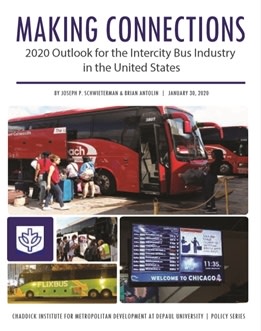
The report, Making Connections: 2020 Outlook for the Intercity Bus Industry in the United States, is the latest installment in DePaul’s reviews the changes in scheduled motorcoach service.
Making Connections anticipates further expansion this year by Germany-based FlixBus, which began U.S. service in Spring 2018. Its most recent expansions have included the deep south and Florida. New routes to more midwestern points, including Chicago — easily the largest U.S. city it does not yet serve — and southeastern cities may be in the offing. Maintaining service standards while growing so rapidly, though, may be challenging. New York-based OurBus is also shows as being on a fast growth trajectory, particularly on the Eastern Seaboard.
The Chaddick Institute is hosting a free hour-long webinar on Making Connections on Friday, February 14 from at noon Central time (10 a.m. Pacific). To register or reach the study team, email chaddick@depaul.edu
Also, tune in to METRO Magazine's April issue for a comprehensive look at this year's report.
More Motorcoach

METRO Opens Submissions for 2026 Motorcoach Awards
Nominations are now being accepted for METRO Magazine’s Operator of the Year and Innovative Operator of the Year awards.
Read More →
Biz Briefs: Alstom Lands Canadian Contract, LYT to Supply California TSP, and More
In METRO's latest installment, we take a look at recent news from Complete Coach Works, Beep, FlixBus, and more partnerships making headlines across the transportation sector.
Read More →
Biz Briefs: RIPTA Unveils New Frontrunners, Clevland RTA Adds New Siemens, and More
In METRO's latest installment, we take a look at recent news from Siemens, Prevost, Dodge, and more partnerships making headlines across the transportation sector.
Read More →
People Movement: Holly Arnold Joins Transdev and More
In this edition, we also cover recent appointments and announcements at Pace, CamTran, MCI, and more, showcasing the individuals helping to shape the future of transportation.
Read More →
ABA Report: Motorcoach Travel Generates $161.6B Economic Impact
The 2025 analysis finds motorcoach travel supported nearly 900,000 jobs and generated $28 billion in federal, state, and local taxes.
Read More →
CharterUP’s Armir Harris on Technology, AI, and the Future of Group Mobility
In a recent episode of METROspectives, CharterUP Founder/CEO Armir Harris discussed the company’s evolution from an online charter bus marketplace into a technology platform supporting public- and private-sector mobility and much more.
Read More →
People Movement: ABC Names John Walsh as Chief Commercial Officer
In this edition, METRO also covers recent appointments and announcements at the DART, STV, and more, showcasing the individuals helping to shape the future of transportation.
Read More →
From Surviving to Thriving: Building Stronger Transportation Organizations
Bus Business Consultants founder Brian Dickson shares lessons on leadership, organizational health, and creating options for long-term success in a changing transportation industry.
Read More →
Biz Briefs: Luminator Marks Milestone and More
From manufacturers and suppliers to transit agencies and motorcoach operators, these updates offer a snapshot of the projects, partnerships and business moves driving the industry forward.
Read More →
ABAF Study Reveals Growing Insurance Crisis for Motorcoach Operators
Preliminary findings show 98% of operators faced premium increases over the past five years, while shrinking insurer participation is putting added pressure on businesses and customers.
Read More →