



JTA Teams with FCSJ to Expand AV Testing on Campus
The announcement builds upon their collective efforts to spotlight the City of Jacksonville on the world stage of transforming mobility and accessibility, improving roadway safety, and positively impacting the environment.

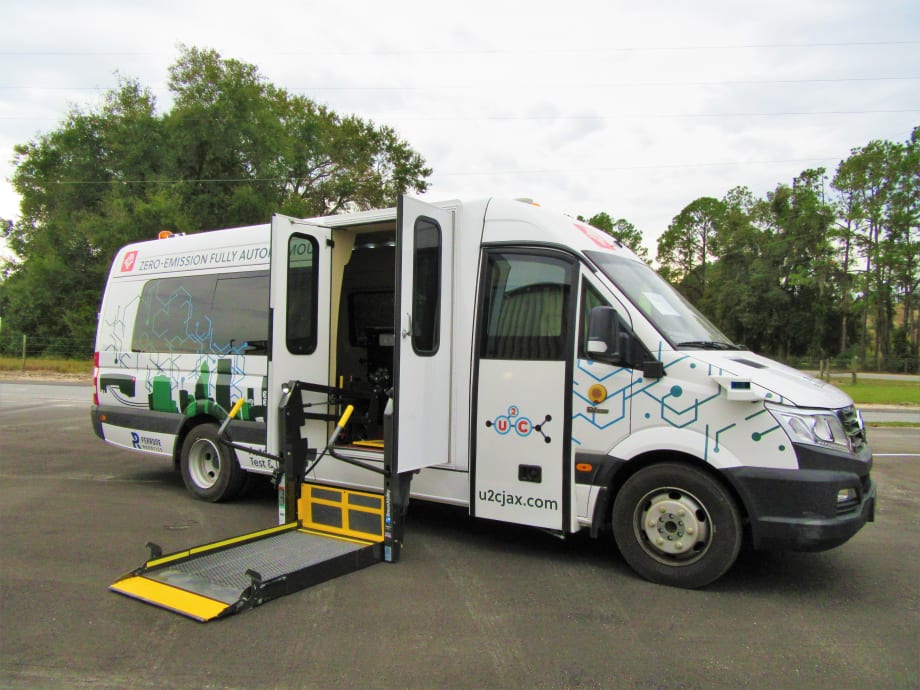
The FSCJ project is one of many planned “Agile” programs pioneered by the JTA team to prepare the Jacksonville community for the future of transportation through the Ultimate Urban Circulator program.
JTA
Florida’s Jacksonville Transportation Authority (JTA) CEO Nathaniel P. Ford Sr. and Florida State College at Jacksonville (FSCJ) President Dr. John Avendano announced a new program to expand testing of autonomous vehicles on FSCJ’s downtown campus.
The announcement builds upon their collective efforts to spotlight the City of Jacksonville on the world stage of transforming mobility and accessibility, improving roadway safety, and positively impacting the environment. This partnership was established in 2020 through a joint Memorandum of Understanding (MOU).
Autonomous Expansion
The MOU was aligned to FSCJ’s National Science Foundation grant awards to design and implement innovative curriculum for preparing students to be the workforce of the future in the important areas of autonomous technology and electric vehicle platforms. It also showcases the JTA’s global leadership in urban transportation transformation, which has been widely recognized by such esteemed organizations as the Intelligent Transportation Society World Congress.
The autonomous, electric vehicle service, to be deployed this fall, will provide a new mobility service for students, faculty, and visitors on the FSCJ Downtown Jacksonville campus. It will connect the Advanced Technology Center, President’s office, and Cafeteria over a one-mile route to enhance movement between these segmented areas of campus.
Increasing Agility
The project is one of many planned “Agile” programs pioneered by the JTA team to prepare the Jacksonville community for the future of transportation through the Ultimate Urban Circulator (U2C) program. These important projects will validate the wide variety of applications for autonomous vehicles throughout the community ahead of the launch of phase one of the U2C, the Bay Street Innovation Corridor in 2025.
Expanding the testing of autonomous vehicles in FSCJ’s Downtown Campus will also continue to ready the community for how autonomous technology will enhance the quality of life for all who learn, live, and work in the City of Jacksonville.
“FSCJ continues to be a vital partner as we advance and socialize autonomous vehicle technology in Jacksonville, both for Bay Street and beyond,” said Ford. “In addition to being some of the first to ride autonomous vehicles in Jacksonville, FSCJ students, faculty, and campus guests will have an opportunity to provide us with direct feedback as we prepare to launch the Bay Street Innovation Corridor in 2025.”
As part of the autonomous vehicle program, FSCJ’s Downtown Campus, faculty, staff, and students will experience autonomous vehicles operating on campus first-hand. Feedback and learnings from the program will build upon the existing knowledge base of this emerging technology as it continues to develop the FSCJ curriculum, skillset, and workforce to support these transformative transportation solutions.
JTA’s Ongoing AV Research
The JTA has been researching and testing autonomous vehicle technologies since 2017. JTA’s efforts to date have greatly impacted development of next generation autonomous platforms and solutions, which will result in the City of Jacksonville being one of the first in the world to deliver on the vision of safe, convenient, autonomous, electric, shared mobility networks to further activate and modernize the downtown area.
The first phase of the U2C program will implement a full-scale autonomous shuttle network with smart and connected technology down Bay Street in 2025.
The entire U2C program comprises three main phases. Each will incrementally build out the 10-mile transportation network connecting key downtown Jacksonville corridors including the Sports/Entertainment District, the Downtown Northbank, and Southbank, with branches into surrounding neighborhoods such as Brooklyn, Riverside, San Marco, and Springfield. This will ultimately provide mobility for all by extending access to goods, services, entertainment, and jobs in this important urban hub along Jacksonville’s riverfront.
More New Mobility

From Hardware to Digital Partner: Luminator Charts Its Next Chapter
CEO Magnus Friberg discusses Luminator’s shift toward becoming a digital partner, the growing importance of software and interoperability, and how AI can help agencies improve operations and passenger experience.
Read More →
Biz Briefs: Alstom Lands Canadian Contract, LYT to Supply California TSP, and More
In METRO's latest installment, we take a look at recent news from Complete Coach Works, Beep, FlixBus, and more partnerships making headlines across the transportation sector.
Read More →
CharterUP’s Armir Harris on Technology, AI, and the Future of Group Mobility
In a recent episode of METROspectives, CharterUP Founder/CEO Armir Harris discussed the company’s evolution from an online charter bus marketplace into a technology platform supporting public- and private-sector mobility and much more.
Read More →
Jacksonville’s NAVI Project Charts a New Course for Autonomous Public Transportation
Through its NAVI program, JTA is showing how autonomous vehicles, intelligent infrastructure, and coordinated operations can work together to deliver everyday public transportation.
Read More →
Biz Briefs: Luminator Marks Milestone and More
From manufacturers and suppliers to transit agencies and motorcoach operators, these updates offer a snapshot of the projects, partnerships and business moves driving the industry forward.
Read More →
New Tricks for Old Bureaucracies: Joshua Schank on Making Transit Innovation Stick
Former LA Metro Chief Innovation Officer Joshua Schank discusses why good ideas aren't enough, how transit agencies can overcome resistance to change, and why today's challenges demand more innovation.
Read More →
How DART's GoPass Is Redefining Regional Mobility
Serving 14 transit agencies, GoPass simplifies multimodal travel by allowing riders to plan, pay for, and manage an entire trip through one app.
Read More →
Biz Briefs: OCTA Taps Clean Energy for Hydrogen Station, Stadler to Supply Via Rail Vehicles, and More
From manufacturers and suppliers to transit agencies and motorcoach operators, these updates offer a snapshot of the projects, partnerships and business moves driving the industry forward.
Read More →CharterUP Expands Into New Mobility and Autonomous Transportation
Vice President of New Mobility Stephen Joos discusses how CharterUP is leveraging its nationwide transportation network, technology platform, and autonomous vehicle partnerships to expand into workforce mobility, campus shuttles, and transit solutions.
Read More →
METRO Magazine Announces 2026 Innovative Solutions Awards Winners
Projects Recognized for Advancing Mobility Through Technology, Accessibility, Workforce Innovation, and Operational Excellence
Read More →