




Read More: Innovation Showcase: King County Metro, Connectpoint Team for Signage Project
King County Exec Proposes Bus Network Upgrades
If the proposed changes are adopted by the King County Council, initial upgrades to the Metro bus network will begin with the Aug. 31 service change alongside the launch of the RapidRide G Line.
February 9, 2024
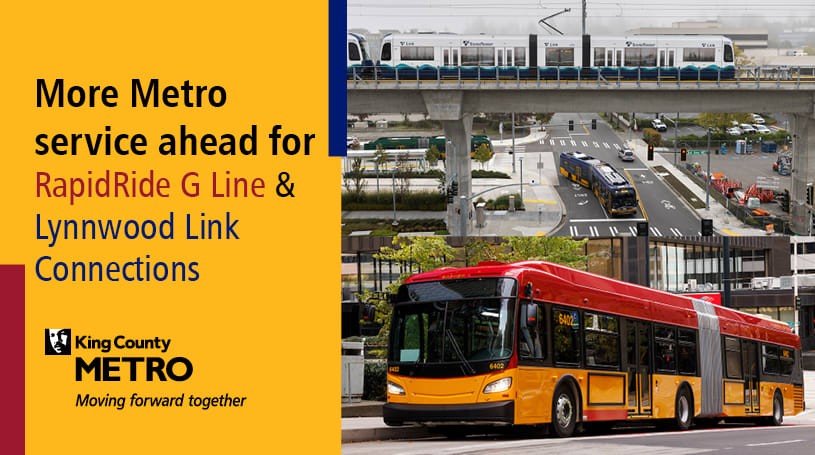
Construction efforts are wrapping up in the next few months as the City of Seattle completes street and sidewalk improvements for the RapidRide G Line, and Sound Transit prepares for the launch of Link 1 Line stations northward to Shoreline, Mountlake Terrace, and Lynnwood.
Photo: King County Metro
3 min to read
King County Executive Dow Constantine proposed new and improved transit services that will allow riders in Seattle, Shoreline, and Snohomish County to better connect with a regional transit system.
If the proposed changes are adopted by the King County Council, initial upgrades to the Metro bus network will begin with the Aug. 31 service change alongside the launch of the RapidRide G Line.
Construction efforts are wrapping up in the next few months as the City of Seattle completes street and sidewalk improvements for the RapidRide G Line, and Sound Transit prepares for the launch of Link 1 Line stations northward to Shoreline, Mountlake Terrace, and Lynnwood.
The RapidRide G Line project and Sound Transit Link expansion represent more than $3.1 billion in public transportation projects scheduled for completion this year.
With accompanying bus service upgrades, the integrated public transportation network will improve transit connections and expand the service that people rely on.
“Riders across the region will have more ways to travel than ever with these two game-changing improvements,” said King County Metro GM Michelle Allison. “We are excited to maintain the momentum of bringing more people to transit and we do so by centering our service on the needs and voices of riders, and that helps us deliver an all-day, all-week transit network that people want.”
Proposed RapidRide G Line Project Improvements
By integrating surrounding Metro bus routes with the RapidRide G Line launching on Aug. 31, people traveling to, from, and along Madison Street and the surrounding neighborhoods will gain access to connections to jobs, education, recreation, and essential services.
Proposed revisions and improvements are for routes 3, 4, 10, 11, 12, 47, 49, and 60. The improvements were guided by community members through over 3,600 survey responses and in person with over 600 people during information sessions.
Service highlights include:
Extending some Route 3 trips to western Capitol Hill where the former Route 47 operated
Streamlining service by shifting Routes 11 and 12 to better serve other destinations near Madison Street
Revising Route 11 to maintain connections to Capitol Hill Station and other destinations
Continuing frequent service where priority transportation needs are greatest, and where rider demand is highest
Increasing frequency on Route 60 on weekdays and weekends between 6 a.m. and 7 p.m. to provide more frequent north-south bus service connecting Capitol Hill, First Hill, Beacon Hill, South Park, and southwest Seattle.
New Bus Services with Sound Transit
Also this year, Sound Transit will extend Link 1 Line service 8.5 miles between Northgate and Lynnwood and open four new stations.
Once launched, Metro will begin network upgrades that integrate new bus services with the Sound Transit system. The proposed legislation adds five new bus routes, revises nine routes, and replaces 11 routes in phases.
To prepare for this major expansion, Metro engaged for over two years with riders and the community-based Lynnwood Link Mobility Board to guide and develop the proposed updates to the transit network.
Highlights of the final bus network in the project area include:
More overall weekday trips (+9%) and weekend trips (+32%)
More evening trips after 10 p.m. (+43%)
Increased span of service on weekday and weekend routes
Net increase of three frequent routes that arrive every 15 minutes or better, and four existing routes with frequency improvements
Three new and three improved east-west routes
Metro also is introducing a new, on-demand Metro Flex service area in Lake Forest Park, north Kenmore, Brier, and southeast Mountlake Terrace. This service will improve connections to community destinations, schools, and other transit services, including Sound Transit’s Link light rail and future bus rapid transit.
More Bus

New York MTA Plans Largest Bus Fleet Upgrade in More Than a Decade
The agency is seeking manufacturers for 650 new CNG buses to replace aging vehicles, improve reliability, and advance its broader fleet modernization strategy.
Read More →
Building a Flexible Path to Transit Electrification
John Hroncich discusses BAE Systems’ modular and scalable approach, lessons learned from decades of real-world operations, and how agencies can identify electrification strategies that fit their fleets.
Read More →
Bus Tech Talk: Keeping Transit Technicians Ahead of the Technology Curve
LA Metro’s Obed Mejia discusses technician training, evolving maintenance technology, fleet replacement, and strategies for getting the most out of today’s transit fleets.
Read More →
Biz Briefs: RIPTA Unveils New Frontrunners, Clevland RTA Adds New Siemens, and More
In METRO's latest installment, we take a look at recent news from Siemens, Prevost, Dodge, and more partnerships making headlines across the transportation sector.
Read More →
People Movement: Holly Arnold Joins Transdev and More
In this edition, we also cover recent appointments and announcements at Pace, CamTran, MCI, and more, showcasing the individuals helping to shape the future of transportation.
Read More →
The High Cost of Transit Buses: Industry Leaders Look to Procurement Reform
Transit leaders and policymakers examine how standardized bus designs, streamlined procurement, and predictable funding could help agencies stretch budgets and deliver better service.
Read More →
The Business Voice Behind Public Transportation
As chair of APTA’s Business Members Board of Governors, Ray Melleady explains how more than 850 business members are partnering with transit agencies to advance funding, innovation, and industry-wide collaboration.
Read More →
From Surviving to Thriving: Building Stronger Transportation Organizations
Bus Business Consultants founder Brian Dickson shares lessons on leadership, organizational health, and creating options for long-term success in a changing transportation industry.
Read More →
Finding the ‘Happy Medium’: Optimizing Maintenance Without Sacrificing Reliability
The key to maintenance optimization isn’t doing less work—it’s doing the right work at the right time on the right assets.
Read More →
LA Metro, City of West Hollywood, and Partners Advance Smarter Bus Lane Enforcement
The award-winning partnership combines AI-powered detection with human oversight to improve bus reliability, accessibility, and enforcement efficiency.
Read More →