



King County Metro hosts APTA Annual
The Seattle network of transit systems allows visitors to conveniently reach a variety of points of interest, from the iconic Space Needle at the Seattle Center to the world-renowned Pike Place Market in downtown Seattle to the EMP Museum, featuring the Experience Music Project, and the Pacific Science Center.

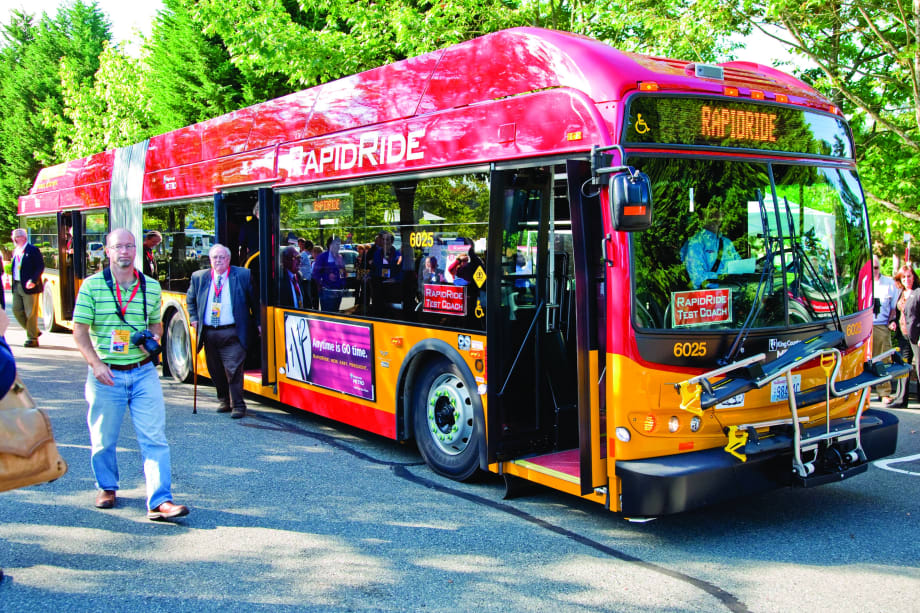
Eager to showcase its much-lauded transit system, green initiatives and popular home town, King County Metro Transit (Metro), along with local partners Sound Transit and the City of Seattle, welcomes APTA Annual Meeting attendees to Seattle with specially planned regional tours and panel sessions with a local flavor, with many representatives from King County Metro and the Seattle area.
Metro and its regional partners are also hosting an information table about the Seattle area and its transit systems.
“We’re very excited about it. It’s the first time we’ve hosted the annual conference,” Kevin Desmond, GM, King County Metro Transit, said. “For people not familiar with Seattle and what’s going on in the transportation environment here, it’s a really rich program, service and policy environment. We hope people enjoy it.”
The Seattle network of transit systems allows visitors to conveniently reach a variety of points of interest, from the iconic Space Needle at the Seattle Center to the world-renowned Pike Place Market in downtown Seattle to the EMP Museum, featuring the Experience Music Project, and the Pacific Science Center.
Additionally, transit can take visitors to Seattle Great Wheel, the city’s new Ferris wheel, which features a million-dollar view of the mountains, waterfront and Seattle skyline, Desmond said.
At the other end of town is the Chinatown-International District near Metro’s headquarters, which is also very easy to access via numerous Metro routes or the Sound Transit light rail running through the Downtown Seattle Transit Tunnel, and connecting Seattle-Tacoma International airport to downtown Seattle.
Visitors can also take transit to Lincoln Park in West Seattle, known for its beach, wooded areas and views, using Metro’s brand new BRT RapidRide C line, which launched days before the conference started. Attendees can also hop on a bus to Boeing Field to visit the Museum of Flight.
Water transportation abounds as well. The Washington State Ferry takes passengers across the Puget Sound to see the water and the mountains around Seattle. Between Seattle and Bremerton and Bainbridge Island, take the King County Water Taxi from the main ferry terminal, across Elliott Bay, where the Port of Seattle is located.
Additionally, on Sept. 29, just days before the conference kicked off, Metro launched its third and fourth BRT lines: the RapidRide C and D, connecting Seattle communities to downtown. “Our first RapidRide line was launched two years ago, and saw a 50% increase in ridership since it launched,” Desmond recalled. “Our second RapidRide, the B line, which was launched one year ago, has seen a 15% increase in ridership. We expect to see a similar customer response.”
Also during that time, Metro eliminated, after 40 years, its downtown ride-free zone, presenting a significant change in the overall dynamic of how the transit system in downtown Seattle works, Desmond said. “We’re making major changes when the conferees are here,” he added. “They’ll get to witness how well we pull some of this stuff off. “
Metro has also pulled off some impressive achievements when it comes to sustainability initiatives.
Five of Metro’s facilities are LEED-certified or in the process of obtaining the certification, most recently its newest and largest bus base. Another bus base features a newly replaced green roof and a series of other upgrades, including a new HVAC system, with more energy-efficient elements.
Legislated energy objectives in King County also guide many of Metro’s green initiatives. This year, based on a 2007 baseline, Metro aims to reduce its fixed-asset energy reduction by 10%, Desmond said. By 2020, its goal is to reduce the energy of its fixed assets by 20%.
Those objectives drive the agency’s investment and state of good repair programming toward state-of-the-art energy efficient components and mechanical and electrical systems in its fixed-asset buildings, including lighting upgrade projects, replacing old HVAC systems and glass windows.
Over the years Metro also received at least $1 million in credits and incentives from utility companies Seattle City Light and Puget Sound Energy because of its energy-efficient efforts.
Additionally, Metro committed to a fleet of diesel hybrid-electric buses to replace its remaining diesel buses and is in the midst of procuring replacements for its entire electric trolley fleet. The new fleet, which should arrive by 2014, is expected to be about 30% more energy-efficient, using electricity generated by hydro-power.
As the Chair of the APTA Sustainability Committee, Desmond manages, with the APTA staff, many of the association’s sustainability-related activities, such as the recent Annual and Public Transportation Workshop in Philadelphia. “We signed the APTA Sustainability Commitment, committing [APTA] to a full range of energy management activities, with environmental sustainability [being] the chief focus,” Desmond said.
More Bus
Report: Transit Bus Manufacturing Supports 34,100 Jobs, $5.1B in GDP
The “Buses Mean Business” report examines the transit bus manufacturing industry’s economic footprint, supply chain, and rising demand for vehicle replacements.
Read More →
Biz Briefs: New Flyer Delivers in Columbus, Houston, Beep and Freebee Merge, and More
In this edition of Biz Briefs, we spotlight the latest developments shaping the future of mobility.
Read More →
People Movement: Dan Dipert Coaches Adds Third-Generation Leader, Keolis Names New Valley Metro VP/GM, and More
In this edition, we also cover recent appointments and announcements at the Wabtec, SilverRide, HNTB, and more, showcasing the individuals helping to shape the future of transportation.
Read More →
New York MTA Plans Largest Bus Fleet Upgrade in More Than a Decade
The agency is seeking manufacturers for 650 new CNG buses to replace aging vehicles, improve reliability, and advance its broader fleet modernization strategy.
Read More →
Building a Flexible Path to Transit Electrification
John Hroncich discusses BAE Systems’ modular and scalable approach, lessons learned from decades of real-world operations, and how agencies can identify electrification strategies that fit their fleets.
Read More →
Bus Tech Talk: Keeping Transit Technicians Ahead of the Technology Curve
LA Metro’s Obed Mejia discusses technician training, evolving maintenance technology, fleet replacement, and strategies for getting the most out of today’s transit fleets.
Read More →
Biz Briefs: RIPTA Unveils New Frontrunners, Clevland RTA Adds New Siemens, and More
In METRO's latest installment, we take a look at recent news from Siemens, Prevost, Dodge, and more partnerships making headlines across the transportation sector.
Read More →
People Movement: Holly Arnold Joins Transdev and More
In this edition, we also cover recent appointments and announcements at Pace, CamTran, MCI, and more, showcasing the individuals helping to shape the future of transportation.
Read More →
The High Cost of Transit Buses: Industry Leaders Look to Procurement Reform
Transit leaders and policymakers examine how standardized bus designs, streamlined procurement, and predictable funding could help agencies stretch budgets and deliver better service.
Read More →
The Business Voice Behind Public Transportation
As chair of APTA’s Business Members Board of Governors, Ray Melleady explains how more than 850 business members are partnering with transit agencies to advance funding, innovation, and industry-wide collaboration.
Read More →