



L.A. Metro Approves Funding for Final Phase of Foothill Gold Line
L.A. Metro has approved a $798 million funding agreement to build the final phase of the Foothill Gold Line. Most of the project’s funding is coming from the State of California’s TIRCP Program.

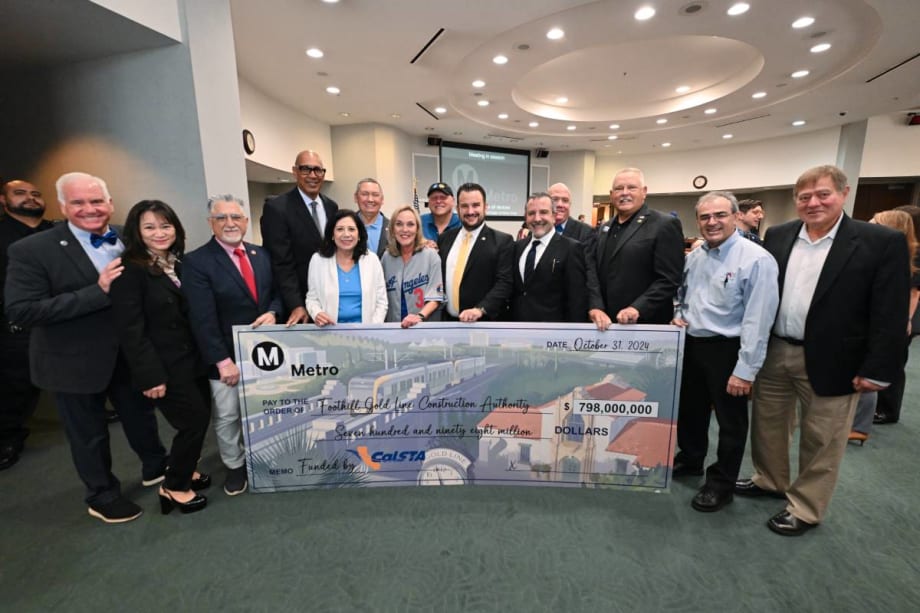
Regional leaders from the San Gabriel Valley celebrating approval of funding agreement for 3.2-mile, two-station Foothill Gold Line light rail project from Pomona to Montclair on Oct. 31, 2024, in Los Angeles, Calif. – From Left to Right: La Verne Mayor Tim Sandoval, Arcadia Mayor Pro Tem Sharon Kwan, California State Senator Anthony Portantino, Los Angeles County Supervisor Hilda Solis (front), California State Assembly Member Chris Holden (back), Los Angeles County Supervisor Kathryn Barger (front), Pomona Mayor Tim Sandoval (back), Claremont Council Member Ed Reece (front), Glendale Council Member Ara Najarian (back), Construction Authority CEO Habib F. Balian (front), Montclair Council Member Bill Ruh (back), Glendora Mayor Mendell Thompson, Montclair Mayor John Dutrey, and Chino Hills Council Member Ray Marquez.
Photo: LA Metro
The Foothill Gold Line Construction Authority (Construction Authority) announced that the Los Angeles County Metropolitan Transportation Authority (Metro) Board approved a $798 million amendment to the ongoing funding agreement between the agencies.
The approved amendment will complete the Los Angeles County portion of the final 3.2 mile, two-station construction segment from Pomona to Montclair.
Under the terms of the agreement, Metro will utilize a State of California Transit and Intercity Rail Capital Program (TRICP) grant to pay for their portion of the project. The project was named the agency’s number one priority for new state funding in 2023. The San Bernardino County Transportation Authority (SBCTA) has dedicated $80 million of state and local funding for the portion of the project in San Bernardino County.
“Completing this project is essential to the future of this corridor and to the region,” stated Construction Authority Board Chair and Claremont City Council Member Ed Reece. “This project will expand mobility with reliable and sustainable transit, reducing emissions and improving quality of life for all. We sincerely appreciate Metro's commitment to completing this number one priority project.”
The approved funding agreement amendment between the two agencies defines the processes needed for Metro to fund work and collaborate with the Construction Authority, as well as sets the foundation for identifying and implementing a detailed budget and means for disbursement, tracking, and management of funds.
It expands the scope of work that the Construction Authority can utilize the county’s funding to include the Los Angeles County portion of the final project segment from Pomona to Montclair.
“The San Gabriel Valley Legislative Caucus made completing the Foothill Gold Line to Claremont and Montclair a top priority after the original six-station project had to be shortened in 2018 due to funding constraints,” stated State Assembly Member Chris Holden, whose district includes both of the future station cities of Claremont and Montclair. “We fought hard to get the funding to stay in the State budget these past two cycles and I want to thank Metro for utilizing the funds quickly to get to work building more transit in Los Angeles.”
The Construction Authority is currently underway to hire the design-build team for the shovel-ready project. The Authority expects to award a contract in Spring 2025 and break ground later in the year.
The final project segment will complete the Foothill Gold Line’s 25-station system, being built in four construction segments.
It will provide a safe, reliable transit alternative to driving the busy 210 and 10 freeways and offer connections with Metrolink’s San Bernardo Line at both the Claremont and Montclair stations. A future trip from Montclair to Pasadena should take just over 40 minutes, and a trip from Montclair to Los Angeles would be about 75 minutes.
“Next year will be an historic year for the Foothill Gold Line, and I am incredibly proud of the progress we are making,” added Chair Reece. “In addition to completing construction on the four-station project segment from Glendora to Pomona the first week of 2025; the Construction Authority will also be able to break ground on the final segment – bringing us one major step closer to completing the agency’s legislative mandate.”
More New Mobility

From Hardware to Digital Partner: Luminator Charts Its Next Chapter
CEO Magnus Friberg discusses Luminator’s shift toward becoming a digital partner, the growing importance of software and interoperability, and how AI can help agencies improve operations and passenger experience.
Read More →
Biz Briefs: Alstom Lands Canadian Contract, LYT to Supply California TSP, and More
In METRO's latest installment, we take a look at recent news from Complete Coach Works, Beep, FlixBus, and more partnerships making headlines across the transportation sector.
Read More →
CharterUP’s Armir Harris on Technology, AI, and the Future of Group Mobility
In a recent episode of METROspectives, CharterUP Founder/CEO Armir Harris discussed the company’s evolution from an online charter bus marketplace into a technology platform supporting public- and private-sector mobility and much more.
Read More →
Jacksonville’s NAVI Project Charts a New Course for Autonomous Public Transportation
Through its NAVI program, JTA is showing how autonomous vehicles, intelligent infrastructure, and coordinated operations can work together to deliver everyday public transportation.
Read More →
Biz Briefs: Luminator Marks Milestone and More
From manufacturers and suppliers to transit agencies and motorcoach operators, these updates offer a snapshot of the projects, partnerships and business moves driving the industry forward.
Read More →
New Tricks for Old Bureaucracies: Joshua Schank on Making Transit Innovation Stick
Former LA Metro Chief Innovation Officer Joshua Schank discusses why good ideas aren't enough, how transit agencies can overcome resistance to change, and why today's challenges demand more innovation.
Read More →
How DART's GoPass Is Redefining Regional Mobility
Serving 14 transit agencies, GoPass simplifies multimodal travel by allowing riders to plan, pay for, and manage an entire trip through one app.
Read More →
Biz Briefs: OCTA Taps Clean Energy for Hydrogen Station, Stadler to Supply Via Rail Vehicles, and More
From manufacturers and suppliers to transit agencies and motorcoach operators, these updates offer a snapshot of the projects, partnerships and business moves driving the industry forward.
Read More →CharterUP Expands Into New Mobility and Autonomous Transportation
Vice President of New Mobility Stephen Joos discusses how CharterUP is leveraging its nationwide transportation network, technology platform, and autonomous vehicle partnerships to expand into workforce mobility, campus shuttles, and transit solutions.
Read More →
METRO Magazine Announces 2026 Innovative Solutions Awards Winners
Projects Recognized for Advancing Mobility Through Technology, Accessibility, Workforce Innovation, and Operational Excellence
Read More →