



Latinos In Transit Wraps Inaugural Navigate Mentorship Program
The LIT Navigate Mentorship Program was launched as a structured, low-cost opportunity for active LIT members, focused on intentional growth, workforce development, mentorship, networking, and education.

Through 12 comprehensive virtual sessions, participants engaged in SMART goal setting, individual development planning, industry trend analysis, leadership and soft skills development, networking expansion, job shadowing, community engagement strategies, and long-term career planning.
LIT
- The LIT Navigate Mentorship Program is designed as an accessible and organized opportunity for members of Latinos In Transit (LIT).
- It emphasizes intentional growth, with a focus on workforce development, mentorship, networking, and education.
- The program is aimed at offering a cost-effective means for active LIT members to enhance their career and professional abilities.
*Summarized by AI
Latinos In Transit (LIT) completed its inaugural Navigate Mentorship Program — a six-month leadership development initiative designed to empower and equip emerging professionals across the public transportation industry.
The LIT Navigate Mentorship Program was launched as a structured, low-cost opportunity for active LIT members, focused on intentional growth, workforce development, mentorship, networking, and education.
Through 12 comprehensive virtual sessions, participants engaged in SMART goal setting, individual development planning, industry trend analysis, leadership and soft skills development, networking expansion, job shadowing, community engagement strategies, and long-term career planning.
LIT’s Inaugural Launch
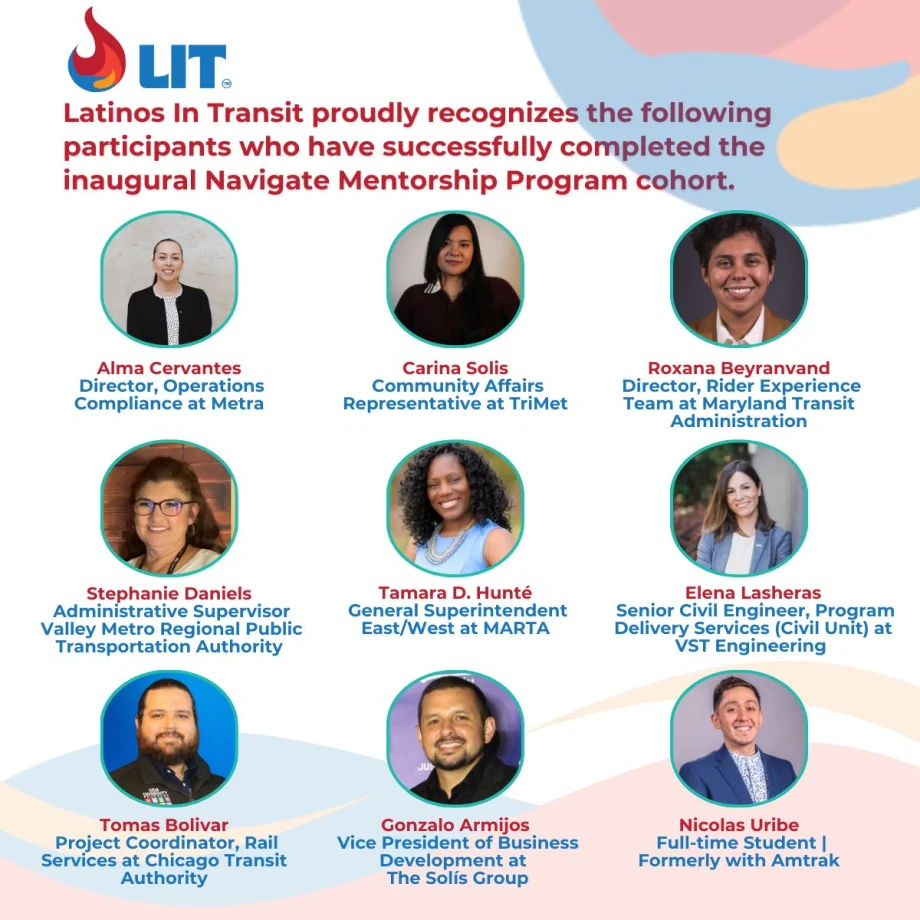
The inaugural cohort included professionals representing major transit agencies, engineering firms, consulting organizations, and emerging industry leaders:
- Roxana Beyranvand, Maryland Transit Administration (MTA)
- Tomas Bolivar, Chicago Transit Authority
- Alma Cervantes, Metra
- Stephanie Daniels, Valley Metro Regional Public Transportation Authority
- Tamara D. Hunté, Metropolitan Atlanta Rapid Transit Authority (MARTA)
- Gonzalo Armijos, The Solís Group
- Elena Lasheras, VST Engineering
- Carina Solis, TriMet
- Nicolas Uribe, Student
Throughout the program, participants strengthened not only their technical knowledge but also their leadership clarity and professional confidence.
“Participating in the inaugural Navigate Mentorship cohort through LIT was exactly the mentorship support I had been seeking, providing a structured and inspiring space to grow with intention,” said Roxana Beyranvand, director, rider experience team, MTA. “The journey strengthened my leadership purpose and focus, while also fostering meaningful relationships with incredible peers across other agencies that I truly value.”
A defining component of the Navigate Mentorship Program was the Capstone Project, which challenged participants to think strategically about their professional brand and future positioning within the industry.
To complete the program, each participant was required to develop a formal conference proposal aligned with their area of expertise, professional network, and long-term career goals.
This capstone experience required participants to:
- Identify a relevant industry topic reflective of their expertise.
- Develop a compelling session proposal suitable for a professional conference.
- Clarify their target audience and learning objectives.
- Demonstrate subject matter credibility.
- Update and refine their CVs.
- Present themselves professionally and competitively to stand out among industry peers.
Envisioning Leadership
The conference proposal process was not simply an academic exercise — it required participants to envision where they want to lead, how they want to contribute, and how they can leverage their network and resources to position themselves as thought leaders in public transportation.
By refining their resumes and professional narratives alongside their session proposals, graduates strengthened both their confidence and their visibility within the industry.
“The Navigate Mentorship Program was created to be intentional, rigorous, and transformative,” said Christina Villarreal, executive director, LIT. “We wanted participants to walk away not only with mentorship conversations, but with tangible deliverables that elevate their professional presence. The capstone project challenged them to think like industry leaders — how to present ideas, position themselves competitively, and step into spaces where their voices belong. This cohort has demonstrated exactly the kind of leadership our industry needs.”
Rather than a traditional certificate, graduates received a Customized Professional Blueprint, a forward-looking, individualized roadmap designed to keep them on track with the goals and objectives established throughout the program. This blueprint outlines refined career goals, leadership development priorities, networking strategies, and measurable next steps to ensure continued growth well beyond the six-month cohort.
The success of the inaugural Navigate Mentorship cohort reflects LIT’s broader mission to strengthen the pipeline of leadership in public transportation and to create meaningful, measurable workforce development opportunities nationwide.
Quick Answers
The LIT Navigate Mentorship Program is a structured initiative by Latinos In Transit designed to provide mentorship, workforce development, networking, and educational opportunities to its active members.
*Summarized by AI
More Management

METRO Opens Submissions for 2026 Motorcoach Awards
Nominations are now being accepted for METRO Magazine’s Operator of the Year and Innovative Operator of the Year awards.
Read More →
New York MTA Advances Final Contract for Second Avenue Subway Expansion
Contract Four is the largest in the Second Avenue Subway Phase 2 project and includes construction of station infrastructure, tracks, and signals for the subway expansion, MTA officials said. Work on Contract Four will begin in 2027.
Read More →
Transit Agencies Highlight Safety Gains at National Summit
Leaders from 15 major transit systems shared crime-reduction results and safety initiatives while discussing the role of continued federal support.
Read More →

NITA Names New Leadership, Expands Reduced-Fare Program at First Board Meeting
The new regional transit authority appointed its first board chair and interim executive director while extending reduced fares across CTA, Metra, and Pace for eligible riders.
Read More →
Beyond the Checklist: A Structured Approach to Transit Maintenance
Reliability-Centered Maintenance helps transit agencies move beyond routine checklists to focus limited resources on the assets and failures that have the greatest impact on safety, reliability, and service.
Read More →
APTA 2026 Nominating Committee Selects Leadership Slate, Names Chair and Vice Chair Nominees
Leadership changes will help shape the association’s priorities and its representation of the transportation industry during the 2026–2027 term.
Read More →
DART Launches Major Security, Fare Enforcement Initiative
The 90-day demonstration will deploy coordinated security teams at five light rail stations while testing controlled access and gathering data to guide future investments.
Read More →
Advancing Fare Collection Through Technology and Innovation
Learn about delivering 1300 gates at 91 stations while managing fare evasion. Explore the large scale deployment, solution customization and real-world results that affect the region. Prepare for deployment in your region now.
Read More →
Game Day in Motion: Moving Millions During the 2026 World Cup
Between packed transit stations and team motorcoaches, see how agencies and operators across North America tackled the transportation demands of the 2026 FIFA World Cup.
Read More →
Surface Transportation Extension Averts Shutdown, Leaves Transit Funding Gap
The stopgap keeps federal transportation programs moving, but missing advance funding could complicate the transit and rail projects agencies are planning next.
Read More →