




Chicago's NITA Act Moves Into Next Phase as Service Improvements Begin
NITA Names New Leadership, Expands Reduced-Fare Program at First Board Meeting
The new regional transit authority appointed its first board chair and interim executive director while extending reduced fares across CTA, Metra, and Pace for eligible riders.
September 14, 2026
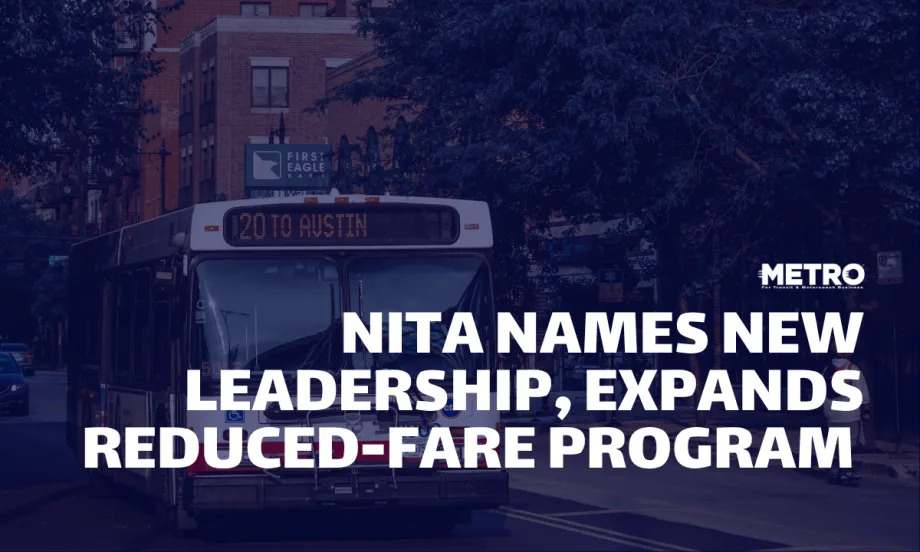
The Access Pilot Program has recorded more than 350,000 rides since launching in 2024 and will expand to CTA and Pace on October 1, creating a regionwide reduced-fare option for eligible SNAP recipients.
Credit:
Blue Arauz/METRO
3 min to read
The Northern Illinois Transit Authority (NITA) Board of Directors held its first meeting, naming the agency's new leadership and taking its first steps on regional fare policy.
The board unanimously elected Tom Kotarac as chair and named Jamie Rhee as interim executive director. It also voted to expand the Access Pilot Program to CTA and Pace beginning October 1, extending reduced fares to eligible Supplemental Nutrition Assistance Program (SNAP) recipients across the Chicago region's three major transit operators.
The moves come as NITA builds the leadership and policies that will guide the region's new approach to public transportation.
NITA Names First Leadership Team
Kotarac serves as senior vice president of the Civic Committee of the Commercial Club of Chicago, where he leads transportation and infrastructure work.
He previously served as deputy executive director of the Chicago Metropolitan Agency for Planning (CMAP) and spent more than 12 years working with the Illinois congressional delegation on Capitol Hill. Kotarac has also served on the Regional Transportation Authority Board, where he chaired the subcommittee overseeing the transition to NITA, and sits on the CTA Board of Directors.
"The NITA Act gives us a dual mandate: deliver real, immediate improvements for riders right now, while building the foundation for a world-class transit system," Kotarac said.
Rhee brings more than 30 years of Chicago government experience to the interim executive director role, including work in airport operations, procurement, real estate, and regulatory compliance.
Most recently, she served as commissioner of the Chicago Department of Aviation from 2018 to 2025, overseeing operations and development at O'Hare and Midway international airports.
Rhee previously served as Chicago's chief procurement officer and held positions including deputy chief of staff in the Mayor's Office and general counsel for the O'Hare Modernization Program.
"My focus as interim executive director is to keep this agency moving by delivering as many early wins for riders as we can while building the strong operational foundation that sets our permanent executive director up for long-term success," Rhee said.
The board also authorized Kotarac to negotiate and execute a contract with national executive search firm K&A to recruit NITA's permanent executive director.
Reduced Fares Expand Across the Region
One of the board's first actions will directly impact riders. Beginning October 1, eligible Access riders will receive reduced fares on CTA and Pace, in addition to Metra, creating a regionwide reduced-fare program for households receiving SNAP benefits.
Under the expansion, qualifying riders will pay $1 for Pace, $1.10 for CTA buses, and $1.25 for CTA trains.
The Access Pilot Program launched in February 2024 following the Fair Transit South Cook Pilot. It expanded reduced-fare eligibility from two Metra lines to SNAP-enrolled riders throughout the Metra system.
More than 350,000 rides have been taken through Access since its launch, with most occurring on the Metra Electric and Rock Island lines serving Chicago's South Side and southern Cook County.
"By making Access available across CTA, Metra and Pace, we're turning a successful pilot into a regional benefit and making transit more affordable for riders who need it most," Kotarac said.
Mapping Transit-Oriented Parking Changes
NITA staff also unveiled a draft mapping tool designed to help municipalities implement the People Over Parking Act, a provision of the NITA Act that took effect June 1.
The law generally prohibits municipalities from requiring minimum amounts of automobile parking for new developments located within one-half mile of a Public Transportation Hub or one-eighth mile of a Public Transportation Corridor.
NITA developed the map in coordination with Metra, CTA, Pace, and CMAP to identify where the law applies. A companion methodology document explains how it identified transportation hubs and corridors.
The agency said the resources are intended to help municipalities determine which developments fall under the law and update local parking regulations accordingly.
The current map identifies transportation hubs and corridors as of January 1, 2027. NITA anticipates updating it in 2029 after completing its regionwide consolidated transit service plan and associated service changes.
See the map at https://nita.illinois.gov/popamap.
NITA's next board meeting is scheduled for October 15.
More Management

Beyond the Checklist: A Structured Approach to Transit Maintenance
Reliability-Centered Maintenance helps transit agencies move beyond routine checklists to focus limited resources on the assets and failures that have the greatest impact on safety, reliability, and service.
Read More →
APTA 2026 Nominating Committee Selects Leadership Slate, Names Chair and Vice Chair Nominees
Leadership changes will help shape the association’s priorities and its representation of the transportation industry during the 2026–2027 term.
Read More →
DART Launches Major Security, Fare Enforcement Initiative
The 90-day demonstration will deploy coordinated security teams at five light rail stations while testing controlled access and gathering data to guide future investments.
Read More →

Sponsored•September 9, 2026
Advancing Fare Collection Through Technology and Innovation
Learn about delivering 1300 gates at 91 stations while managing fare evasion. Explore the large scale deployment, solution customization and real-world results that affect the region. Prepare for deployment in your region now.
Read More →
Game Day in Motion: Moving Millions During the 2026 World Cup
Between packed transit stations and team motorcoaches, see how agencies and operators across North America tackled the transportation demands of the 2026 FIFA World Cup.
Read More →
Surface Transportation Extension Averts Shutdown, Leaves Transit Funding Gap
The stopgap keeps federal transportation programs moving, but missing advance funding could complicate the transit and rail projects agencies are planning next.
Read More →
Bus Tech Talk: Keeping Transit Technicians Ahead of the Technology Curve
LA Metro’s Obed Mejia discusses technician training, evolving maintenance technology, fleet replacement, and strategies for getting the most out of today’s transit fleets.
Read More →
Why Simulating Pedestrian Movement Has Become Essential for Modern Rail Stations
Pedestrian microsimulation is helping rail planners identify bottlenecks, test station designs, and prepare complex transit hubs for growing passenger volumes.
Read More →
People Movement: Holly Arnold Joins Transdev and More
In this edition, we also cover recent appointments and announcements at Pace, CamTran, MCI, and more, showcasing the individuals helping to shape the future of transportation.
Read More →
NITA Launches New Era of Regional Transit in Chicago
The new authority replaces the RTA and brings CTA, Metra, and Pace under a strengthened regional framework for funding, planning, fares, safety, and service coordination.
Read More →