



Metra’s Proposed 2021 Budget Includes $386M in Capital Spending
Funding will go toward major investments in railcars, locomotives, bridges, and stations.
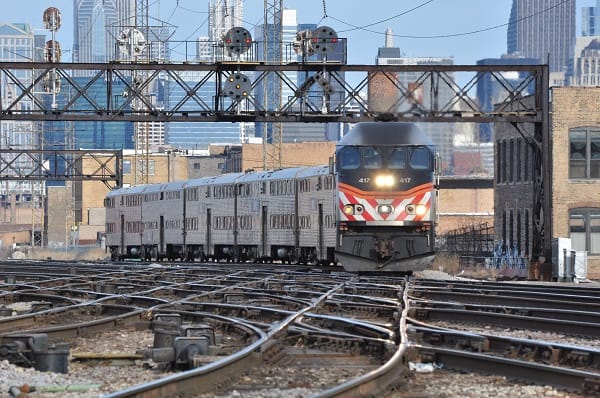
The operating budget assumes that Metra’s ridership will end 2020 at about 20% of the pre-COVID-19 level and increase to 50% by the end of 2021.
Metra
Chicago’s Metra introduced a proposed $700 million operating budget, and proposed $386.4 million in capital spending, including major investments in railcars, locomotives, bridges, and stations.
While the budget does not call for any fare increases or service cuts, it will require expenses to be cut by $70 million unless the agency receives additional COVID-related financial assistance.
The proposed operating and spending budget, which includes $336 million expected from regional transportation sales taxes and $206 million from the federal CARES Act, assumes that Metra’s ridership will end 2020 at about 20% of the pre-COVID-19 level and increase to 50% by the end of 2021. If that happens, Metra expects about $158 million in fare revenue.
However, at current spending rates and service levels and with projected 2021 increases — mostly due to inflation and contractual obligations — Metra will need and additional $70 million in revenue next year. With a fare increase ruled out, the agency must either secure the extra revenue from other sources — most likely another federal relief bill — further trim its expenses, or identify new revenue and cuts.
One change Metra is proposing is an adjustment to its Weekend Pass in order to entice more riders. Starting Feb. 1, a new Day Pass will be available for $7 and valid only on either Saturday or Sunday. The existing $10 two-day Weekend Pass would be retained, but only on the Ventra app. The validity period for both passes will be 14 days, a change from the current 90-day validity period for the existing Weekend Pass.
A public hearing for Metra’s Preliminary 2021 Operating and Capital Program and Budget, the 2021-2023 Financial Plan, and the 2021-2025 Capital Program will be conducted virtually on Thursday, Nov. 5 from 4 p.m. to 7 p.m.
The breakdown for the proposed $386.4 million in capital spending includes:
$69.9 million for locomotive and car rehabilitation. Metra will continue its innovative and cost-efficient locomotive and car rehab programs and will fund programs to overhaul 21 recently purchased Amtrak locomotives and upgrade locomotives with more reliable AC traction motors.
$61.5 million for new rolling stock. Metra is close to purchasing new railcars after asking manufacturers to propose new designs that maximize capacity and add customer amenities.
$12.9 million for bridges. Metra has nearly 500 bridges that are more than a century old. Funding will be used to design and construct the replacement of several bridges
$47.3 million for stations. Metra is undertaking a major effort to upgrade its stations, with an emphasis on improving ADA accessibility and ensuring that every station has a warming shelter.
$34.9 million for equipment and vehicles.
More Rail

FTA Ends Direct Oversight of MBTA Safety Actions
The federal agency closed its remaining special directive to the Massachusetts Department of Public Utilities following a safety review that began in 2022.
Read More →
Amtrak, CN Reach Agreements to Strengthen Passenger Rail Service, Safety
The agreement resolves a more than decade-long proceeding before the Surface Transportation Board concerning the terms and conditions for Amtrak services, such as the City of New Orleans, Illini/Saluki, and Wolverine.
Read More →
New York MTA Advances Final Contract for Second Avenue Subway Expansion
Contract Four is the largest in the Second Avenue Subway Phase 2 project and includes construction of station infrastructure, tracks, and signals for the subway expansion, MTA officials said. Work on Contract Four will begin in 2027.
Read More →
San Diego MTS Breaks Monthly Trolley Ridership Record
Agency officials said July’s ridership indicates MTS’s continued recovery from the pandemic.
Read More →
Report Examines NJ TRANSIT Reliability, Funding Challenges
The Garden State Initiative analysis examines the roles of Amtrak infrastructure, fleet management, and agency operations while recommending a more performance-based approach to improving reliability.
Read More →
Stadler, CapMetro Sign Long-Term Rail Fleet Support Agreement
Beginning in 2027, Stadler will provide on-site technical expertise, spare parts support, training, and obsolescence management to help extend the reliability and longevity of CapMetro’s GTW fleet.
Read More →
Biz Briefs: Alstom Lands Canadian Contract, LYT to Supply California TSP, and More
In METRO's latest installment, we take a look at recent news from Complete Coach Works, Beep, FlixBus, and more partnerships making headlines across the transportation sector.
Read More →
CATS Gold Line Marks 5 Years of Service, 2.8M Passenger Trips
With a six-mile expansion planned, the Charlotte streetcar is positioned to connect more neighborhoods and major transit hubs across the region.
Read More →
Why Simulating Pedestrian Movement Has Become Essential for Modern Rail Stations
Pedestrian microsimulation is helping rail planners identify bottlenecks, test station designs, and prepare complex transit hubs for growing passenger volumes.
Read More →
Amtrak Begins Major Construction at New York’s Sunnyside Yard
The new maintenance facility will support Amtrak’s Airo trainsets while improving maintenance efficiency and turnaround times in New York.
Read More →