



METRO, PERC honor innovation, clean fleets at BusCon 2016
Arrow Stage Lines, L.A. Metro and Pierce Transit and their supplier partners, as well as fleets in San Diego and Detroit were among the honorees.

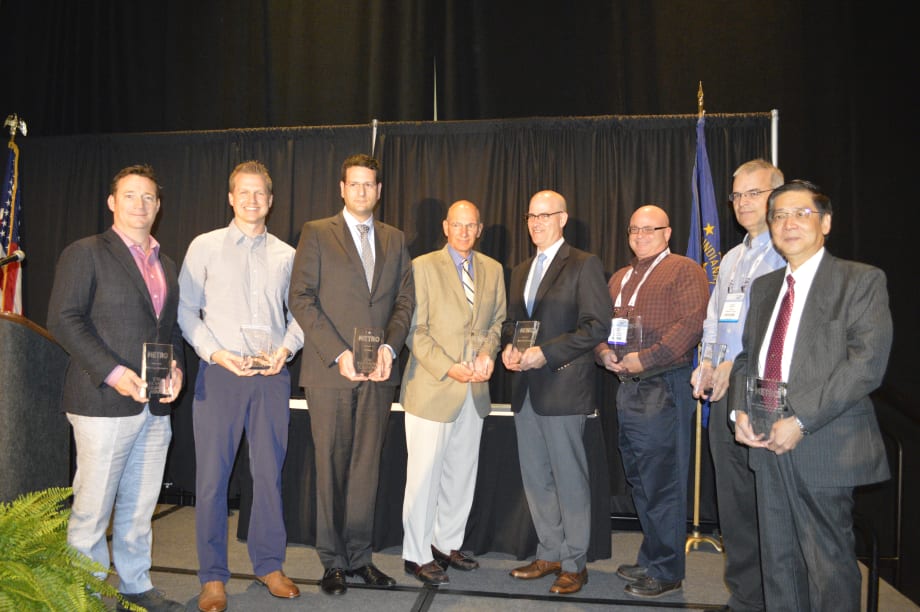
METRO's Innovative Solutions winners.
METRO's Innovative Solutions winners.
The best and brightest were honored at BusCon’s Breakfast Awards Ceremony on Wednesday in Indianapolis, including the winners of the second annual METROMagazine Innovative Solutions Awards.
In all, METRO honored three bus operations and their supplier partners for implementing a new initiative that helped them improve training, save money, run more efficiently, streamline operations or improve safety.
Winners Included:
Norfolk, Neb.’s Arrow Stage Lines and Motor Coach Industries (MCI)
MCI provided Arrow Stage Lines an online training site for drivers. This allows drivers to take training classes in the field on their smartphones, at home and at the office. It tracks how long they spend on the course and how many attempts it takes them to pass the test. It allows the safety coordinators to run reports against training numbers and identify drivers who need additional training. This has simplified Arrow Stage Lines training needs to allow drivers to have more training and more familiarization with little cost or actual classroom time.
Los Angeles County Metropolitan Transportation Authority, New Flyer and Parker Hannifin
LA Metro, in collaboration with its bus partner, New Flyer and New Flyer’s electronics supplier Parker Hannifin, has started using an innovative LCD display panel with integrated 7-inch LCD touchscreen. This display panel is part of recent LA Metro bus orders for New Flyer Xcelsior compressed natural gas 40-foot buses. LA Metro’s drive to smart-bus solutions is underway with this modern display panel solution, providing both bus drivers and service teams with a clear view of the bus performance and bus health.
Lakewood, Wash.’s Pierce Transit, Rosco, Mobileye and Munich Reinsurance America
Pierce Transit, along with its reinsurer Munich RE, Rosco, Mobileye, the Washington Transit Insurance Pool and the University of Washington, have installed a collision avoidance system on seven buses currently in service. They have had this system on a few Pierce Transit buses since September 2015, and on those buses, have seen approximately a 9% drop in aggressive driving. The pilot project spans six transit agencies and 40 buses in Washington State. The University of Washington will complete the final analysis of the pilot in a paper due out in July 2017. However, preliminary results have been sufficiently encouraging to cause participants to look to significant fleet test size expansion to 400 buses.
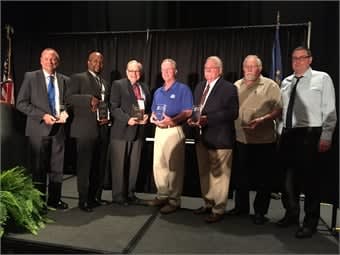
PERC's award winners from BusCon 2016.
In addition, the Propane Education & Research Council (PERC) honored six fleets for their use of clean, domestic propane autogas. The award recognizes public transportation fleets for their commitment to improving the environment and health of their communities by adopting the nation’s leading alternative fuel, propane autogas.
Winners included:
The San Diego Metropolitan Transit System
San Diego converted 36% of its minibuses and paratransit buses to propane autogas just this fall, with plans to convert the entire fleet of 215 buses within five years. The fleet hopes to reduce greenhouse gas emissions by over 2,580 tons per year, when all buses are converted, and save over $700,000 in the first year of operation.
Detroit’s Suburban Mobility Authority for Regional Transportation (SMART)
Detroit’s SMART first considered propane autogas after experiencing high fuel costs for its diesel and gasoline fleets in 2014, and began using 74 propane autogas buses in October 2015. The fleet hopes to expand to operating 117 of their 341 buses on propane autogas. SMART pays $0.98 per gallon on propane autogas and also sees savings in reduced wear-and-tear on the engine and exhaust system of each bus.
Burlington, N.C.’s Alamance County Transportation Authority (ACTA)
Alamance County has operated dual-fuel vehicles since October 2015. They have converted 16 of their 27 transit vehicles, and plan to convert the remainder of the fleet over the next three years. ACTA has predicted a savings of $30,000 for its first year running propane autogas and anticipates greater savings as gasoline costs rise.
Fayetteville, N.C.’s Fayetteville Area System of Transit
Fayetteville’s fleet began using propane autogas in May 2016 and is on track to exceed $50,000 in savings annually. The city has converted three buses of 29 in its fixed-route fleet, and 12 of 18 in its paratransit fleet, with plans to convert all paratransit buses to propane autogas. Both routes service almost 6,000 people each day in an area with a population of over 150,000.
Richmond, Va.’s VanGo
The Richmond, Va.-based company began using propane autogas in 2012. The fleet is currently running 49 of its 60 vehicles on propane autogas, with an additional five buses coming online with the alternative fuel this year. Since the fleet began using propane autogas, it has seen a 40% reduction in towing and repair costs.
City of Austin, Texas
The City of Austin currently runs nine propane autogas buses and began using propane in 1999. The city hopes to run half of its fleet on propane autogas and half on CNG as part of the city’s initiative for a cleaner environment.
BusCon 2016 featured more than 70 buses, the innagural Transit Maintenance Forum and top-notch educational programs. It will return to Indianapolis for 2017, from Sept. 11 to 13 at the Indiana Convention Center.
More Bus

New York MTA Plans Largest Bus Fleet Upgrade in More Than a Decade
The agency is seeking manufacturers for 650 new CNG buses to replace aging vehicles, improve reliability, and advance its broader fleet modernization strategy.
Read More →
Building a Flexible Path to Transit Electrification
John Hroncich discusses BAE Systems’ modular and scalable approach, lessons learned from decades of real-world operations, and how agencies can identify electrification strategies that fit their fleets.
Read More →
Bus Tech Talk: Keeping Transit Technicians Ahead of the Technology Curve
LA Metro’s Obed Mejia discusses technician training, evolving maintenance technology, fleet replacement, and strategies for getting the most out of today’s transit fleets.
Read More →
Biz Briefs: RIPTA Unveils New Frontrunners, Clevland RTA Adds New Siemens, and More
In METRO's latest installment, we take a look at recent news from Siemens, Prevost, Dodge, and more partnerships making headlines across the transportation sector.
Read More →
People Movement: Holly Arnold Joins Transdev and More
In this edition, we also cover recent appointments and announcements at Pace, CamTran, MCI, and more, showcasing the individuals helping to shape the future of transportation.
Read More →
The High Cost of Transit Buses: Industry Leaders Look to Procurement Reform
Transit leaders and policymakers examine how standardized bus designs, streamlined procurement, and predictable funding could help agencies stretch budgets and deliver better service.
Read More →
The Business Voice Behind Public Transportation
As chair of APTA’s Business Members Board of Governors, Ray Melleady explains how more than 850 business members are partnering with transit agencies to advance funding, innovation, and industry-wide collaboration.
Read More →
From Surviving to Thriving: Building Stronger Transportation Organizations
Bus Business Consultants founder Brian Dickson shares lessons on leadership, organizational health, and creating options for long-term success in a changing transportation industry.
Read More →
Finding the ‘Happy Medium’: Optimizing Maintenance Without Sacrificing Reliability
The key to maintenance optimization isn’t doing less work—it’s doing the right work at the right time on the right assets.
Read More →
LA Metro, City of West Hollywood, and Partners Advance Smarter Bus Lane Enforcement
The award-winning partnership combines AI-powered detection with human oversight to improve bus reliability, accessibility, and enforcement efficiency.
Read More →