



N.Y. MTA, AT&T Launch App Development Challenge
To increase transparency and to give developers new forms of data to work with, the MTA is releasing four new sets of raw data. App developers will be able to use the new data and merge it with existing data to create apps that have never been seen before.

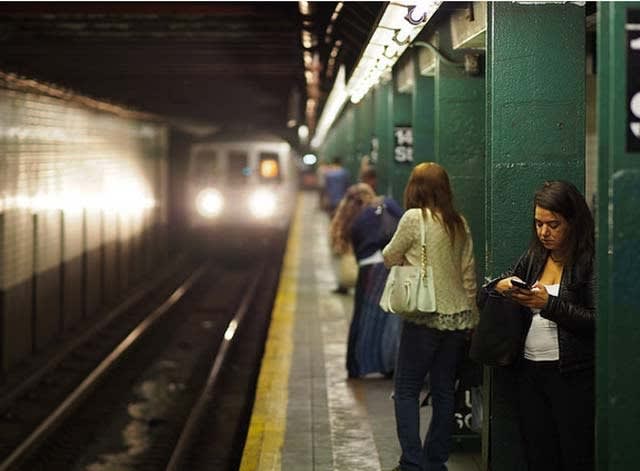
The MTA currently provides 20 sets of data for app developers, including real-time service status for all lines, real-time elevator and escalator status, data on items in the MTA’s lost and found units, and real-time bus locations and subway arrival estimates for trains on eight subway routes and the Staten Island Railway.
Photo: beanhead4529
New York’s Metropolitan Transportation Authority (MTA), AT&T, Transit Wireless, the NYU Center for Urban Science and Progress (CUSP), and ChallengePost announced the opening of App Quest 3.0, the third annual challenge seeking to generate the best transportation-related apps for New Yorkers using MTA data. App developers will be able to compete for a total of $50,000 in prize money being contributed by AT&T.
To increase MTA transparency and to give developers new forms of data to work with, the MTA is releasing four new sets of raw data. App developers will be able to use the new data and merge it with existing data to create apps that have never been seen before.
The new data sets are:
Train departure times, current on-time status and track assignments for all LIRR and Metro-North stations enabled on the Train Time system. This is the data that is currently available through the official Metro-North Train Time and Long Island Rail Road Train Time apps and websites.
From MTA Bus Time, historical bus locations every 30 seconds over more than three months.
Historical train arrival estimates at every station on the 1, 2, 3, 4, 5, 6, and L subway lines; 42nd Street Shuttle; and the Staten Island Railway every five minutes, starting last September.
Newly reformatted and easier to use data on turnstile counts at each subway station.
And, to enable the possibility of greater navigation functionality of apps, App Quest 3.0 will incorporate the use of experimental wireless PROMObeacons that have been set up at the Grand Central-42nd Street subway station. The PROMObeacons can transmit to beacon-enabled apps to allow the apps to know the precise location of an app user within a subway station. That could help sensory impaired people, or people unfamiliar with the layout of given subway stations, find their way through a station.
The PROMObeacons have been installed by Transit Wireless as an experimental “proof-of-concept” beta test to take place as part of App Quest 3.0. The beacons will not receive any data from smartphones, and they will only transmit data to smartphones if a user affirmatively opts to enable location services underground.
The MTA currently provides 20 sets of data for app developers, including real-time service status for all lines, real-time elevator and escalator status, data on items in the MTA’s lost and found units, and real-time bus locations and subway arrival estimates for trains on eight subway routes and the Staten Island Railway.
The MTA also publishes daily traffic volumes at its toll plazas, and the volume of subway customers using each bank of turnstiles at each station every four hours, and at each station based on type of MetroCard. Three to four times each year, the MTA publishes schedules for all MTA services, in raw, machine readable data formatted for app developers.
More Management

METRO Opens Submissions for 2026 Motorcoach Awards
Nominations are now being accepted for METRO Magazine’s Operator of the Year and Innovative Operator of the Year awards.
Read More →
New York MTA Advances Final Contract for Second Avenue Subway Expansion
Contract Four is the largest in the Second Avenue Subway Phase 2 project and includes construction of station infrastructure, tracks, and signals for the subway expansion, MTA officials said. Work on Contract Four will begin in 2027.
Read More →
Transit Agencies Highlight Safety Gains at National Summit
Leaders from 15 major transit systems shared crime-reduction results and safety initiatives while discussing the role of continued federal support.
Read More →

NITA Names New Leadership, Expands Reduced-Fare Program at First Board Meeting
The new regional transit authority appointed its first board chair and interim executive director while extending reduced fares across CTA, Metra, and Pace for eligible riders.
Read More →
Beyond the Checklist: A Structured Approach to Transit Maintenance
Reliability-Centered Maintenance helps transit agencies move beyond routine checklists to focus limited resources on the assets and failures that have the greatest impact on safety, reliability, and service.
Read More →
APTA 2026 Nominating Committee Selects Leadership Slate, Names Chair and Vice Chair Nominees
Leadership changes will help shape the association’s priorities and its representation of the transportation industry during the 2026–2027 term.
Read More →
DART Launches Major Security, Fare Enforcement Initiative
The 90-day demonstration will deploy coordinated security teams at five light rail stations while testing controlled access and gathering data to guide future investments.
Read More →
Advancing Fare Collection Through Technology and Innovation
Learn about delivering 1300 gates at 91 stations while managing fare evasion. Explore the large scale deployment, solution customization and real-world results that affect the region. Prepare for deployment in your region now.
Read More →
Game Day in Motion: Moving Millions During the 2026 World Cup
Between packed transit stations and team motorcoaches, see how agencies and operators across North America tackled the transportation demands of the 2026 FIFA World Cup.
Read More →
Surface Transportation Extension Averts Shutdown, Leaves Transit Funding Gap
The stopgap keeps federal transportation programs moving, but missing advance funding could complicate the transit and rail projects agencies are planning next.
Read More →