




RELATED: Can Public Transportation Save the World from Climate Change?
N.Y. MTA launches all-electric bus pilot program
MTA will test 10 new buses by Proterra and New Flyer with the hope of ordering an additional 60 all-electric buses.
January 8, 2018
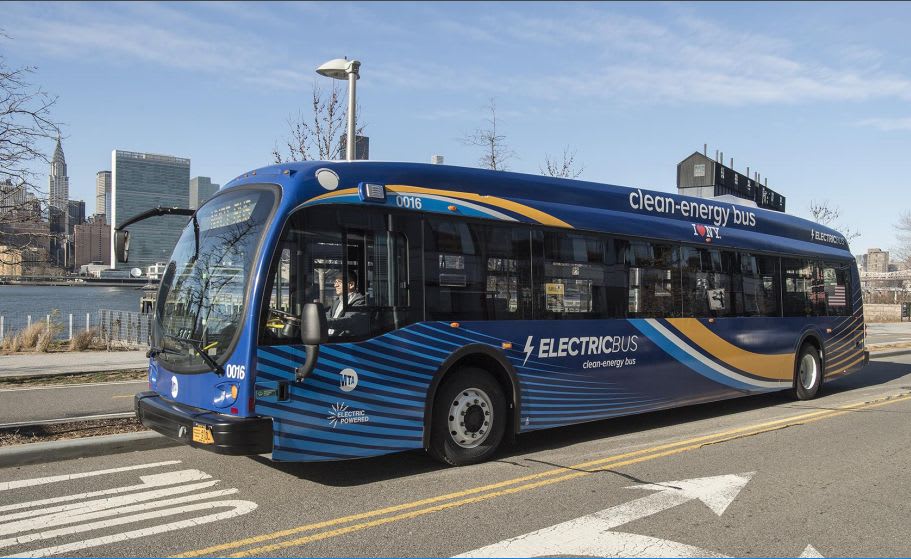
The new zero-emission, all-electric buses support environmental sustainability, are quieter than traditional buses, and will feature amenities such as Wi-Fi and USB ports to enhance customer experience. Photo: N.Y. MTA
4 min to read
The new zero-emission, all-electric buses support environmental sustainability, are quieter than traditional buses, and will feature amenities such as Wi-Fi and USB ports to enhance customer experience. Photo: N.Y. MTA
Governor Andrew Cuomo announced the start of a three-year pilot program for 10 all-electric buses with the goal of reducing emissions and modernizing the MTA's bus fleet. Using lessons learned from the initial phase of the pilot, the MTA intends to order an additional 60 all-electric buses.
Timing of the larger order will be dictated by the buses' performance during the initial phase of the pilot. The new zero-emission, all-electric buses support environmental sustainability, are quieter than traditional buses, and will feature amenities such as Wi-Fi and USB ports to enhance customer experience.
After a study of best practices from systems across the U.S. and around the world, the MTA identified two vendors to manufacture a total of ten all-electric buses, which were leased for test and evaluation over a period of three years in the New York City operating environment. The first of those vendors, Proterra, was selected to provide five over-night charging electric buses which will be operated on routes including the B32 in Brooklyn and Queens. The second vendor, New Flyer, will provide five buses that will be operated on the M42 and M50 routes in midtown Manhattan. All of the new electric buses will feature customer amenities such as Wi-Fi and USB ports that will enhance the customer experience.
The three-year lease for the Proterra buses includes six depot charging stations, which will be installed in the Grand Avenue Depot in Maspeth, Queens, where the buses will be recharged overnight or mid-day. The first leg of the pilot will also include one 'en-route' high power charging station, which will be located at Williamsburg Bridge Plaza in Brooklyn, and be used to extend the range of the buses by quickly recharging without having to return to the depot. The plaza is the hub for nine routes that serve Brooklyn, Manhattan and Queens.
The three-year lease for the New Flyer buses includes two depot charging stations, which will be installed in the Michael J Quill depot, Manhattan, where the buses will be recharged overnight or mid-day and to eventually support maintenance & operations type activities. The first leg of the pilot will also include two 'en-route' high power charging stations, one on East 41 Street and the second at Pier 83, Circle Line on West 43 Street. The MTA plans to learn if these two 'en-route' chargers can eventually support 24 hours of operation without having to return buses to the depot.
In preparation for the pilot the MTA conducted a four-year study of global best practices for electric buses. The process included a review of reports from systems in Europe, Asia, and South America; involvement in industry groups such as the Electric Power Research Institute, the Society of Automotive Engineers and the American Public Transportation Association; in-person visits and consultations with transportation authorities in London, Geneva, Chicago, Philadelphia, Seattle, Los Angeles, and Montreal; and testing and inspections of buses from a variety of suppliers.
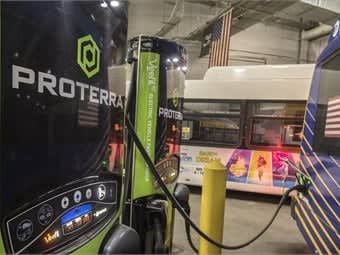
MTA will test 10 new buses by Proterra and New Flyer with the hope of ordering an additional 60 all-electric buses. Photo: N.Y. MTA
The pilot program is intended to provide the MTA and manufacturers of electric buses with actionable data on what works best in New York's metropolitan environment. The MTA will use the results from the pilot to refine and develop bus specifications for future electric bus procurements to ensure buses are fully able to meet the rigors of operating in New York City. As a result, the initial lease and evaluation of buses does not eliminate any other builders from future competitive procurements.
In addition to testing the new electric buses, the MTA has ordered 110 new Compressed Natural Gas buses to operate across the Bronx and Brooklyn between now and the first quarter of 2019. The new buses will be the first CNG 60-foot articulated buses, and will refresh a portion of the existing fleet of 781, 40-foot CNG buses, taking the oldest buses out of service and adding capacity. CNG buses are cleaner burning and have lower particulate emissions than diesel buses.
Under Governor Cuomo's direction, New York is attacking climate change by moving the transportation system from high-emission fossil fuels to electricity, provided increasingly by renewable power. Last week, the 2018 State of the State announced that the state would invest funds from the Volkswagen settlement in supporting the transition to electric mobility, including electric buses, and that it would support increasing the number of publicly-available electric vehicle charging stations to 10,000 by 2021.
More Bus

New York MTA Plans Largest Bus Fleet Upgrade in More Than a Decade
The agency is seeking manufacturers for 650 new CNG buses to replace aging vehicles, improve reliability, and advance its broader fleet modernization strategy.
Read More →
Building a Flexible Path to Transit Electrification
John Hroncich discusses BAE Systems’ modular and scalable approach, lessons learned from decades of real-world operations, and how agencies can identify electrification strategies that fit their fleets.
Read More →
Bus Tech Talk: Keeping Transit Technicians Ahead of the Technology Curve
LA Metro’s Obed Mejia discusses technician training, evolving maintenance technology, fleet replacement, and strategies for getting the most out of today’s transit fleets.
Read More →
Biz Briefs: RIPTA Unveils New Frontrunners, Clevland RTA Adds New Siemens, and More
In METRO's latest installment, we take a look at recent news from Siemens, Prevost, Dodge, and more partnerships making headlines across the transportation sector.
Read More →
People Movement: Holly Arnold Joins Transdev and More
In this edition, we also cover recent appointments and announcements at Pace, CamTran, MCI, and more, showcasing the individuals helping to shape the future of transportation.
Read More →
The High Cost of Transit Buses: Industry Leaders Look to Procurement Reform
Transit leaders and policymakers examine how standardized bus designs, streamlined procurement, and predictable funding could help agencies stretch budgets and deliver better service.
Read More →
The Business Voice Behind Public Transportation
As chair of APTA’s Business Members Board of Governors, Ray Melleady explains how more than 850 business members are partnering with transit agencies to advance funding, innovation, and industry-wide collaboration.
Read More →
From Surviving to Thriving: Building Stronger Transportation Organizations
Bus Business Consultants founder Brian Dickson shares lessons on leadership, organizational health, and creating options for long-term success in a changing transportation industry.
Read More →
Finding the ‘Happy Medium’: Optimizing Maintenance Without Sacrificing Reliability
The key to maintenance optimization isn’t doing less work—it’s doing the right work at the right time on the right assets.
Read More →
LA Metro, City of West Hollywood, and Partners Advance Smarter Bus Lane Enforcement
The award-winning partnership combines AI-powered detection with human oversight to improve bus reliability, accessibility, and enforcement efficiency.
Read More →