



New Rail, Revamped Bus Network Drives Houston Metro’s Success
Houston Metro’s revamped bus network includes additional weekend services, extended weekday hours and improved frequencies on popular routes — all without adding any operational costs. The agency was named APTA’s Outstanding Public Transit System, carrying more than 20 million passengers per year.

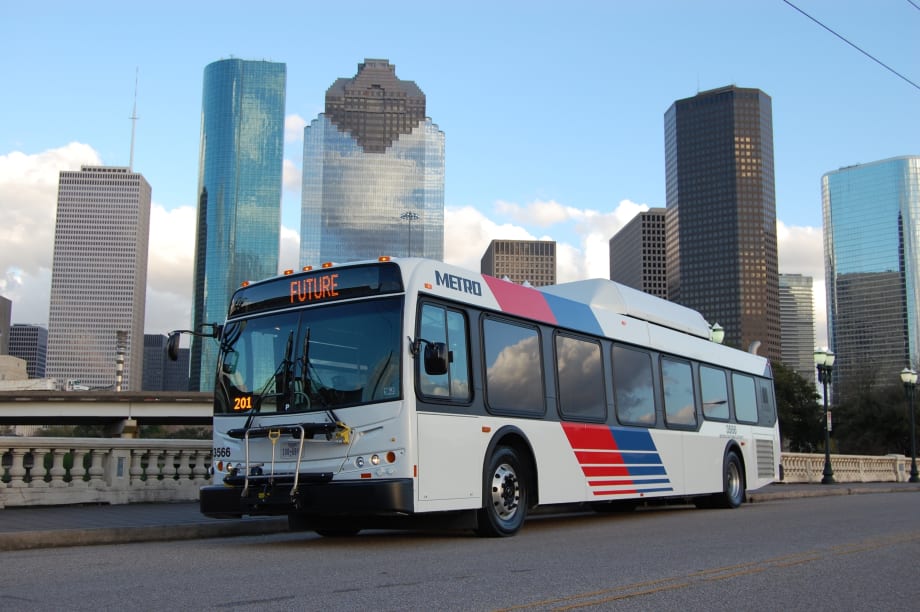
Much has happened in the Houston/Harris County Region since last year’s APTA EXPO, including the launch of two new rail lines in May and a complete revamp of its bus system, which began running services in August.
“It’s been very exciting for the Houston Metro employees, and the organization as a whole, to be able to expand services and travel choices to our customers,” said Houston Metro President/CEO Tom Lambert.
In 2001, Metro adopted a Regional Transit Plan that was enacted in 2003 and called for 30 miles of light rail transit, including the 5.3-mile North Line, which opened in 2013. Two more rail lines in that plan — Southeast and East End — launched in May.
The 3.3-mile East End Line runs along Harrisburg Boulevard — a major boulevard in Houston — and features six stations, connecting riders to jobs and residential areas, while the six-plus-mile Southeast Corridor serves major residential areas, as well as Texas Southern University and the University of Houston’s main campus.
“We’re really beginning to see the building of a rail network that not only travels North-South, but East-West,” said Lambert. “Since May, we’ve seen ridership continuing to grow incrementally on both of those lines.”
Lambert added that development along all of Metro’s rail corridors has also continued to grow, with public and private investment along the Main Street Line now hitting about $8.2 billion since it launched in 2004.
“We are seeing the growth of urban environments where people use transit to work, live and play in the areas where they reside, so I think we will see this type of development continue to take off,” said Lambert.
To better integrate with the changing transit system, Houston Metro embarked on a three-year project to update its bus network for the first time since the 1970s. That new bus network launched in August, bringing along with it several improvements without any additional operational costs, including 38% more bus service on Saturdays; 93% more service on Sundays; and the addition of 22 high-frequency routes, with headways that are 15 minutes or better, seven days a week.
“Our old transportation network basically forced people to go to Downtown Houston and then transfer out to where they really wanted to go,” Lambert explained. “The new network is a grid-based network, where riders can get directly to where they’d like to go without having to come downtown, unless they want to.”
To help riders with the transition, Houston Metro launched a trip planner that helped passengers plan their trips on the old network and then see how their trip would change once the new network launched.
The agency also launched a massive outreach program, which included radio and television advertising and approximately 22 million pieces of collateral materials designed to create awareness amongst the communities Houston Metro serves.
The new network also includes the Community Connector, which covers an approximate five-square-mile area and functions similar to a demand-response system. Connector riders can either be picked up at their door or at two designated stops.
“We launched the service about six months ago and have been getting very good feedback from the community,” Lambert said. “It was something we looked at from a coverage standpoint, and we’ll continue to see how this type of service may better serve other regions that may need service.”
For all this and more, Houston Metro has been named APTA’s Outstanding Public Transit System, carrying more than 20 million passengers per year.
“I’m proud for the community first and foremost,” Lambert said. “Back in 1978, they voted to tax themselves to support transit, and through that, they gave us the opportunity to build a network that continues to improve.”
More Management

LIT Marks 10-Year Milestone at Annual Summit
Hosted by the COTA from September 10 to 13, the Summit carried the theme “Celebrating 10 Years of Excellence, Leadership, and Impact,” with every part of the program honoring the people, agencies, and partners who built LIT over its first decade.
Read More →
People Movement: Dan Dipert Coaches Adds Third-Generation Leader, Keolis Names New Valley Metro VP/GM, and More
In this edition, we also cover recent appointments and announcements at the Wabtec, SilverRide, HNTB, and more, showcasing the individuals helping to shape the future of transportation.
Read More →
METRO Opens Submissions for 2026 Motorcoach Awards
Nominations are now being accepted for METRO Magazine’s Operator of the Year and Innovative Operator of the Year awards.
Read More →

New York MTA Advances Final Contract for Second Avenue Subway Expansion
Contract Four is the largest in the Second Avenue Subway Phase 2 project and includes construction of station infrastructure, tracks, and signals for the subway expansion, MTA officials said. Work on Contract Four will begin in 2027.
Read More →
Transit Agencies Highlight Safety Gains at National Summit
Leaders from 15 major transit systems shared crime-reduction results and safety initiatives while discussing the role of continued federal support.
Read More →
NITA Names New Leadership, Expands Reduced-Fare Program at First Board Meeting
The new regional transit authority appointed its first board chair and interim executive director while extending reduced fares across CTA, Metra, and Pace for eligible riders.
Read More →
Beyond the Checklist: A Structured Approach to Transit Maintenance
Reliability-Centered Maintenance helps transit agencies move beyond routine checklists to focus limited resources on the assets and failures that have the greatest impact on safety, reliability, and service.
Read More →
APTA 2026 Nominating Committee Selects Leadership Slate, Names Chair and Vice Chair Nominees
Leadership changes will help shape the association’s priorities and its representation of the transportation industry during the 2026–2027 term.
Read More →
DART Launches Major Security, Fare Enforcement Initiative
The 90-day demonstration will deploy coordinated security teams at five light rail stations while testing controlled access and gathering data to guide future investments.
Read More →
Advancing Fare Collection Through Technology and Innovation
Learn about delivering 1300 gates at 91 stations while managing fare evasion. Explore the large scale deployment, solution customization and real-world results that affect the region. Prepare for deployment in your region now.
Read More →