



New York City Transit expands bus lane enforcement program
ABLE forward-facing cameras captures evidence of vehicles obstructing bus lanes to document bus lane violations.

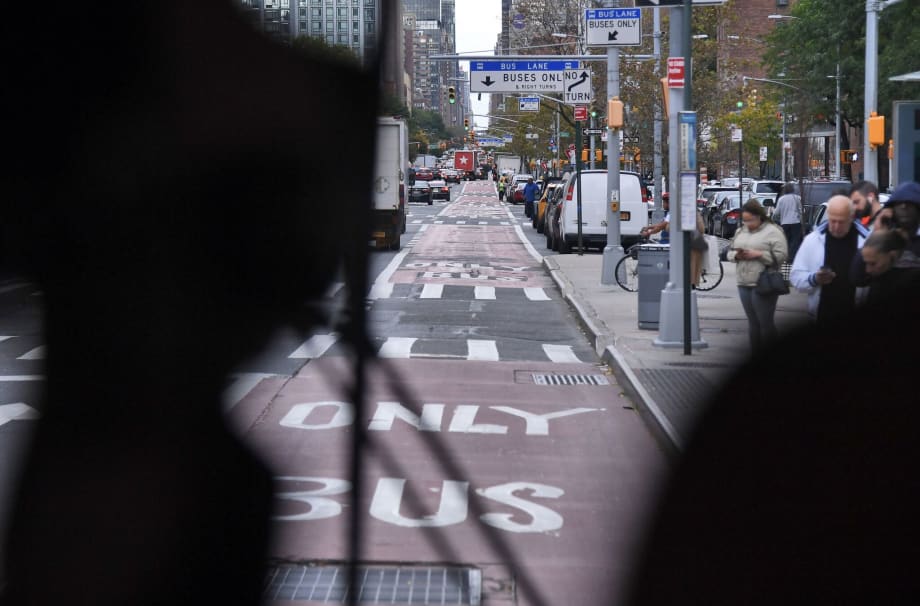
NYCT is using an Automated Bus Lane Enforcement system on 33 buses serving the B44 SBS route, which travels on approximately 10 miles of dedicated bus lanes implemented by the NYCDOT.
Marc A. Hermann / MTA New York City Transit
NYCT is using an Automated Bus Lane Enforcement system on 33 buses serving the B44 SBS route, which travels on approximately 10 miles of dedicated bus lanes implemented by the NYCDOT.
Marc A. Hermann / MTA New York City Transit
The MTA’s New York City Transit (NYCT) is using bus-mounted cameras to enforce dedicated bus lanes on its B44 Select Bus Service route to help speed up rides for a total of 37,000 customers. The MTA began enforcement with camera systems on the M15 SBS fleet in October to enhance the city’s traffic initiative to clear bus lanes, speed up rides, and prioritize transit on high-volume corridors.
NYCT is using an Automated Bus Lane Enforcement (ABLE) system on 33 buses serving the B44 SBS route, which travels on approximately 10 miles of dedicated bus lanes implemented by the New York City Department of Transportation (NYCDOT). ABLE camera systems capture evidence such as license plate information, photos, and videos, as well as location and timestamp information, of vehicles obstructing bus lanes to document bus lane violations. The system collects multiple pieces of evidence to ensure that vehicles making permitted turns from bus lanes are not ticketed. The package of evidence is transmitted to NYCDOT for review and processing, and the program is administered in partnership with NYCDOT and the NYC Department of Finance.
Motorists who remain in a bus lane without exiting at the first possible right turn, or they are captured as blocking the bus lane by two successive buses, are considered violating traffic laws and will be ticketed. During the initial 60-day grace period, motorists who block bus lanes are issued a warning that does not carry a fine. At the end of this grace period, motorists who continue to block bus lanes will be subject to a fine of $50 for the first violation, and for additional violations within a 12-month period: $100 for a second offense, $150 for a third offense, $200 for a fourth offense; and $250 for a fifth violation and each subsequent offense thereafter within a 12-month period.
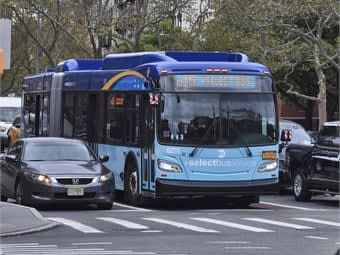
Motorists who remain in a bus lane without exiting at the first possible right turn, or they are captured as blocking the bus lane by two successive buses, are considered violating traffic laws and will be ticketed.
Marc A. Hermann / MTA New York City Transit
The graduated fine structure applies to the type of violation and is not specific to the bus route, therefore a motorist that is ticketed for blocking a bus lane on the M15 SBS and subsequently is caught blocking a bus lane on the B44 SBS route will be subject to a fine of $100 for the second offense within a 12-month period. The MTA’s bus-mounted cameras enhance NYCDOT’s use of stationary cameras on streets to enforce bus lanes, as well as NYPD’s initiatives to deter parking in bus lanes that began earlier this year.
The MTA’s bus-mounted camera enforcement program will expand to the M14 SBS by the end of November, with the ABLE system to be deployed on a total of 123 buses serving the M15 SBS, B44 SBS, and M14 SBS routes. The proposed 2020-2024 Capital Plan includes $85 million for further expansion of the program.
NYC Transit is working with NYCDOT and NYPD to increase bus lane enforcement in highly congested areas as part of NYC Transit’s Fast Forward plan to improve bus service, increase bus speeds, and attract new ridership. Results so far have yielded faster bus speeds by as much as 19% on a portion of Fifth Avenue and as much as 30% near the Hugh L. Carey Tunnel’s Manhattan approach. Other strategies include redesigning every borough’s bus network to better meet customer needs, installing traffic signal priority technology, implementing more transit priority street designs, and deploying new modern buses with better reliability and customer amenities.
More Bus

New York MTA Plans Largest Bus Fleet Upgrade in More Than a Decade
The agency is seeking manufacturers for 650 new CNG buses to replace aging vehicles, improve reliability, and advance its broader fleet modernization strategy.
Read More →
Building a Flexible Path to Transit Electrification
John Hroncich discusses BAE Systems’ modular and scalable approach, lessons learned from decades of real-world operations, and how agencies can identify electrification strategies that fit their fleets.
Read More →
Bus Tech Talk: Keeping Transit Technicians Ahead of the Technology Curve
LA Metro’s Obed Mejia discusses technician training, evolving maintenance technology, fleet replacement, and strategies for getting the most out of today’s transit fleets.
Read More →
Biz Briefs: RIPTA Unveils New Frontrunners, Clevland RTA Adds New Siemens, and More
In METRO's latest installment, we take a look at recent news from Siemens, Prevost, Dodge, and more partnerships making headlines across the transportation sector.
Read More →
People Movement: Holly Arnold Joins Transdev and More
In this edition, we also cover recent appointments and announcements at Pace, CamTran, MCI, and more, showcasing the individuals helping to shape the future of transportation.
Read More →
The High Cost of Transit Buses: Industry Leaders Look to Procurement Reform
Transit leaders and policymakers examine how standardized bus designs, streamlined procurement, and predictable funding could help agencies stretch budgets and deliver better service.
Read More →
The Business Voice Behind Public Transportation
As chair of APTA’s Business Members Board of Governors, Ray Melleady explains how more than 850 business members are partnering with transit agencies to advance funding, innovation, and industry-wide collaboration.
Read More →
From Surviving to Thriving: Building Stronger Transportation Organizations
Bus Business Consultants founder Brian Dickson shares lessons on leadership, organizational health, and creating options for long-term success in a changing transportation industry.
Read More →
Finding the ‘Happy Medium’: Optimizing Maintenance Without Sacrificing Reliability
The key to maintenance optimization isn’t doing less work—it’s doing the right work at the right time on the right assets.
Read More →
LA Metro, City of West Hollywood, and Partners Advance Smarter Bus Lane Enforcement
The award-winning partnership combines AI-powered detection with human oversight to improve bus reliability, accessibility, and enforcement efficiency.
Read More →