



New York MTA Surpasses 100M OMNY Taps
The agency's contactless payment system, OMNY, continues to gain increased share of overall fare payments. The system is set to replace the MetroCard in 2023.
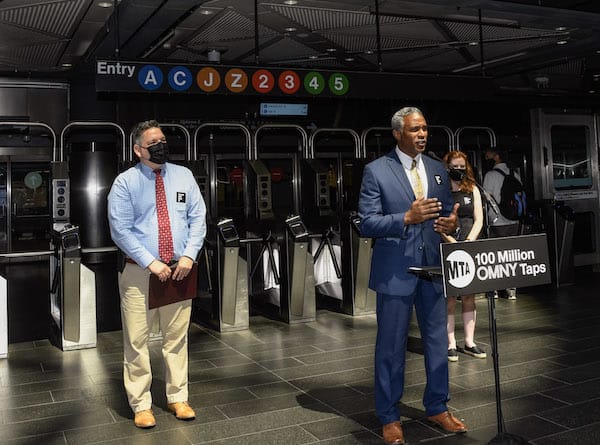
New York MTA officials announced the 100 millionth use of the OMNY tap-and-go fare payment system at a press conference at Fulton Transit Center on July 6.
New York MTA, Marc A. Hermann
New York’s Metropolitan Transportation Authority (MTA) announced that OMNY, the authority’s contactless fare payment system, recently surpassed 100 million taps. The figure marks an additional 25 million OMNY payments in the last two months alone.
OMNY, or One Metro New York, debuted to the public in 2019 during a pilot phase at 19 subway stations and on Staten Island buses. The rollout of the contactless system was completed in December 2020, with all 472 subway stations and the entirety of the MTA’s 5,800 bus-fleet now equipped with approximately 15,000 OMNY readers.
The OMNY readers process customer payments from smartphones, contactless bank cards, and wearable devices. In recent weeks, the system has recorded more than 600,000 taps a day. The nearly 17 million OMNY taps in June 2021 nearly tripled the number of taps from January 2021 (6.1 million).
Customers from 153 countries have now paid their fare using OMNY. Nearly 80% of OMNY taps came on the subway, the other fifth of taps largely coming on buses, and a remaining fraction on Staten Island Railway.
OMNY is set to completely replace the MTA’s MetroCard in 2023.
More Technology
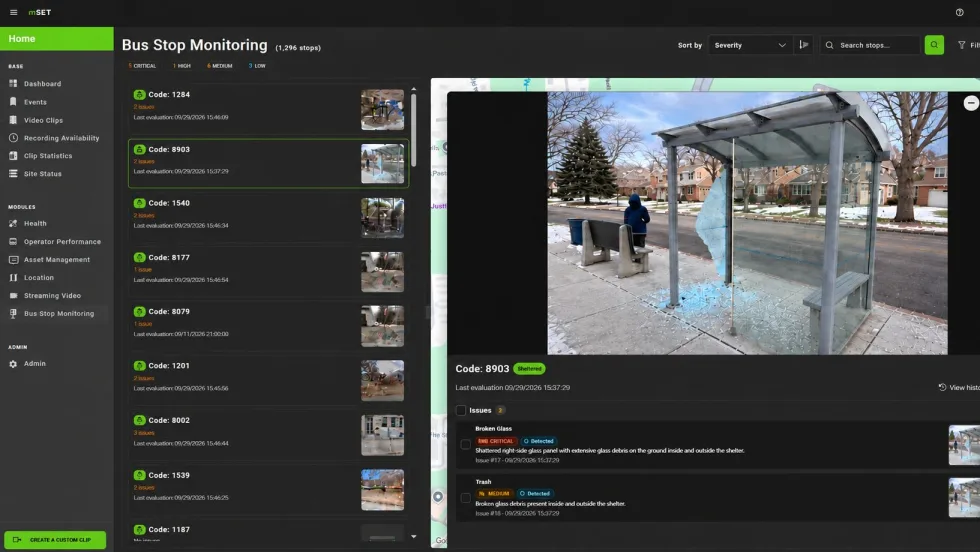
Biz Briefs: Luminator Launches AI Technology to Monitor Bus Stop Conditions and More
In METRO's latest installment, we also take a look at recent news from Masabi, Troman Industries, ioki, CCW, and more partnerships making headlines across the transportation sector.
Read More →
Public Transit Conference Returning to GFX in 2027, Call for Papers Now Open
The Call for Papers is now open, allowing transit agency professionals and industry experts to help shape the PTC educational program by submitting session ideas for consideration.
Read More →
ENC Lands MATA Contract and More in Biz Briefs
In this edition of Biz Briefs, we spotlight the latest developments shaping the future of mobility.
Read More →

Strada360’s Steve Lassey on Turning Transit Data Into Better Decisions
From breaking down data silos to preparing for AI, Strada360 CEO Steve Lassey discusses how transit agencies can use technology to improve operations, customer information, and long-term decision-making.
Read More →
Almaviva Looks to Open Architecture to Advance Transit Technology
Eric Reese discusses how interoperability, open architecture, and modular design can help transit agencies control costs, reduce vendor lock-in, and upgrade technology without starting over.
Read More →
Driving Smarter Paratransit
John Hanlon shares how AlphaRoute is leveraging AI-powered technology to help paratransit providers optimize operations, support frontline staff, and enhance the rider experience.
Read More →
From Hardware to Digital Partner: Luminator Charts Its Next Chapter
CEO Magnus Friberg discusses Luminator’s shift toward becoming a digital partner, the growing importance of software and interoperability, and how AI can help agencies improve operations and passenger experience.
Read More →
Beyond the Checklist: A Structured Approach to Transit Maintenance
Reliability-Centered Maintenance helps transit agencies move beyond routine checklists to focus limited resources on the assets and failures that have the greatest impact on safety, reliability, and service.
Read More →
NJ TRANSIT Advances Bus Technology Upgrades Across Statewide Fleet
More than 1,500 buses now feature upgraded technology designed to improve arrival predictions and provide free Wi-Fi, with deployment expected to reach nearly 2,000 buses by the end of 2026.
Read More →
Building a Flexible Path to Transit Electrification
John Hroncich discusses BAE Systems’ modular and scalable approach, lessons learned from decades of real-world operations, and how agencies can identify electrification strategies that fit their fleets.
Read More →