



NJ TRANSIT to add 772 MCI Commuter Coaches
The latest equipment purchase in a 33-year relationship, the $395 million order for clean diesel, cruiser-style coaches will offer NJ TRANSIT riders three-point seatbelts and comfortable forward-facing seating for 57 passengers.

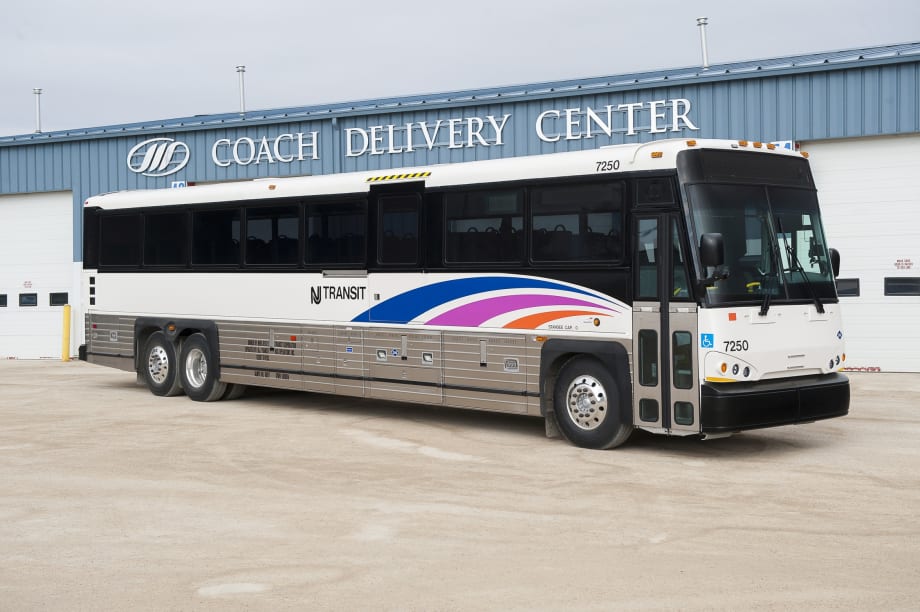
In one of the largest contracts between NJ TRANSIT and Motor Coach Industries (MCI), the agency’s board of directors authorized the purchase of 772 fully featured MCI 45-foot Commuter Coaches.
The latest equipment purchase in a 33-year relationship between NJ TRANSIT and MCI, the $395 million order for clean diesel, cruiser-style coaches will offer NJ TRANSIT riders three-point seatbelts, comfortable forward-facing seating for 57 passengers, as well as individual airflow controls and reading lights. The six-year delivery schedule for the new Commuter Coaches will begin in 2016.
The order will replace existing MCI coaches in New Jersey’s fleet. MCI has delivered over 2,000 Commuter Coaches to the agency since 1982. NJ TRANSIT was one of the first public transit operators to use the MCI Commuter Coach to reach outlying city and expanding suburban areas.
NJ TRANSIT estimates the new MCI Commuter Coaches will allow the agency to boost seating capacity by 6%.
The MCI Commuter Coach is renowned for its durability and quality; built with a rugged semi-monocoque structure that elevates passengers and drivers above traffic, while safety features including electronic stability control offer even more security.
Compliant with the Americans with Disabilities Act (ADA), the new coaches will offer cleaner engine technology with Diesel Exhaust Fluid (DEF) to reduce exhaust emissions required by the latest Clean Air Act amendment.
“We are tremendously honored that NJ TRANSIT has once again selected MCI,” said MCI President/CEO Rick Heller. “Our Commuter Coach has been the mainstay in its express service capabilities for decades. Today’s announcement for 772 additional vehicles marks another milestone in an important customer relationship centered on coach performance and innovation.”
The MCI Commuter Coach was the industry best-seller in the public sector in 2014. Heller points out that MCI’s long relationship with NJ TRANSIT has helped drive company sales records and innovation. MCI won its first contract with NJ TRANSIT in 1982 for 700 MC-9 cruiser buses, purchasing another 415 in 1987. In 2000, the agency gave MCI the biggest public transit order in North American bus-industry history at the time with a 1,400- vehicle purchase.
NJ TRANSIT was also the first U.S. public transit agency to purchase new-model CNG MCI Commuter Coaches, starting with a 50-coach order as part of a 1999 pilot program and adding 27 more units the following year. It recently replaced those inaugural models with 177 CNG MCI Commuter Coaches delivered in 2014 and 2015.
“MCI greatly values our relationship with NJ TRANSIT,” said Patrick Scully, MCI executive VP, sales and marketing. “Our newest models incorporate next-generation leaps in engine technology, efficiency, environmental innovation and passenger comfort. Our innovations will help New Jersey Transit to deliver reliability, value and environmental benefits to the riding public in the state. Furthermore, we’re committed to providing NJ TRANSIT with superior parts and service to support the agency’s strong reputation for dependable commuter express service.”
More Bus

People Movement: Dan Dipert Coaches Adds Third-Generation Leader, Keolis Names New Valley Metro VP/GM, and More
In this edition, we also cover recent appointments and announcements at the Wabtec, SilverRide, HNTB, and more, showcasing the individuals helping to shape the future of transportation.
Read More →
New York MTA Plans Largest Bus Fleet Upgrade in More Than a Decade
The agency is seeking manufacturers for 650 new CNG buses to replace aging vehicles, improve reliability, and advance its broader fleet modernization strategy.
Read More →
Building a Flexible Path to Transit Electrification
John Hroncich discusses BAE Systems’ modular and scalable approach, lessons learned from decades of real-world operations, and how agencies can identify electrification strategies that fit their fleets.
Read More →
Bus Tech Talk: Keeping Transit Technicians Ahead of the Technology Curve
LA Metro’s Obed Mejia discusses technician training, evolving maintenance technology, fleet replacement, and strategies for getting the most out of today’s transit fleets.
Read More →
Biz Briefs: RIPTA Unveils New Frontrunners, Clevland RTA Adds New Siemens, and More
In METRO's latest installment, we take a look at recent news from Siemens, Prevost, Dodge, and more partnerships making headlines across the transportation sector.
Read More →
People Movement: Holly Arnold Joins Transdev and More
In this edition, we also cover recent appointments and announcements at Pace, CamTran, MCI, and more, showcasing the individuals helping to shape the future of transportation.
Read More →
The High Cost of Transit Buses: Industry Leaders Look to Procurement Reform
Transit leaders and policymakers examine how standardized bus designs, streamlined procurement, and predictable funding could help agencies stretch budgets and deliver better service.
Read More →
The Business Voice Behind Public Transportation
As chair of APTA’s Business Members Board of Governors, Ray Melleady explains how more than 850 business members are partnering with transit agencies to advance funding, innovation, and industry-wide collaboration.
Read More →
From Surviving to Thriving: Building Stronger Transportation Organizations
Bus Business Consultants founder Brian Dickson shares lessons on leadership, organizational health, and creating options for long-term success in a changing transportation industry.
Read More →
Finding the ‘Happy Medium’: Optimizing Maintenance Without Sacrificing Reliability
The key to maintenance optimization isn’t doing less work—it’s doing the right work at the right time on the right assets.
Read More →