



NTSB unveils 2014 Top 10 'Most Wanted' improvements
Improving operational safety in rail transit made the list for the first time. The list also includes making improvements to occupant protection and fire safety, doing more to prevent distracted and impaired driving.

The National Transportation Safety Board (NTSB) released its 2014 Most Wanted List, the top 10 advocacy and awareness priorities for the agency for 2014, which for the first time includes improving operational safety in rail transit.
The NTSB in the past year has opened investigations into accidents involving New York Metropolitan Transportation Authority (MTA) Metro-North Railroad, Chicago Transit Authority and Oakland, Calif.-based Bay Area Rapid Transit District. Additionally, there are still open safety recommendations to the Washington Metropolitan Area Transit Authority stemming from its fatal crash in 2009.
In numerous accident investigation reports on public transportation, the NTSB has repeatedly identified the need for safety improvements, particularly with regard to safety culture and operational practices, in systems providing light, heavy and commuter rail.
"The traveling public relies on a safe and efficient transportation system. Yet, every year, we see over 35,000 fatalities," said NTSB Chairman Deborah A.P. Hersman. "That's why we have the Most Wanted List: Steps we can take today, so that more people make it home tonight."
Occupant protection is also new for 2014. While preventing accidents is always the goal, saving lives and reducing injuries in the event of an accident, is also critical. Increasing the use of available occupant protection systems and improving crashworthiness to preserve survivable space can mean the difference between life and death.
Also on the list:
Distraction: Accident investigations and safety studies conducted by the NTSB in all modes of transportation underscore the dangers of using portable electronic devices while operating a car, train, plane or marine vessel. In addition to banning the use of these devices while driving, education and company policies help to reinforce laws and regulations by explaining the dangers of distraction and what companies expect from their employees.
Fire Safety: The NTSB has issued numerous recommendations where fire was caused by power sources, as well as recommendations on survivability in the event of a fire and improving fire detection and suppression systems.
Positive Train Control (PTC): The NTSB has long been calling for PTC, which works by monitoring the location and movement of trains, then slowing or stopping a train that is not being operated in accordance with signal systems or operating rules. Just since 2004, the NTSB has completed investigations of 25 train accidents that killed 65, injured over 1,100 and caused millions of dollars in damages, all of which could have been prevented or mitigated by PTC.
Substance-Impaired Driving: In 2012 more than 10,000 traffic deaths in the U.S. involved an alcohol-impaired driver, according to NHTSA. Drugs also affect driving ability.
More Motorcoach

METRO Opens Submissions for 2026 Motorcoach Awards
Nominations are now being accepted for METRO Magazine’s Operator of the Year and Innovative Operator of the Year awards.
Read More →
Biz Briefs: Alstom Lands Canadian Contract, LYT to Supply California TSP, and More
In METRO's latest installment, we take a look at recent news from Complete Coach Works, Beep, FlixBus, and more partnerships making headlines across the transportation sector.
Read More →
Biz Briefs: RIPTA Unveils New Frontrunners, Clevland RTA Adds New Siemens, and More
In METRO's latest installment, we take a look at recent news from Siemens, Prevost, Dodge, and more partnerships making headlines across the transportation sector.
Read More →
People Movement: Holly Arnold Joins Transdev and More
In this edition, we also cover recent appointments and announcements at Pace, CamTran, MCI, and more, showcasing the individuals helping to shape the future of transportation.
Read More →
ABA Report: Motorcoach Travel Generates $161.6B Economic Impact
The 2025 analysis finds motorcoach travel supported nearly 900,000 jobs and generated $28 billion in federal, state, and local taxes.
Read More →
CharterUP’s Armir Harris on Technology, AI, and the Future of Group Mobility
In a recent episode of METROspectives, CharterUP Founder/CEO Armir Harris discussed the company’s evolution from an online charter bus marketplace into a technology platform supporting public- and private-sector mobility and much more.
Read More →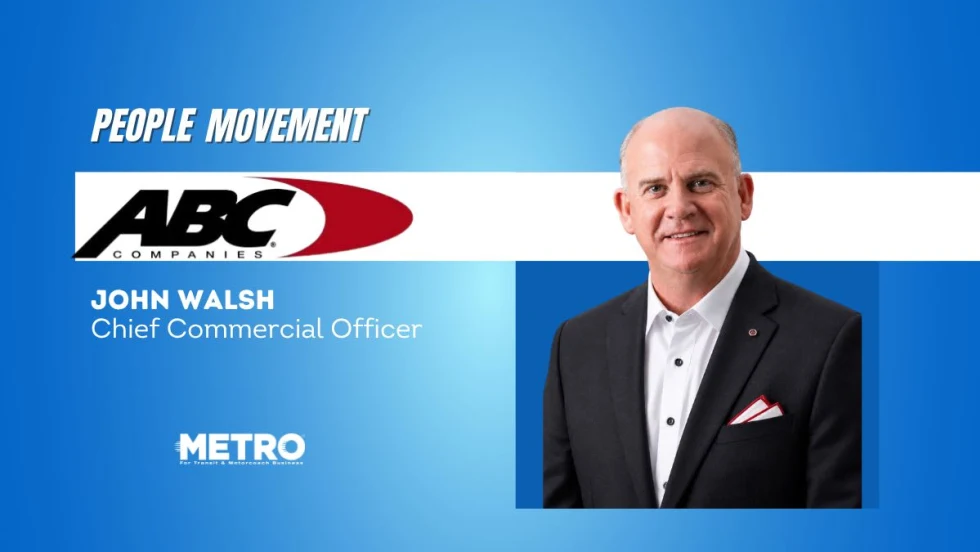
People Movement: ABC Names John Walsh as Chief Commercial Officer
In this edition, METRO also covers recent appointments and announcements at the DART, STV, and more, showcasing the individuals helping to shape the future of transportation.
Read More →
From Surviving to Thriving: Building Stronger Transportation Organizations
Bus Business Consultants founder Brian Dickson shares lessons on leadership, organizational health, and creating options for long-term success in a changing transportation industry.
Read More →
Biz Briefs: Luminator Marks Milestone and More
From manufacturers and suppliers to transit agencies and motorcoach operators, these updates offer a snapshot of the projects, partnerships and business moves driving the industry forward.
Read More →
ABAF Study Reveals Growing Insurance Crisis for Motorcoach Operators
Preliminary findings show 98% of operators faced premium increases over the past five years, while shrinking insurer participation is putting added pressure on businesses and customers.
Read More →