




Now Featured: Optibus Launches New 'Ridership Insights' Feature
Optibus Software Improves MV Transportation, LADOT Work Processes
Optibus said the collaboration reinforces a strong partnership through better insight into partners’ work processes.
September 22, 2022
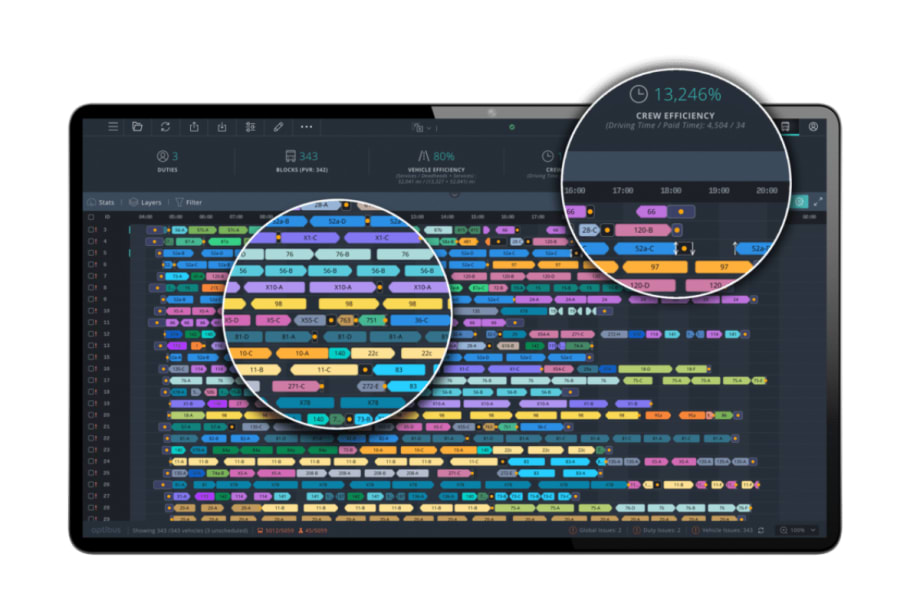
Data validation is crucial in ensuring quality services and a successful partnership, according to Optibus.
Photo: Optibus
5 min to read
The Los Angeles Department of Transportation's (LADOT) and MV Transportation's recent use of Optibus in both LADOT’s planners and MV’s schedulers have cut days off the planning process by reducing back-and-forth communication around data validation, according to Optibus' news release.
Optibus said the collaboration reinforces a strong partnership through better insight into partners’ work processes, resulting in fewer errors, more realistic client expectations, and better services for passengers.
Data validation is crucial in ensuring quality services and a successful partnership, according to Optibus. Operators need to ensure that every trip starts when it is supposed to and that headways and runtimes are correct at all times. However, manually checking every time point of every stop for errors can be a time-consuming task.
Liz Stayner, senior transit planning manager at MV, explained that when working with an agency that uses GTFS or that stores data in a manual or legacy system, “there's a lot of additional time that’s spent validating it to make sure there were no errors in the data source and everything matches what it should match.”
Stayner said things get even more complicated if an agency works with a third party to generate GTFS data.
“We’re talking about data that’s gone from one system into another and it’s now going into a third. If there’s a blank line or a time isn’t correct in a time point in the 57th trip of the day, you don't see that until you’re doing a true stare and compare,” said Stayner.
Jacob Brothers, enhanced technology program coordinator at LADOT, said that using multiple platforms doubled LADOT’s workload and forced them to review data “line by line, having to figure out what’s wrong with the feed before it will import,” even for minor errors.
By conducting all work within Optibus’ platform, MV and LADOT avoided those hurdles.
“When all of your data is in one space, there’s not as much time to spend in data validations and conversions and imports, so it’s a quicker workstream than if we’re using multiple platforms. So when we get the data from LADOT, it’s all ready,” said Stayner.
Using Optibus, MV sources its data directly from LADOT. LADOT sends MV the data through the Optibus platform, and MV imports the JSON file from LADOT’s domain into their own, according to Optibus. The data arrives in the correct format and there are no concerns about data validation because there haven’t been any conversions.
“When it’s built in the same system, you don't have the frequency of errors because it hasn't gone into three different formats since it was created,” said Stayner. “I know it’s a clean dataset for us to start working with.”
Stayner estimates that if MV and LADOT were not both using Optibus, each service change would cause a setback of “probably several days” between all the emails, phone calls, and screen sharing sessions that would be needed to replicate work on both the operator’s and agency’s systems.
“They have to verify that what I found is correct and then make changes on their side. We either make the changes on our side as well or we get new data. It’s definitely not something that is caught or able to be handled as quickly as when you’re working in the same system,” said Stayner.
Working off the same files and data in Optibus means LADOT and MV skip the back and forth and avoid miscommunication, enabling Stayner and her team to save as many as three days of work time.
“We have never had anything like Optibus before,” said Brothers. “For sure there were huge time savings.”
Optibus said it enables LADOT and MV to work collaboratively when support is needed, and independently when tasks can be completed more effectively alone.
In some cases, LADOT creates a schedule and sends it to MV to build within Optibus. MV sets the headways, conducts blocking, and ensures that scheduling aligns with vehicle availability.
“Within the [Optibus] timetable, you can see what blocking would look like [using Vehicle View],” said Stayner. “For the planners who are developing the schedules to have that capability and not have to go into the vehicle schedule to see what the capital needs are going to be for that particular service, that’s been quite cool.”
“If there are no scheduling changes, we are just moving a stop, we as an agency could push that out rather than waiting for MV,” said Brothers.
Brothers emphasized the value of being able to hop into Optibus and “eliminate that part of having [Liz] invest in it and just put out that feed ourselves.”
LADOT can manage that work independently - and without worrying that they will disrupt MV’s work - because Optibus said it helps LADOT catch errors in the advanced stages.
“[Optibus] won't allow us to schedule two trips at the same time,” Brothers explained. “This is a multi-level check to make sure the data is clean, our schedules match, and they make sense.”
According to Optibus, because both LADOT and MV are familiar with the platform, the parties collaboratively plan and deliver services, and the agency and operator gain insight into each other’s work.
“The agency understands what we’re doing and they understand the tools that we’re using. So I think there’s more realistic expectations on both sides of how long a process takes and what steps are needed,” Stayner explained. “They know what a realistic timeline looks like for moving the data, the schedule has been designed, and we know how long it is going to take to finish developing the schedule to having it operational.”
More Technology

From Hardware to Digital Partner: Luminator Charts Its Next Chapter
CEO Magnus Friberg discusses Luminator’s shift toward becoming a digital partner, the growing importance of software and interoperability, and how AI can help agencies improve operations and passenger experience.
Read More →
Beyond the Checklist: A Structured Approach to Transit Maintenance
Reliability-Centered Maintenance helps transit agencies move beyond routine checklists to focus limited resources on the assets and failures that have the greatest impact on safety, reliability, and service.
Read More →
NJ TRANSIT Advances Bus Technology Upgrades Across Statewide Fleet
More than 1,500 buses now feature upgraded technology designed to improve arrival predictions and provide free Wi-Fi, with deployment expected to reach nearly 2,000 buses by the end of 2026.
Read More →

Building a Flexible Path to Transit Electrification
John Hroncich discusses BAE Systems’ modular and scalable approach, lessons learned from decades of real-world operations, and how agencies can identify electrification strategies that fit their fleets.
Read More →
Biz Briefs: Alstom Lands Canadian Contract, LYT to Supply California TSP, and More
In METRO's latest installment, we take a look at recent news from Complete Coach Works, Beep, FlixBus, and more partnerships making headlines across the transportation sector.
Read More →
Sponsored•September 8, 2026
From Legacy Silos to Conversational Intelligence
What if transit leaders could ask any operational question and get a trusted answer in seconds? Conversational AI is transforming how agencies use their data.
Read More →
USDOT Announces Rail Vehicle Replacement Grants, Chattanooga AV Shuttle Funding
More than $191 million in federal funding will help three transit agencies replace aging rail vehicles and support a new autonomous shuttle service in Chattanooga.
Read More →
Bus Tech Talk: Keeping Transit Technicians Ahead of the Technology Curve
LA Metro’s Obed Mejia discusses technician training, evolving maintenance technology, fleet replacement, and strategies for getting the most out of today’s transit fleets.
Read More →
Biz Briefs: RIPTA Unveils New Frontrunners, Clevland RTA Adds New Siemens, and More
In METRO's latest installment, we take a look at recent news from Siemens, Prevost, Dodge, and more partnerships making headlines across the transportation sector.
Read More →
Why Simulating Pedestrian Movement Has Become Essential for Modern Rail Stations
Pedestrian microsimulation is helping rail planners identify bottlenecks, test station designs, and prepare complex transit hubs for growing passenger volumes.
Read More →