



Reno, Nev. Transit System Expands Services to Deal with Burgeoning Growth
The Regional Transportation Commission of Washoe County has a host of new BRT projects and has recently launched a mobile fare payment app.

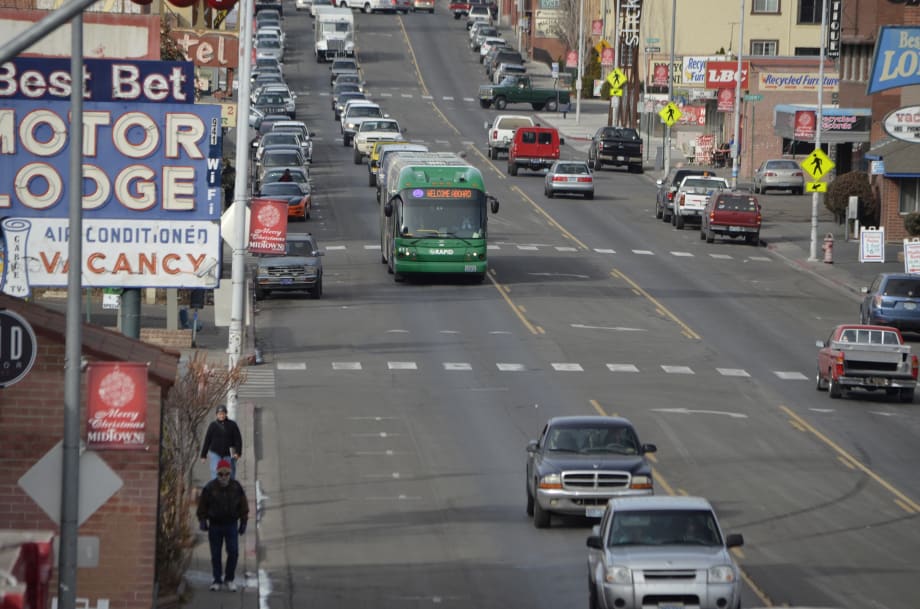
In addition to building BRT lines to deal with population growth and the stabilizing economy, the RTC is also developing bikeshare programs and looking for other ways to provide transportation services to the area using a multimodal approach.
In addition to building BRT lines to deal with population growth and the stabilizing economy, the RTC is also developing bikeshare programs and looking for other ways to provide transportation services to the area using a multimodal approach.
By Alex Roman, Managing Editor
Serving as the metropolitan planning organization, public transit operator, and street and highway agency for the Reno-Sparks metropolitan area and the unincorporated area in Washoe County, the Regional Transportation Commission of Washoe County (RTC) has a host of new projects in the works as it deals with population growth and continues to recover from the Great Recession.
“There has been great enthusiasm from the community to see what is happening and what is going to happen,” says Michael Moreno, the RTC’s public affairs administrator.
Building bus rapid transit systems
Currently under construction is its $58 million, 3.1-mile 4th Street & Prater Way BRT project, which will provide a direct connection between Reno’s 4th Street Station and Sparks’ Centennial Plaza transit station.
The project will feature ADA and safety improvements, enhanced pedestrian- and bicycle-friendly infrastructure, and aesthetic landscape treatments, as well as eight new stations.
“The 4th Street area was hit harder during the economic recession and experienced severe economic hardships,” says Jeff Wilbrecht, project manager for the RTC. “Our project is going to reconstruct the road and beautify the corridor, which will promote more activity and redevelopment.”
The corridor will be served by Proterra fully-electric buses with weekday peak and off-peak service operating on 10-minute headways; weekday evenings on 20-minute headways; and weekends on 20-minute headways. The new service, to be called the Lincoln Line for its historical significance, is estimated to increase annual ridership by approximately 180,000 trips and eliminate more than 40,000 annual vehicle trips.
“On the Reno side, the BRT line is next to a baseball park and many breweries, restaurants, and bars that are becoming trendier, while on the Sparks side, there is more of a small town feel with lots of communities and small businesses,” Wilbrecht explains.
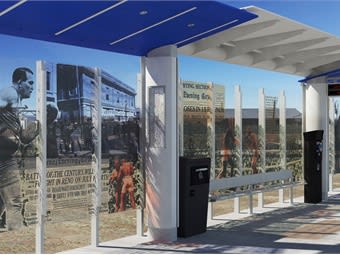
RTC’s 4th & Prater stations will integrate glass panels etched with historical photographs relevant to local cultural history.
Robust public outreach
A key to the development of the 4th Street & Prater Way BRT system was the RTC’s unique outreach approach, explains Moreno.
“The development of the project spanned a few years and a robust outreach program that included discussions with both the businesses in the area as well as residents,” he says. “A key part of the project was the oral history component we commissioned with a local historian to create a foundation and establish the significance of the corridor and what the community wanted to bring to it — improved connectivity and mobility for the community, as well as the redevelopment of an almost dilapidated corridor.”
Moreno attributes the RTC’s thoughtful approach to the agency’s Executive Director Lee Gibson.
“Prior to his appointment, the public for the most part had a very cynical view of how our agency developed projects,” he says. “Through our approach, stakeholders participate in the process and help us develop a project through consensus, which builds community support for the projects we develop and deliver. What is awesome about this way of doing business is we have gained a sincere respect from the public. They know we will listen to them. If they have ideas, we develop them if we are able to, but if we can’t, we let them know why we can’t develop them.”
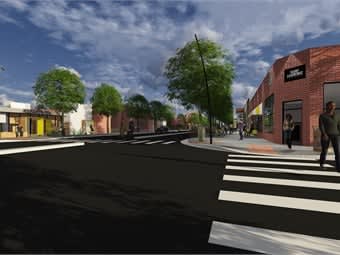
A rendering of the RTC’s Virginia Street corridor, which will connect the University of Nevada, Reno to downtown and midtown Reno.
Virginia Street bus rapid transit corridor
Also in development is the Virginia Street BRT extension, which is approximately 3.25-miles long and will provide a direct connection between the University of Nevada, Reno (UNR), downtown, and the midtown district. Eight new stations will be constructed or enhanced along the corridor, and like 4th & Prater, will include ADA and safety improvements, enhanced pedestrian- and bicycle-friendly infrastructure, and aesthetic treatments consistent with the neighborhood’s identity. The line will use the RTC 4th Street Station as its central hub.
“Today, we have about 30,000 students, faculty, and staff at UNR, which is located at the northern limits of the project, and for them to access the rest of the Virginia Street corridor, they have to transfer at the 4th Street Station, adding a 10- to 15-minute delay for those who want to get from UNR to downtown or midtown,” says Amy Cummings, director of planning, at the RTC. “This new system will really streamline travel and provide a quick connection to the jobs and resources the UNR community needs. We also have a lot of students living in the Virginia Street corridor.”
RTC plans to use all-electric articulated buses for service operating 10-minute headways during peak hours and 15-minute headways during off-peak and evening hours. The new service is estimated to increase annual ridership by approximately 180,000 trips and eliminate more than 30,000 annual vehicle trips, as well as provide access to thousands of jobs along both corridors.
“There is about 7,000 jobs within the 4th Street & Prater Way corridor that people will have access to, but the lines will also connect the resort corridor on Virginia Street, which has in excess of 35,000 jobs along with educational opportunities available through UNR and Truckee Meadows Community College’s main campus, as well as campuses they have south of downtown,” explains Moreno.
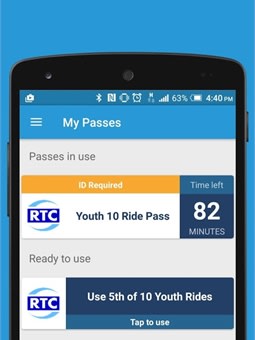
RTC's new Token Transit mobile app.
Bolstering transit agency's use of technology
In addition to building BRT lines to deal with population growth and the stabilizing economy, the RTC is also developing bikeshare programs and looking for other ways to provide transportation services to the area using a multimodal approach, including exploring the use of Uber and Lyft to provide paratransit trips.
Another major initiative that Gibson has taken on at the RTC is to increase the agency’s use of technology, he explains.
“We want to make sure that we have more accessibility for people to have information via technology,” he says. “One of my biggest concerns I have had over the years is making sure that people understand how to use our system, and the more information we can provide via a mobile device, the easier it is, I believe, for people to use the system.”
To that end, the RTC launched its Token Transit mobile fare payment app in December.
“The app really overcomes one of the big hurdles of using transit and that is getting on a bus and not knowing how much the fare is or shuffling around trying to roundup the proper fare,” says Ed Park, transit planner at RTC. “With the mobile fare payment app, riders can find out what all of our fare options are on their smartphones and buy tickets that are then validated by scanners when they board the bus. It’s a very simple process.”
Within four months after launching, the app was being used to pay fares on 4% of the agency’s approximate 600,000 rides per month, adds Park. The agency worked with Token Transit on the app and was actually the company’s first customers.
“There are definitely pros and cons to being the first customer. The con, of course, is they had never done a mobile phone payment system before, but the pro is, because we were their first customer, they were very attentive and really customized the app to fit our needs,” says Park. “We were very pleased with the level of attention and service they provided us and are very pleased with the product.”
Adoption of the new tech has been relatively smooth for the agency, Park explains, with the one major glitch being the tech savviness of its customers.
“We found that many of our customers only used their smartphones to access the internet, email, or to text, and were maybe not so familiar with apps, so we had to provide some training to them,” Park says.
He adds that while the agency is eventually looking to tie in trip-planning and first- and last-mile options like Uber and Lyft, its main focus is increasing the usage of the Token Transit app.
“Right now, we’re looking at getting this mobile app out there and getting people to adopt it, but the future is heading toward things like tying into Uber/Lyft and real-time information, so we do want to be there at the same time,” Park says.
More New Mobility

From Hardware to Digital Partner: Luminator Charts Its Next Chapter
CEO Magnus Friberg discusses Luminator’s shift toward becoming a digital partner, the growing importance of software and interoperability, and how AI can help agencies improve operations and passenger experience.
Read More →
Biz Briefs: Alstom Lands Canadian Contract, LYT to Supply California TSP, and More
In METRO's latest installment, we take a look at recent news from Complete Coach Works, Beep, FlixBus, and more partnerships making headlines across the transportation sector.
Read More →
CharterUP’s Armir Harris on Technology, AI, and the Future of Group Mobility
In a recent episode of METROspectives, CharterUP Founder/CEO Armir Harris discussed the company’s evolution from an online charter bus marketplace into a technology platform supporting public- and private-sector mobility and much more.
Read More →
Jacksonville’s NAVI Project Charts a New Course for Autonomous Public Transportation
Through its NAVI program, JTA is showing how autonomous vehicles, intelligent infrastructure, and coordinated operations can work together to deliver everyday public transportation.
Read More →
Biz Briefs: Luminator Marks Milestone and More
From manufacturers and suppliers to transit agencies and motorcoach operators, these updates offer a snapshot of the projects, partnerships and business moves driving the industry forward.
Read More →
New Tricks for Old Bureaucracies: Joshua Schank on Making Transit Innovation Stick
Former LA Metro Chief Innovation Officer Joshua Schank discusses why good ideas aren't enough, how transit agencies can overcome resistance to change, and why today's challenges demand more innovation.
Read More →
How DART's GoPass Is Redefining Regional Mobility
Serving 14 transit agencies, GoPass simplifies multimodal travel by allowing riders to plan, pay for, and manage an entire trip through one app.
Read More →
Biz Briefs: OCTA Taps Clean Energy for Hydrogen Station, Stadler to Supply Via Rail Vehicles, and More
From manufacturers and suppliers to transit agencies and motorcoach operators, these updates offer a snapshot of the projects, partnerships and business moves driving the industry forward.
Read More →CharterUP Expands Into New Mobility and Autonomous Transportation
Vice President of New Mobility Stephen Joos discusses how CharterUP is leveraging its nationwide transportation network, technology platform, and autonomous vehicle partnerships to expand into workforce mobility, campus shuttles, and transit solutions.
Read More →
METRO Magazine Announces 2026 Innovative Solutions Awards Winners
Projects Recognized for Advancing Mobility Through Technology, Accessibility, Workforce Innovation, and Operational Excellence
Read More →