




RELATED: LA Mayor creates zero-emissions mobility pilot fund
Report helps determine how much transit reduces pollution emissions
Researchers used tap-on tap-off rider data to quantify the emissions saved by buses and commuter rail lines.
August 27, 2019
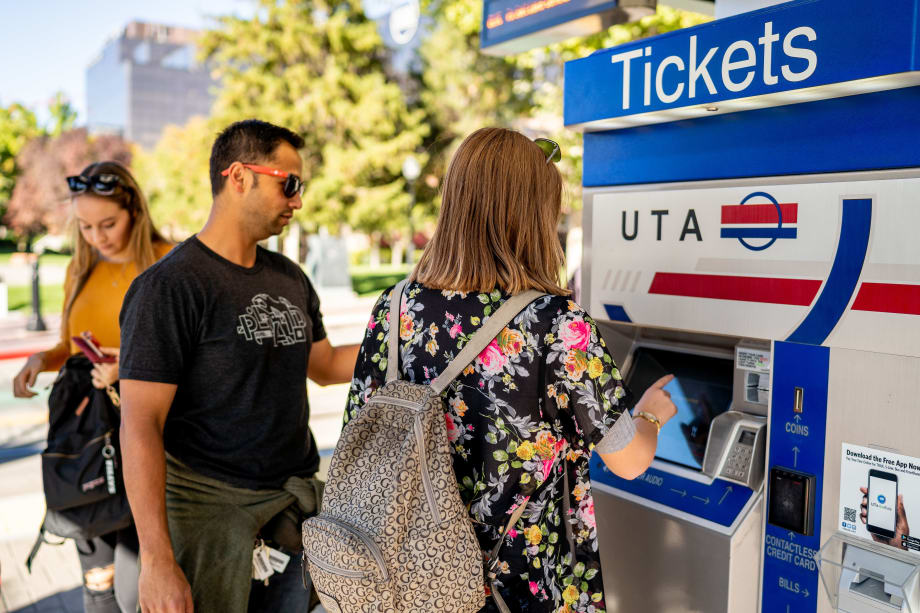
Approximately half of Utah Transit Authority passengers use an electronic fare medium.
University of Utah
3 min to read
Approximately half of Utah Transit Authority passengers use an electronic fare medium.
University of Utah
With the use of better rider tracking tools, a new report from the University of Utah and the Utah Transit Authority can better answer the question: How much does public transit reduce pollution emissions?
Researchers used tap-on tap-off rider data to quantify the emissions saved by buses and commuter rail lines, and also project how much additional emissions could be saved by upgrading the bus and rail fleet.
High-resolution rider data
A couple of recent technological advances have enabled University of Utah researchers Daniel Mendoza, Martin Buchert and John Lin to answer the question with a level of detail previously unparalleled.
The first is the advance of tap-on tap-off farecards that provide anonymized data on where those riders who have electronic passes enter and exit public transit. Approximately half of UTA’s passengers use an electronic fare medium. “Now we can truly quantify trips in both time and space,” Mendoza says. “We accounted for all of the 2016 passenger miles by scaling the farecard data, and we know which trips farecard holders make on buses, light rail and commuter rail.”
The second is the General Transit Feed Specification system. It’s the data source that supplies Google Maps with transit information to help users find the bus or train they need. With that data source, the researchers could track where and how often UTA’s buses and trains run.
So, with high-resolution data on the movement of both vehicles and passengers, the researchers could paint a nearly comprehensive picture of public transit along the Wasatch Front.
Balancing emissions
So, with that data, the researchers could quantify the emissions produced and miles traveled of the transit systems (TRAX light rail uses electricity produced outside the Wasatch Front, hence the emissions aren’t in Salt Lake’s air) and balance that with the miles traveled by passengers and the estimated amount of car travel avoided by riding transit.
On weekdays during rush hours, and in densely populated areas, the balance was clearly on the side of reduced emissions. “That tapers off significantly during the evening hours, on the outskirts of the city, and definitely during the weekends,” Mendoza says. In those situations, the number of passengers and how far they rode transit did not offset certain criteria pollutant emissions. (Criteria pollutants are six common air pollutants that the EPA sets standards for through the Clean Air Act.)
For transit to improve its regional reduction in emissions, particularly PM2.5 and NOx, the following strategies, alone or in combination, could be employed: more daily riders per trip, more clean-fuel buses and train cars and/or fewer low-ridership trips.
What-ifs
The current study looks at the bus and train fleet as they are now, with some UTA buses around 20 years old and FrontRunner trains whose engines are rated a Tier 0+ on a 0-4 scale of how clean a locomotive’s emissions are (Tier 4 is the cleanest; UTA is scheduled to receive funds programmed through the Metropolitan Planning Organizations to upgrade FrontRunner locomotives to Tier 2+). So, Mendoza and his colleagues envisioned the future.
“What if we upgrade all these buses, some of them from 1996 or so?” Mendoza says. “They emit a significantly larger amount than the newer buses, which are 2013 and newer.”
What if, they asked, UTA upgraded their buses to only 2010 models and newer, fueled by either natural gas or clean diesel? And what if the FrontRunner engines were upgraded to Tier 3?
Emissions of some pollutants would drop by 50%, and some by up to 75%, they found.
“Now, with this information, UTA can go to stakeholders and funding agencies and say, ‘Look, we’ve done this analysis,” Mendoza says. “This is how much less we can pollute.’”
The study was conducted in cooperation with the Utah Transit Authority and the Utah Department of Environmental Quality, Division of Air Quality.
More Management

METRO Opens Submissions for 2026 Motorcoach Awards
Nominations are now being accepted for METRO Magazine’s Operator of the Year and Innovative Operator of the Year awards.
Read More →
New York MTA Advances Final Contract for Second Avenue Subway Expansion
Contract Four is the largest in the Second Avenue Subway Phase 2 project and includes construction of station infrastructure, tracks, and signals for the subway expansion, MTA officials said. Work on Contract Four will begin in 2027.
Read More →
Transit Agencies Highlight Safety Gains at National Summit
Leaders from 15 major transit systems shared crime-reduction results and safety initiatives while discussing the role of continued federal support.
Read More →

NITA Names New Leadership, Expands Reduced-Fare Program at First Board Meeting
The new regional transit authority appointed its first board chair and interim executive director while extending reduced fares across CTA, Metra, and Pace for eligible riders.
Read More →
Beyond the Checklist: A Structured Approach to Transit Maintenance
Reliability-Centered Maintenance helps transit agencies move beyond routine checklists to focus limited resources on the assets and failures that have the greatest impact on safety, reliability, and service.
Read More →
APTA 2026 Nominating Committee Selects Leadership Slate, Names Chair and Vice Chair Nominees
Leadership changes will help shape the association’s priorities and its representation of the transportation industry during the 2026–2027 term.
Read More →
DART Launches Major Security, Fare Enforcement Initiative
The 90-day demonstration will deploy coordinated security teams at five light rail stations while testing controlled access and gathering data to guide future investments.
Read More →
Sponsored•September 9, 2026
Advancing Fare Collection Through Technology and Innovation
Learn about delivering 1300 gates at 91 stations while managing fare evasion. Explore the large scale deployment, solution customization and real-world results that affect the region. Prepare for deployment in your region now.
Read More →
Game Day in Motion: Moving Millions During the 2026 World Cup
Between packed transit stations and team motorcoaches, see how agencies and operators across North America tackled the transportation demands of the 2026 FIFA World Cup.
Read More →
Surface Transportation Extension Averts Shutdown, Leaves Transit Funding Gap
The stopgap keeps federal transportation programs moving, but missing advance funding could complicate the transit and rail projects agencies are planning next.
Read More →