




Fact Sheet: Strengthening Skills Training and Career Pathways across the Transportation Industry
Report IDs employment 'hot spots' in transportation sector
It also identifies good-paying, high-demand transportation jobs and analyzes the patterns in the education and work experience required for entry, including on-the-job training requirements for new entrants to gain full competency.
August 25, 2015
Photo: USDOT
3 min to read
Photo: USDOT
A newly released U.S. Departments of Transportation, Education, and Labor report details the future growth areas or employment “hot spots” in transportation by industry subsectors, occupations, career areas and geographic areas. It also identifies good-paying, high-demand transportation jobs and analyzes the patterns in the education and work experience required for entry, including on-the-job training requirements for new entrants to gain full competency.
“Careers in the transportation industry can lift Americans into the middle class or help them stay there, and this report concludes that there will be more job opportunities in the near future,” said U.S. Secretary of Transportation Anthony Foxx. “We want to fill all these new positions, so industry and government must increase recruitment and help young people get the skills, training, and apprenticeships they need to gain entry into these careers.”
The report, entitled “Strengthening Skills Training and Career Pathways across the Transportation Industry,” indicates that employers will need to hire and train a total of 4.6 million new workers — 1.2 times the current transportation workforce — due to expected growth, retirements, and turnover in the transportation industry from 2012 to 2022.
Projections suggest that 417,000 of these positions will be created as a direct result to increased demand on our transportation systems. The highest percentage of these jobs will be in transit and ground passenger transportation and these new openings will be concentrated in the West Coast, the Gulf Coast, the upper Mid-Atlantic, several Mountain States, and the Midwest.
Much of the regional transportation job growth is driven by growth in the large metropolitan areas within those regions — the highest number of job openings in transportation will likely be generated in New York City, Dallas, Los Angeles, Houston and Chicago. In addition, these jobs will pay relatively well. Thirteen out of the top 20 highest demand transportation jobs pay above the median wage, sometimes substantially.
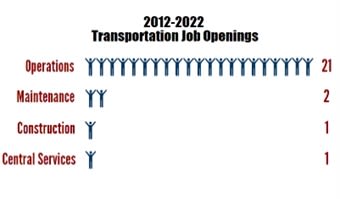
While demand for transportation workers will vary by region, subsector, and occupation, these workforce changes will result in increased job opportunities for skilled and semi-skilled workers across the transportation sector. For every future job opening in central services or construction in the transportation industry, there will be an estimated two jobs in maintenance and 21 in operations. The recruitment and training of new and current workers responsible for the operation, maintenance, and construction of America’s transportation infrastructure will be critical to maintaining a system that meets our economic and security needs in the 21st century global economy.
But the report also highlights a significant skills gap in the demand for and supply of high skilled workers; it indicates that projected annual job openings are 68% larger than the number of students who are completing related educational programs annually across selected transportation occupational groups. One solution is an increase in Career and Technical Education programs of study. Such programs begin in high school and continue into postsecondary education or apprenticeship and provide the foundational and early occupational skills training needed in skilled occupations. Pre-apprenticeship programs for disadvantaged youth and adults can prepare low-skilled and underrepresented populations for entry into these skilled positions. Furthermore, Career Pathways systems that are aligned with Registered Apprenticeship programs can expand the number of people who can access these high-demand jobs.
See more at: https://www.transportation.gov/us-departments-transportation-education-and-labor-release-joint-transportation-jobs-report#sthash.3ZoaMOaX.dpuf
More Management

METRO Opens Submissions for 2026 Motorcoach Awards
Nominations are now being accepted for METRO Magazine’s Operator of the Year and Innovative Operator of the Year awards.
Read More →
New York MTA Advances Final Contract for Second Avenue Subway Expansion
Contract Four is the largest in the Second Avenue Subway Phase 2 project and includes construction of station infrastructure, tracks, and signals for the subway expansion, MTA officials said. Work on Contract Four will begin in 2027.
Read More →
Transit Agencies Highlight Safety Gains at National Summit
Leaders from 15 major transit systems shared crime-reduction results and safety initiatives while discussing the role of continued federal support.
Read More →

NITA Names New Leadership, Expands Reduced-Fare Program at First Board Meeting
The new regional transit authority appointed its first board chair and interim executive director while extending reduced fares across CTA, Metra, and Pace for eligible riders.
Read More →
Beyond the Checklist: A Structured Approach to Transit Maintenance
Reliability-Centered Maintenance helps transit agencies move beyond routine checklists to focus limited resources on the assets and failures that have the greatest impact on safety, reliability, and service.
Read More →
APTA 2026 Nominating Committee Selects Leadership Slate, Names Chair and Vice Chair Nominees
Leadership changes will help shape the association’s priorities and its representation of the transportation industry during the 2026–2027 term.
Read More →
DART Launches Major Security, Fare Enforcement Initiative
The 90-day demonstration will deploy coordinated security teams at five light rail stations while testing controlled access and gathering data to guide future investments.
Read More →
Sponsored•September 9, 2026
Advancing Fare Collection Through Technology and Innovation
Learn about delivering 1300 gates at 91 stations while managing fare evasion. Explore the large scale deployment, solution customization and real-world results that affect the region. Prepare for deployment in your region now.
Read More →
Game Day in Motion: Moving Millions During the 2026 World Cup
Between packed transit stations and team motorcoaches, see how agencies and operators across North America tackled the transportation demands of the 2026 FIFA World Cup.
Read More →
Surface Transportation Extension Averts Shutdown, Leaves Transit Funding Gap
The stopgap keeps federal transportation programs moving, but missing advance funding could complicate the transit and rail projects agencies are planning next.
Read More →