



San Antonio's VIA unveils zoo-themed bus stop shelters
The stop serves VIA’s VIVA culture route and is part of VIA’s ongoing Passenger Amenities Improvement Program, which includes the improvement of 1,000 existing bus stops throughout the VIA service area.

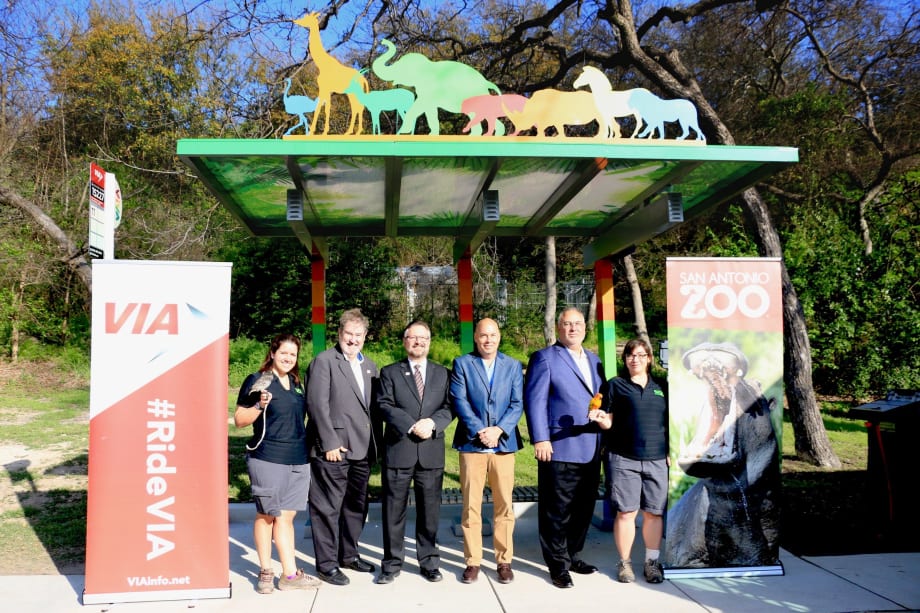
(L to R) Kara Campbell, Animal Care Specialist, San Antonio Zoo (holding “Twig”); Bob Comeaux, VIA Board of Trustees Member; Jeffrey C. Arndt, President/CEO, VIA Metropolitan Transit; Tim Morrow, CEO/Executive Director, San Antonio Zoological Society; A. David Marne, VIA Board of Trustees Member; Sara Escobedo, Animal Care Specialist, San Antonio Zoo (holding “Cindy”)
(L to R) Kara Campbell, Animal Care Specialist, San Antonio Zoo (holding “Twig”); Bob Comeaux, VIA Board of Trustees Member; Jeffrey C. Arndt, President/CEO, VIA Metropolitan Transit; Tim Morrow, CEO/Executive Director, San Antonio Zoological Society; A. David Marne, VIA Board of Trustees Member; Sara Escobedo, Animal Care Specialist, San Antonio Zoo (holding “Cindy”)
VIA Metropolitan Transit and San Antonio Zoo unveiled a custom-designed VIA bus shelter that connects visitors to the Broadway corridor and Will Smith Zoo School. The stop serves VIA’s VIVA culture route (11B) and is part of VIA’s ongoing Passenger Amenities Improvement Program, which includes the improvement of 1,000 existing bus stops throughout the VIA service area.
“The custom branding for this shelter was designed in partnership with San Antonio Zoo to create a unique experience for visitors — one that reflects the rich culture along the VIVA corridors” VIA President/CEO Jeffrey C. Arndt said. “Just as VIA connects us to opportunity, VIVA connects us to adventure and to destinations like the zoo that make the heart of San Antonio special. As we plan for the transportation needs of our region, partnerships like these ensure that our customers’ quality of life is enhanced through public transit options.”
This bus stop improvement brings the total number of sheltered stops in the VIA service area to more than 2,250. Streamlined and modern, the new Next-Gen shelter design provides comfortable, covered seating, and sidewalk and ADA improvements to assist all passengers in making travel safer and connections smoother.
“San Antonio Zoo is thrilled to be a part of the VIVA Culture route,” said Tim Morrow, CEO and executive director of San Antonio Zoo. “We’re excited to join with VIA Metropolitan Transit to unveil these new zoo-themed bus stops that will further enhance our beautiful city.”
The bus shelter is on St. Mary’s street, just a short walk from the Train Depot, San Antonio Zoo, Brackenridge Park, and the Japanese Tea Garden. Two other zoo-themed bus stops are on Tuleta Drive, giving San Antonians access to Alamo Stadium, Trinity University, and Will Smith Zoo School.
With its completion, VIA will now provide sheltered locations for 95% of boardings throughout its system. In keeping with VIA’s ongoing commitment to support local-, small-, and minority-owned businesses, approximately 73% of the work done in connection with the program went to DBE/SBE companies.
More Management

METRO Opens Submissions for 2026 Motorcoach Awards
Nominations are now being accepted for METRO Magazine’s Operator of the Year and Innovative Operator of the Year awards.
Read More →
New York MTA Advances Final Contract for Second Avenue Subway Expansion
Contract Four is the largest in the Second Avenue Subway Phase 2 project and includes construction of station infrastructure, tracks, and signals for the subway expansion, MTA officials said. Work on Contract Four will begin in 2027.
Read More →
Transit Agencies Highlight Safety Gains at National Summit
Leaders from 15 major transit systems shared crime-reduction results and safety initiatives while discussing the role of continued federal support.
Read More →

NITA Names New Leadership, Expands Reduced-Fare Program at First Board Meeting
The new regional transit authority appointed its first board chair and interim executive director while extending reduced fares across CTA, Metra, and Pace for eligible riders.
Read More →
Beyond the Checklist: A Structured Approach to Transit Maintenance
Reliability-Centered Maintenance helps transit agencies move beyond routine checklists to focus limited resources on the assets and failures that have the greatest impact on safety, reliability, and service.
Read More →
APTA 2026 Nominating Committee Selects Leadership Slate, Names Chair and Vice Chair Nominees
Leadership changes will help shape the association’s priorities and its representation of the transportation industry during the 2026–2027 term.
Read More →
DART Launches Major Security, Fare Enforcement Initiative
The 90-day demonstration will deploy coordinated security teams at five light rail stations while testing controlled access and gathering data to guide future investments.
Read More →
Advancing Fare Collection Through Technology and Innovation
Learn about delivering 1300 gates at 91 stations while managing fare evasion. Explore the large scale deployment, solution customization and real-world results that affect the region. Prepare for deployment in your region now.
Read More →
Game Day in Motion: Moving Millions During the 2026 World Cup
Between packed transit stations and team motorcoaches, see how agencies and operators across North America tackled the transportation demands of the 2026 FIFA World Cup.
Read More →
Surface Transportation Extension Averts Shutdown, Leaves Transit Funding Gap
The stopgap keeps federal transportation programs moving, but missing advance funding could complicate the transit and rail projects agencies are planning next.
Read More →