



San Diego MTS reduces costs, footprint with propane autogas buses
San Diego MTS will save about $5.8 million over the five- to seven-year lifecycle of the vehicles.


MTS will save about $5.8 million over the five- to seven-year lifecycle of the vehicles. The agency has put metrics in place to measure economic success. Photo courtesy San Diego MTS.
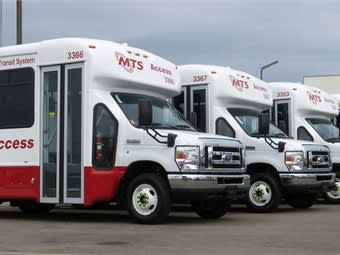
MTS will save about $5.8 million over the five- to seven-year lifecycle of the vehicles. The agency has put metrics in place to measure economic success. Photo courtesy San Diego MTS.
The San Diego Metropolitan Transit System (MTS) has increased its alternatively-fueled fleet by adding propane autogas buses. Along with its compressed natural gas (CNG) full-size buses, MTS is operating a fleet of 77 buses fueled by emissions-reducing, economical propane autogas. These propane-fueled buses help the agency lower its operating costs and reduce carbon intensity by 71%.
“Our agency was looking for an alternative fuel for our paratransit and minibus fleets,” said Jay Washburn, manager, paratransit and minibus, for MTS. “These Ford models provide the range we needed for our services, and the propane fuel technology gives us the lower greenhouse gas emissions that will help clear the air in our communities.”
MTS’s Propane Fleet
Included in the agency’s propane-fueled fleet are 31 minibuses and 46 paratransit buses. These buses are stationed at its Copley Park Division in Kearny Mesa where MTS operates 37 minibuses and 178 paratransit vehicles. In addition to paratransit services, the division covers 30 bus routes and serves about 1.3 million passengers annually. With the switch to propane, 35% of the Copley Park fleet is now operating on this clean, alternative fuel.
The minibuses are built on the Ford F-550 chassis and the paratransit buses are built on the Ford E-450 chassis. Each model is equipped with a Ford 6.8L V10 engine and a ROUSH CleanTech propane autogas fuel system. These propane models are certified by the California Air Resources Board and Environmental Protection Agency (EPA) for sale in all 50 states.
Real Cost Savings
MTS will save about $5.8 million over the five- to seven-year lifecycle of the vehicles. The agency has put metrics in place to measure economic success. It measures return on investment, miles per gallon, maintenance savings, and analysis as the vehicles age.
“Our return on investment for our propane paratransit and minibus fleets is less than two-and-a-half years,” said Washburn. “We typically use our minibuses for seven years, so that’s four-and-a-half years of pure savings. And, it’s even better for our paratransit buses that we operate for five years.”
Historically, propane autogas costs 40% less than gasoline and up to 50% less than diesel. The current gasoline price MTS pays is $2.20 per gallon, compared to the propane autogas price of $1.45 per gallon. The paratransit vehicles travel around 40,000 miles annually and the minibuses travel about 45,000 miles annually.
These cost savings are being funneled into other areas of operation to help MTS maintain the level of service that its customers expect.
Funds to Help Cost
The ROUSH CleanTech Ford E-450 has completed the Federal Transit Administration’s (FTA) New Model Bus Testing Program (Altoona Testing). MTS was able to purchase the buses using FTA funds.
Last year, the agency received an alternative fuel tax credit of 50 cents per gallon of propane, to further reduce per gallon fuel price. Although this federal Alternative Fuel Excise Tax expired, new legislation has been introduced in the House of Representatives to extend federal tax credits for fuels such as propane for the next five years.
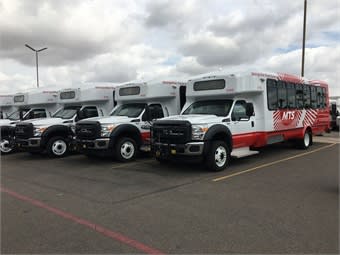
MTS will save about $5.8 million over the five- to seven-year lifecycle of the vehicles. The agency has put metrics in place to measure economic success. Photo courtesy San Diego MTS.
Emissions-Reducing Benefits
Propane autogas is a low carbon alternative fuel that reduces greenhouse gases by up to 25% and decreases carbon monoxide by 60%, while producing fewer particulate emissions versus gasoline. Over the lifetime of MTS’s fleet, more than 7.8 million pounds of carbon dioxide will be eliminated from its total carbon footprint — the equivalent of taking 747 passenger vehicles off the road for a year, according to the EPA’s equivalencies calculator.
“MTS is doing its part to reduce harmful emissions around the San Diego community by implementing buses fueled by propane autogas,” said Todd Mouw, VP, sales and marketing, at ROUSH CleanTech. “Propane autogas is a cleaner burning, domestically produced alternative fuel that also lowers total ownership costs.”
Fueling the Buses
Propane supplier Ferrellgas provides the fuel for MTS’s propane buses. Every night, Ferrellgas arrives to fuel the buses onsite. This has enabled MTS to have a fueling solution while its onsite propane autogas fueling station is being built. The agency expects the new station to be operational this fall.
Once the onsite fuel infrastructure is in place, the cost for propane will drop to $1.17 per gallon due to the agency’s contract with Ferrellgas. The infrastructure is also included in the contract and will come at no cost to the agency.
“The biggest lesson we learned, and that we would suggest to other agencies adopting propane buses, is to get the fuel station installed ahead of time,” Washburn said. “If we had to do it again, we would have had an onsite station installed before operating the vehicles, which would have saved in both cost and convenience.”
Recently, MTS purchased an additional 26 propane-fueled minibuses that will go into operation by the end of year. Within the next three years, the agency plans to operate a 100% alternatively-fueled fleet, with approximately 25% of the vehicles fueled by propane.
More Technology
Frontrunner Bus Group Introduces XF Low-Floor Bus with Enhanced Accessibility
The new mid-sized bus features a full flat-floor design, eight-inch curbside step-in height, and zero-entry rear ramp to improve passenger access and operational flexibility.
Read More →
Building a Flexible Path to Transit Electrification with BAE's John Hroncich
John Hroncich discusses BAE Systems’ modular and scalable approach, lessons learned from decades of real-world operations, and how agencies can identify electrification strategies that fit their fleets.
Read More →
Scenes from APTA TRANSform & EXPO 2026
Transit leaders, manufacturers, and industry professionals gathered in Chicago to explore new technologies, share ideas, and discuss the future of public transportation.
Read More →
Biz Briefs: New Flyer Secures Additional 100-Bus Order from WMATA and More
In METRO's latest installment, we also take a look at recent news from Masabi, MCI, Samsara, and more partnerships making headlines across the transportation sector.
Read More →
MTA Fare Gate Pilot Reduces Fare Evasion by 35%
Following a 20-station pilot, the agency plans to install new fare gates at 20 additional subway stations as part of a $1.1 billion modernization initiative.
Read More →
California Law Extends AC Transit’s Bus Lane Camera Enforcement
The new law allows AC Transit to continue using forward-facing bus cameras to enforce parking violations in bus-only lanes and at bus stops.
Read More →
Biz Briefs: Luminator Launches AI Technology to Monitor Bus Stop Conditions and More
In METRO's latest installment, we also take a look at recent news from Masabi, Troman Industries, ioki, CCW, and more partnerships making headlines across the transportation sector.
Read More →
Public Transit Conference Returning to GFX in 2027, Call for Papers Now Open
The Call for Papers is now open, allowing transit agency professionals and industry experts to help shape the PTC educational program by submitting session ideas for consideration.
Read More →
ENC Lands MATA Contract and More in Biz Briefs
In this edition of Biz Briefs, we spotlight the latest developments shaping the future of mobility.
Read More →
Strada360’s Steve Lassey on Turning Transit Data Into Better Decisions
From breaking down data silos to preparing for AI, Strada360 CEO Steve Lassey discusses how transit agencies can use technology to improve operations, customer information, and long-term decision-making.
Read More →