




Read More: Inside SEPTA Artist’s Augmented Reality Public Art Project
SEPTA, Drexel University Announce Station Naming Rights Agreement
Under a new naming rights agreement between SEPTA and Drexel University, the station will be transformed into Drexel Station at 30th Street.
December 22, 2023
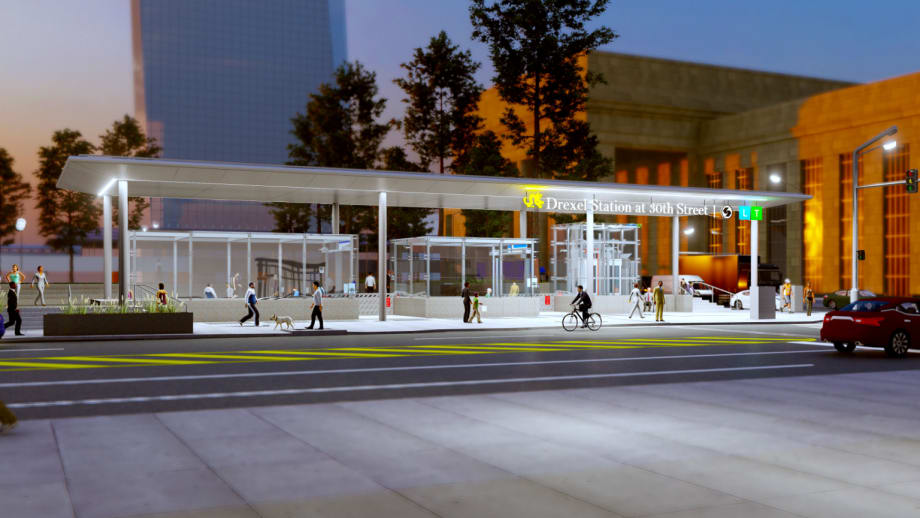
SEPTA and Drexel expect to unveil new signage and other enhancements for the transformation to Drexel Station at 30th Street early next year.
Photo: SEPTA
3 min to read
The Southeastern Pennsylvania Transportation Authority (SEPTA) announced that the 30th Street Station for the Market-Frankford Line and City Trolleys will soon include the name of a Philadelphia institution served by this transit hub.
Under a new naming rights agreement between SEPTA and Drexel University, the station will be transformed into Drexel Station at 30th Street. This marks SEPTA’s most recent station naming rights agreement.
“SEPTA is proud to partner with Drexel on this exciting naming rights agreement,” said SEPTA Board Chairman Pasquale T. Deon Sr. “These naming rights agreements are great opportunities for SEPTA to enhance service to the communities we serve and generate much-needed new revenues.”
The agreement gives Drexel exclusive naming rights for five years.
“We’re so proud to partner with SEPTA to put Drexel University’s name on the station that serves as the gateway for so many of our students, faculty, professional staff, and community partners as they arrive on campus,” said Drexel President John Fry. “As new educational, research, and business development opportunities continue to grow in West Philadelphia, it is fitting for Drexel to welcome everyone to University City.”
SEPTA 30th Street Station Details
The 30th Street Station serves as a gateway to both Center City and University City, with access to multiple transit modes, including the Market-Frankford Line, City Trolley routes, and buses. Regional Rail service is also available nearby at the William H. Gray III 30th Street Station.
Combined with the adjacent Drexel Square, Drexel Station at 30th Street will welcome visitors to Schuylkill Yards, a district Drexel is developing in partnership with Brandywine Realty Trust in University City.
Drexel Station is the latest step in the $3.5-billion Schuylkill Yards, which began with the opening of Drexel Square in 2019.
Drexel has also partnered with Brandywine, Spark Therapeutics, Gattuso Development Partners, and Wexford Science and Technology in an effort to equitably bolster the neighborhood’s economic opportunities. The university, through these partnerships, is creating new spaces for teaching and learning and for working and conducting research in life sciences and cell and gene therapy.
The naming agreement marks the latest development in Drexel’s longstanding relationship with SEPTA. The university was also one of the first partners in SEPTA’s Key Advantage Program in 2022, which offered benefit-eligible employees all-access SEPTA monthly transit passes.
“We are grateful to Drexel for recognizing SEPTA’s value to the city and region,” said SEPTA CEO/GM Leslie S. Richards. “We have long enjoyed a strong partnership with Drexel University, and we are proud to have their name on one of our flagship stations. We look forward to the official unveiling of Drexel Station at 30th Street in the coming months.”
Drexel Station at 30th Street is undergoing extensive renovations. Improvements include new elevators, a new headhouse, upgraded lighting, and enhanced safety and security features. SEPTA said it has been closely coordinating with Drexel and community stakeholders throughout the project.
SEPTA and Drexel expect to unveil new signage and other enhancements for the transformation to Drexel Station at 30th Street early next year.
More Management

METRO Opens Submissions for 2026 Motorcoach Awards
Nominations are now being accepted for METRO Magazine’s Operator of the Year and Innovative Operator of the Year awards.
Read More →
New York MTA Advances Final Contract for Second Avenue Subway Expansion
Contract Four is the largest in the Second Avenue Subway Phase 2 project and includes construction of station infrastructure, tracks, and signals for the subway expansion, MTA officials said. Work on Contract Four will begin in 2027.
Read More →
Transit Agencies Highlight Safety Gains at National Summit
Leaders from 15 major transit systems shared crime-reduction results and safety initiatives while discussing the role of continued federal support.
Read More →

NITA Names New Leadership, Expands Reduced-Fare Program at First Board Meeting
The new regional transit authority appointed its first board chair and interim executive director while extending reduced fares across CTA, Metra, and Pace for eligible riders.
Read More →
Beyond the Checklist: A Structured Approach to Transit Maintenance
Reliability-Centered Maintenance helps transit agencies move beyond routine checklists to focus limited resources on the assets and failures that have the greatest impact on safety, reliability, and service.
Read More →
APTA 2026 Nominating Committee Selects Leadership Slate, Names Chair and Vice Chair Nominees
Leadership changes will help shape the association’s priorities and its representation of the transportation industry during the 2026–2027 term.
Read More →
DART Launches Major Security, Fare Enforcement Initiative
The 90-day demonstration will deploy coordinated security teams at five light rail stations while testing controlled access and gathering data to guide future investments.
Read More →
Sponsored•September 9, 2026
Advancing Fare Collection Through Technology and Innovation
Learn about delivering 1300 gates at 91 stations while managing fare evasion. Explore the large scale deployment, solution customization and real-world results that affect the region. Prepare for deployment in your region now.
Read More →
Game Day in Motion: Moving Millions During the 2026 World Cup
Between packed transit stations and team motorcoaches, see how agencies and operators across North America tackled the transportation demands of the 2026 FIFA World Cup.
Read More →
Surface Transportation Extension Averts Shutdown, Leaves Transit Funding Gap
The stopgap keeps federal transportation programs moving, but missing advance funding could complicate the transit and rail projects agencies are planning next.
Read More →