



Oregon's TriMet Adopts Major Budget Cuts to Address Financial Shortfall
The board adopted the agency’s fiscal year 2027 budget, approving approximately $64.5 million in spending reductions, including about $53 million in administrative cuts and roughly $11 million in service reductions.

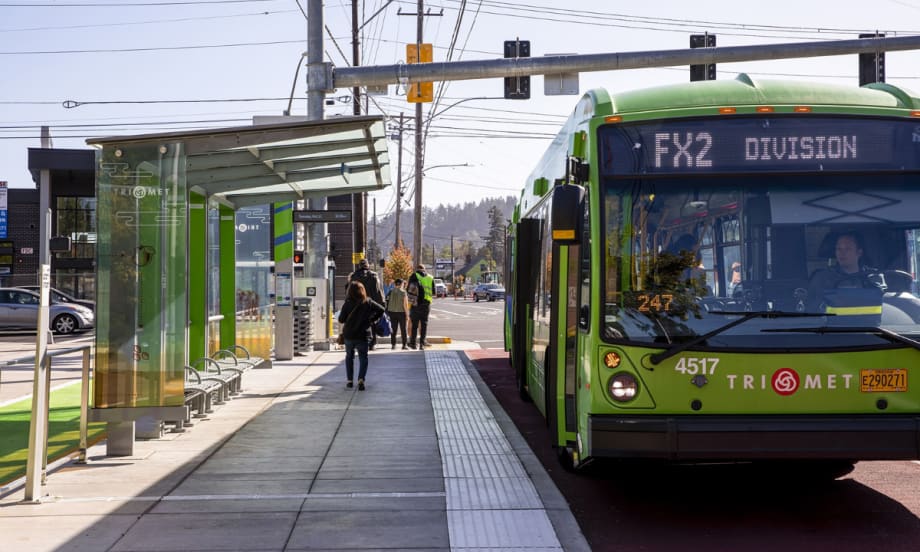
TriMet will also reduce service beginning Aug. 23, implementing changes to 33 lines previously approved by the board.
Photo: TriMet
- TriMet's board approved a budget for fiscal year 2027 with $64.5 million in spending reductions.
- The budget cuts include approximately $53 million in administrative expenses.
- There will be about $11 million in service reductions as part of the budget cuts.
*Summarized by AI
Portland, Oregon’s TriMet will implement major spending reductions and a historic staffing cut beginning July 1, as the agency works to address a growing structural budget deficit while maintaining core transit service across the region.
The TriMet board adopted the agency’s fiscal year 2027 budget, approving approximately $64.5 million in spending reductions, including about $53 million in administrative cuts and roughly $11 million in service reductions.
The adopted budget totals $1.75 billion, with $1.14 billion allocated for operations, service, maintenance, and capital projects. TriMet officials said the budget relies on $127 million in reserve funds to help close the gap between expenses and revenues.
The agency first announced a $300 million structural deficit in July 2025. Despite earlier spending cuts, staffing reductions, and postponed service expansions that generated approximately $150 million in savings, the agency said rising operating costs and lagging revenues have continued to widen the financial gap.
“We at TriMet have made historic investments in security, cleaning, and promoting service to increase ridership, but we must now resize our agency to reflect our current financial reality,” said GM Sam Desue Jr., in a statement.
Staffing and Service Reductions
A significant portion of the budget reductions will come through staffing cuts.
Beginning in the first quarter of FY2027, TriMet plans to eliminate approximately 400 positions, including about 140 currently vacant roles. Of the remaining affected positions, many union employees will have opportunities to return to previously held positions under agreements with Amalgamated Transit Union Local 757, said officials.
The agency estimates roughly 170 employees — including about 100 nonunion and 70 union workers — could face layoffs.
Combined with earlier reductions implemented in fall 2025, TriMet’s workforce will decline by more than 500 positions since July 2025.
Total budgeted positions will decrease from 3,708 to 3,204 once the latest reductions take effect.
TriMet will also reduce service beginning Aug. 23, implementing changes to 33 lines previously approved by the board.
The adjustments include eliminating two bus lines, shortening the MAX Green Line, and modifying routes to focus service in higher-ridership areas. The changes will reduce weekly bus service hours by approximately 3.1% and weekly MAX service hours by 8.7%.
The agency said additional rounds of service reductions could be considered next year as it continues evaluating long-term financial sustainability.
Rising Costs, Slower Revenue Growth
TriMet said operating costs have increased approximately 56% between 2019 and 2025, driven by higher prices for fuel, materials, equipment, and contracted services.
Fuel costs alone have risen sharply in 2026, with the agency citing impacts related to the situation in Iran.
At the same time, ridership remains about 30% below pre-pandemic levels despite a fare increase implemented in 2024. Payroll tax revenues — a key funding source for Oregon transit agencies — have also lagged due to high unemployment and slower economic growth in the region.
TriMet and other Oregon transit agencies had advocated for increased transit funding through the Statewide Transportation Improvement Fund (STIF). However, the Oregon Legislature did not approve a broader transportation funding package during the 2025 regular session, and a temporary STIF increase approved during a later special session was subsequently rejected by voters through Measure 120 in May 2026.
“This is a challenging time — not only for TriMet but for the region,” Desue said. “We urge lawmakers to join the Oregon Transit Association and us in seeking new strategies to address sustainable public transit funding.”
Continuing Investment in Safety, Reliability
Despite the cuts, officials said it will continue investing in safety and state-of-good-repair projects.
The FY2027 budget includes $217 million for capital projects, including $103.2 million dedicated to maintaining and modernizing buses, trains, and light rail infrastructure.
The agency also said its Security Operations Center, supported by more than 3,500 live-feed cameras and partnerships with local law enforcement agencies, will continue operating 24/7. According to TriMet, the center has contributed to faster response times and improved de-escalation efforts across the transit system.
Quick Answers
TriMet adopted major budget cuts to address a financial shortfall in its fiscal year 2027 budget.
*Summarized by AI
More Management

Bus Tech Talk: Keeping Transit Technicians Ahead of the Technology Curve
In this episode of Bus Tech Talk, Complete Coach Works’ Business Development Manager Mark Hollenbeck and METRO’s Executive Editor Alex Roman sit down with Obed Mejia, Senior Technical Trainer for Bus Maintenance, at LA Metro to discuss how rapidly evolving bus technology is changing the maintenance shop — and the skills technicians need to keep pace.
Read More →
Michael Schneider Joins Paslay Group to Expand Transportation Practice
The longtime transportation executive will help Paslay Group grow its advisory and program management work across transit, highway, and other infrastructure sectors.
Read More →
People Movement: Connectpoint Expands Leadership Team, Stadler Names New Group CEO, and More
In this edition, we also spotlight recent personnel moves at Burns, UZURV, and more, highlighting the people taking on new roles across the transportation industry.
Read More →
More Than a Summer Job: Building the Next Generation of Transit Talent
The Delaware River Port Authority and PATCO have transformed their internship program into a hands-on professional development experience that introduces students to the breadth of transportation careers — and creates a pipeline for future employees.
Read More →
LA Metro Board Awards 220 Battery-Electric Bus Contract to ENC
The contract, which is the largest base award of battery-electric buses by a U.S. transit agency, will be built in Southern California, sustaining good jobs as LA prepares to welcome the world in 2028
Read More →
What’s Behind San Diego MTS’s Award-Winning Transit Strategy
Named one of APTA’s 2026 Outstanding Public Transportation Systems with 50 million or more annual passenger trips, California’s San Diego Metropolitan Transit System points to gains in ridership, safety, technology, and reliability as foundations of its success.
Read More →
Public Transit Conference Returning to GFX in 2027, Call for Papers Now Open
The Call for Papers is now open, allowing transit agency professionals and industry experts to help shape the PTC educational program by submitting session ideas for consideration.
Read More →
Indian River Transit’s Community-Focused Approach Earns National Recognition
Named APTA’s 2026 Outstanding Public Transportation System in its size category, Florida’s Indian River County transit system continues to grow ridership through fare-free service and a focus on evolving community needs.
Read More →
ENC Lands MATA Contract and More in Biz Briefs
In this edition of Biz Briefs, we spotlight the latest developments shaping the future of mobility.
Read More →From Surviving to Thriving: Building Stronger Transportation Organizations
Bus Business Consultants founder Brian Dickson shares lessons on leadership, organizational health, and creating options for long-term success in a changing transportation industry.
Read More →