




RELATED: Stertil-Koni introduces high-performance, low-capacity hydraulic vehicle lift
Stertil-Koni adds new capabilities to transmission jack
The battery-operated jack can be charged overnight and used without cables. The pneumatic jack has an attached air hose to keep it working. Previously, transmission jacks were manually hand-pumped, much like a car jack.
February 9, 2017

2 min to read
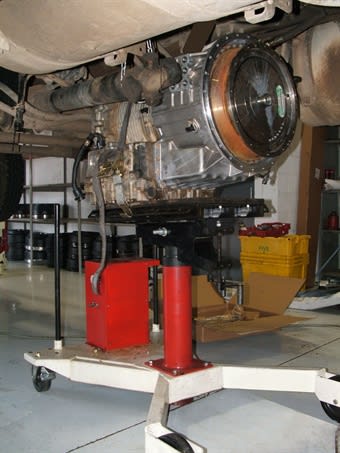
As buses and trucks grow ever larger and more complex, busy maintenance shops — particularly those serving transit agencies, public works departments, and school districts — are demanding new technologies that make the work environment both more safe and productive, according to heavy duty vehicle lift provider Stertil-Koni.
One of the most pressing needs remains: how to efficiently service truck and bus transmissions. The challenge is big.
“They are extremely heavy pieces of machinery (anywhere, from 1,500 lbs. to 3,000 lbs. each) that, when service is required, have to be manually removed from the undercarriage of the vehicle,” noted Peter Bowers, technical sales support manager at Stertil-Koni.
Enter the latest technologies that have been incorporated into the good old fashioned transmission jack (TJ), which is designed for the removal and installation of transmissions, differentials, and other components on heavy vehicles. They have proved to be ideal for servicing buses, trucks, industrial vehicles, and a broad range of construction equipment.
Now, the powerful TJ is bringing new capabilities to the shop floor, all courtesy of the latest advances:
Lifting capacities have been increased.
Newer “X” shaped base frames improve stability and access.
Base frames have been broadened for further steadiness.
Fine-tuning adjustments to place the TJ in the optimal position are now available.
Hydraulics have been added to make one-touch lifting and lowering a snap.
“Our transmission jacks have the highest capacity in the industry,” added Bowers. “What’s more, the fully-hydraulic telescopic system can support 3,500 pounds at a speed of 30-inches per minute with a lifting range of 37- to 74-inches. Further, full-swivel dolly wheels ensure a tight turning radius with mechanical locks for safety.”
Stertil-Koni TJs are constructed with heavy steel framing, assembled to the highest industry standards and are available in two formats — battery-operated and pneumatic. The battery-operated jack can be charged overnight and used without cables. The pneumatic jack has an attached air hose to keep it working. Previously, transmission jacks were manually hand-pumped, much like a car jack.
The adaptable transmission jack can be used for a variety of service jobs in transit or fleet maintenance facilities, including the servicing of transmissions, diesel particulate filters, gas tanks, rear and front differentials, and secondary auxiliary tasks that require lifting heavy loads in tight spaces.
More Bus

New York MTA Plans Largest Bus Fleet Upgrade in More Than a Decade
The agency is seeking manufacturers for 650 new CNG buses to replace aging vehicles, improve reliability, and advance its broader fleet modernization strategy.
Read More →
Building a Flexible Path to Transit Electrification
John Hroncich discusses BAE Systems’ modular and scalable approach, lessons learned from decades of real-world operations, and how agencies can identify electrification strategies that fit their fleets.
Read More →
Bus Tech Talk: Keeping Transit Technicians Ahead of the Technology Curve
LA Metro’s Obed Mejia discusses technician training, evolving maintenance technology, fleet replacement, and strategies for getting the most out of today’s transit fleets.
Read More →
Biz Briefs: RIPTA Unveils New Frontrunners, Clevland RTA Adds New Siemens, and More
In METRO's latest installment, we take a look at recent news from Siemens, Prevost, Dodge, and more partnerships making headlines across the transportation sector.
Read More →
People Movement: Holly Arnold Joins Transdev and More
In this edition, we also cover recent appointments and announcements at Pace, CamTran, MCI, and more, showcasing the individuals helping to shape the future of transportation.
Read More →
The High Cost of Transit Buses: Industry Leaders Look to Procurement Reform
Transit leaders and policymakers examine how standardized bus designs, streamlined procurement, and predictable funding could help agencies stretch budgets and deliver better service.
Read More →
The Business Voice Behind Public Transportation
As chair of APTA’s Business Members Board of Governors, Ray Melleady explains how more than 850 business members are partnering with transit agencies to advance funding, innovation, and industry-wide collaboration.
Read More →
From Surviving to Thriving: Building Stronger Transportation Organizations
Bus Business Consultants founder Brian Dickson shares lessons on leadership, organizational health, and creating options for long-term success in a changing transportation industry.
Read More →
Finding the ‘Happy Medium’: Optimizing Maintenance Without Sacrificing Reliability
The key to maintenance optimization isn’t doing less work—it’s doing the right work at the right time on the right assets.
Read More →
LA Metro, City of West Hollywood, and Partners Advance Smarter Bus Lane Enforcement
The award-winning partnership combines AI-powered detection with human oversight to improve bus reliability, accessibility, and enforcement efficiency.
Read More →