



Study finds Metrolink's rail system rebuild will create 1.3M jobs
The 10-year, $10B program to upgrade regional rail infrastructure, and improve commute times ahead of 2028 Olympics.

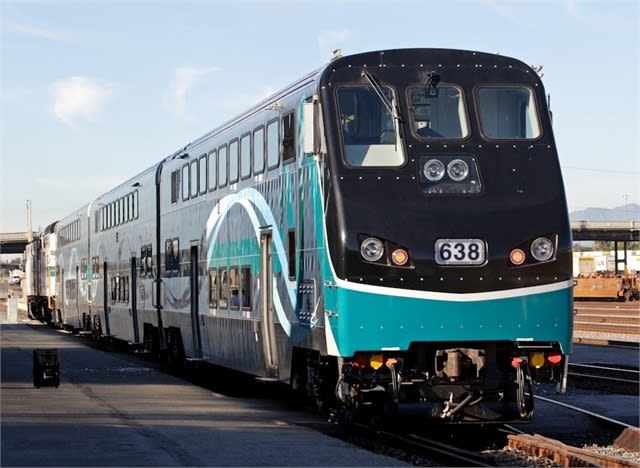
SCORE accelerates progress toward Metrolink’s zero-emissions future and provides safety upgrades that will allow some cities to apply for Quiet Zones.
Metrolink
SCORE accelerates progress toward Metrolink’s zero-emissions future and provides safety upgrades that will allow some cities to apply for Quiet Zones.
Metrolink
Southern California can expect an economic boost of 1.3 million jobs and an increase to the gross regional product of almost $684 billion through 2050 as the result of Metrolink’s Southern California Optimized Rail Expansion (SCORE) Program, according to a new Los Angeles County Economic Development Corporation (LAEDC) study. LAEDC presented the findings at a meeting of the Metrolink Board of Directors.
SCORE is a 10-year, $10 billion capital improvement program to upgrade regional rail infrastructure to better and more safely serve Southern California residents in the future while improving commute times and air quality in advance of the 2028 Los Angeles Olympic and Paralympic Games. Improvements include track additions and enhancements to stations, signals, and grade crossings that will bolster safety and enable more frequent, bi-directional service throughout the day.
SCORE also accelerates progress toward Metrolink’s zero-emissions future and provides safety upgrades that will allow some cities to apply for Quiet Zones. Quiet Zones are designated stretches of track where safety enhancements have been made to grade crossings so that the routine sounding of train horns is not required.
The State of California was the first funding partner for the SCORE program and Metrolink has secured $1.8 billion in funding to deliver preliminary designs and environmental studies for critical projects.
The study predicts that SCORE will create more than 1.3 million jobs through 2050, while the nine-year construction period alone will account for at least 110,000 jobs, paying an average of nearly $64,000 annually.
The LAEDC study also forecasted SCORE will increase wages by $185 billion over three decades and boost the region’s economic output by more than $1 trillion.
Metrolink commissioned the LAEDC to assess the impact of construction investment for SCORE and associated effects from forecasted changes in travel, regional labor accessibility, and reduced transportation costs from saved time.
The study indicates that SCORE benefits disadvantaged communities by connecting residents to the rail network, capable of quickly moving them through the five-county region enabling service at least every 30 minutes on all lines throughout the day when demand and funding exist.
SCORE’s environmental benefits include a reduction of 3.4 billion vehicle miles traveled between 2023 and 2078 and an elimination of 515.7 million metric tons of carbon dioxide equivalent in the same period. Additionally, the LAEDC projects SCORE will add 2.3 million pedestrian trips and 1.3 million bicycle trips each year.
More Rail

New York MTA Advances Final Contract for Second Avenue Subway Expansion
Contract Four is the largest in the Second Avenue Subway Phase 2 project and includes construction of station infrastructure, tracks, and signals for the subway expansion, MTA officials said. Work on Contract Four will begin in 2027.
Read More →
San Diego MTS Breaks Monthly Trolley Ridership Record
Agency officials said July’s ridership indicates MTS’s continued recovery from the pandemic.
Read More →
Report Examines NJ TRANSIT Reliability, Funding Challenges
The Garden State Initiative analysis examines the roles of Amtrak infrastructure, fleet management, and agency operations while recommending a more performance-based approach to improving reliability.
Read More →
Stadler, CapMetro Sign Long-Term Rail Fleet Support Agreement
Beginning in 2027, Stadler will provide on-site technical expertise, spare parts support, training, and obsolescence management to help extend the reliability and longevity of CapMetro’s GTW fleet.
Read More →
Biz Briefs: Alstom Lands Canadian Contract, LYT to Supply California TSP, and More
In METRO's latest installment, we take a look at recent news from Complete Coach Works, Beep, FlixBus, and more partnerships making headlines across the transportation sector.
Read More →
CATS Gold Line Marks 5 Years of Service, 2.8M Passenger Trips
With a six-mile expansion planned, the Charlotte streetcar is positioned to connect more neighborhoods and major transit hubs across the region.
Read More →
Why Simulating Pedestrian Movement Has Become Essential for Modern Rail Stations
Pedestrian microsimulation is helping rail planners identify bottlenecks, test station designs, and prepare complex transit hubs for growing passenger volumes.
Read More →
Amtrak Begins Major Construction at New York’s Sunnyside Yard
The new maintenance facility will support Amtrak’s Airo trainsets while improving maintenance efficiency and turnaround times in New York.
Read More →
Chicago Leaders Unveil Plans for O’Hare Airport Express Train
The privately developed project would offer a 15-minute trip between downtown and O’Hare’s Terminal 2, with trains operating every 15 minutes on a dedicated track. The service would use battery-electric trains and three existing freight rail rights-of-way.
Read More →
OCTA Maps Out 30-Year Strategy to Protect Coastal Rail Corridor
The draft feasibility report identifies strategies to protect the coastal rail line for decades as the agency continues near-term stabilization and sand placement efforts.
Read More →