



Sumwalt III sworn in as NTSB chairman
His tenure with the NTSB began in August 2006 with his appointment as the 37th member of the NTSB, whereupon President George W. Bush designated him as vice chairman for a two-year term.

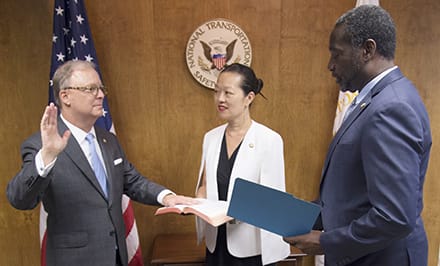
Robert L. Sumwalt III (left) was sworn in as the National Transportation Safety Board’s 14th Chairman during a brief ceremony held at NTSB headquarters. NTSB Board Member Bella T. Dinh-Zarr (center) NTSB Acting Managing Director Dennis Jones (right) (Photo by NTSB).
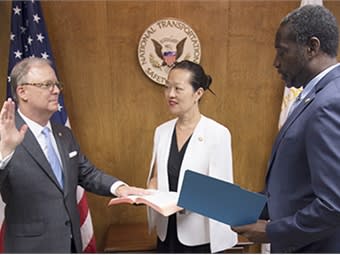
Robert L. Sumwalt III (left) was sworn in as the National Transportation Safety Board’s 14th Chairman during a brief ceremony held at NTSB headquarters. NTSB Board Member Bella T. Dinh-Zarr (center) NTSB Acting Managing Director Dennis Jones (right) (Photo by NTSB).
Robert L. Sumwalt III was sworn in as the National Transportation Safety Board’s (NTSB) 14th chairman during a brief ceremony.
Sumwalt’s nomination for a two-year term by was confirmed by the Senate earlier this month. Sumwalt has been serving as the agency’s acting chairman since late March 31 and has been a NTSB member since August 2006.
Acting Managing Director Dennis Jones presided over the ceremony attended by NTSB staff.
“The NTSB is commemorating 50 years of making transportation safer yesterday, today, and tomorrow, and I am humbled and honored to have the privilege of guiding the dedicated men and women of the NTSB as we take on the challenges of transportation safety in the 21st century,” said NTSB Chairman Robert Sumwalt. “Transportation technologies continue to advance and the NTSB must continue to increase the breadth and depth of our knowledge and understanding of transportation innovations, such as autonomous vehicles, intelligent infrastructure, commercial space transportation, hyper-speed rail, solar-powered planes, and new recording technologies. That knowledge enables us to craft safety recommendations that leverage technology to prevent accidents and save lives.”
Sumwalt tenure with the NTSB began in August 2006 with his appointment as the 37th member of the NTSB, whereupon President George W. Bush designated him as vice chairman for a two-year term. President Barack Obama reappointed Sumwalt to an additional five-year term as a board member in November 2011.
The NTSB has five board members, each nominated by the president and confirmed by the Senate to serve five-year terms. By statute, the president designates, with Senate confirmation, a chairman. The president also designates a board member as vice chairman, however, Senate confirmation is not required for the vice chairman. The vice chairman and chairman each serve two-year terms. When there is no designated chairman, the vice chairman serves as acting chairman. Board members whose terms expire may remain on the board until their replacement is appointed.
More Management

METRO Opens Submissions for 2026 Motorcoach Awards
Nominations are now being accepted for METRO Magazine’s Operator of the Year and Innovative Operator of the Year awards.
Read More →
New York MTA Advances Final Contract for Second Avenue Subway Expansion
Contract Four is the largest in the Second Avenue Subway Phase 2 project and includes construction of station infrastructure, tracks, and signals for the subway expansion, MTA officials said. Work on Contract Four will begin in 2027.
Read More →
Transit Agencies Highlight Safety Gains at National Summit
Leaders from 15 major transit systems shared crime-reduction results and safety initiatives while discussing the role of continued federal support.
Read More →

NITA Names New Leadership, Expands Reduced-Fare Program at First Board Meeting
The new regional transit authority appointed its first board chair and interim executive director while extending reduced fares across CTA, Metra, and Pace for eligible riders.
Read More →
Beyond the Checklist: A Structured Approach to Transit Maintenance
Reliability-Centered Maintenance helps transit agencies move beyond routine checklists to focus limited resources on the assets and failures that have the greatest impact on safety, reliability, and service.
Read More →
APTA 2026 Nominating Committee Selects Leadership Slate, Names Chair and Vice Chair Nominees
Leadership changes will help shape the association’s priorities and its representation of the transportation industry during the 2026–2027 term.
Read More →
DART Launches Major Security, Fare Enforcement Initiative
The 90-day demonstration will deploy coordinated security teams at five light rail stations while testing controlled access and gathering data to guide future investments.
Read More →
Advancing Fare Collection Through Technology and Innovation
Learn about delivering 1300 gates at 91 stations while managing fare evasion. Explore the large scale deployment, solution customization and real-world results that affect the region. Prepare for deployment in your region now.
Read More →
Game Day in Motion: Moving Millions During the 2026 World Cup
Between packed transit stations and team motorcoaches, see how agencies and operators across North America tackled the transportation demands of the 2026 FIFA World Cup.
Read More →
Surface Transportation Extension Averts Shutdown, Leaves Transit Funding Gap
The stopgap keeps federal transportation programs moving, but missing advance funding could complicate the transit and rail projects agencies are planning next.
Read More →