




RELATED: $300M in University Transportation Center grants announced
Texas A&M Transportation Institute, partners explore bus system optimization
Project will attempt to optimize traffic flows for bus ridership and utilize data analytics to improve navigation at Texas A&M University.
July 24, 2017
Texas A&M
3 min to read
Texas A&M
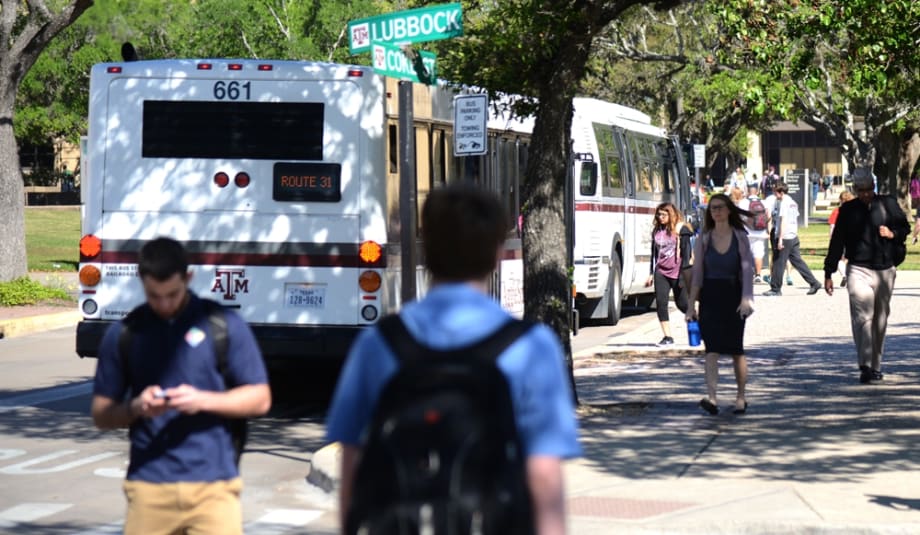
Texas A&M Transportation Institute (TTI) and Aruba, a Hewlett Packard Enterprise company, announced an exploratory transportation project to optimize traffic flows for bus ridership and utilize data analytics to improve navigation at Texas A&M University through Aruba Wireless and Data Analytics.
Texas A&M University is one of the largest universities in the U.S. with a College Station-based student population of 61,000, and a 5,200-acre campus. At Texas A&M, the Texas A&M Transportation Services Department operates the university’s transit system with 98 buses and 7.5 million annual riders. The initiative is taking place through the Campus Transportation Technology Initiative (CTTI), which seeks to bring private sector transportation innovation into the campus community to improve mobility, safety, and quality of life.
Like many large universities, navigating the campus, and using a mix of parking, transit, and walking to various destinations can be challenging across a diverse mix of students, faculty, staff, and visitors. TTI and Transportation Services partnered with Aruba and Skyfii to implement a pilot project at some of the busiest stopping points on the main campus. Aruba and Skyfii are the first technology vendors under the initiative to partner with TTI to support a big data and IoT initiative.
Initial results have provided insight into rider dwell time, as well as dispersal patterns after riders exit the bus. Though in the early stages of data collection, researchers are already gaining insights into the percentage of visitors who travel to certain venues on campus, the dwell times associated with various venues, and the busiest transit days and hours of the week.
“Our primary goal is to examine the optimization of bus stops in the implementation area,” said Robert Brydia, TTI senior research scientist. “If a high percentage of visitors move from the current stop location to other venues where there are spaces for transit stops, perhaps stop locations on routes should be adjusted. Our new data analytics will give us this information, and we can adjust our system accordingly.”
To track and monitor traffic flows related to bus ridership, Texas A&M deployed Aruba’s outdoor access points for dense outdoor Wi-Fi coverage and location triangulation at the most-used bus stop on campus. For data analytics, TTI is using Aruba’s Analytics and Location Engine, and Skyfii’s cloud-based data visualization and analytics.
Expansion of the pilot project could utilize the Aruba technology to implement pedestrian-flow diagrams across the entire university to help establish a dedicated campus-wide pedestrian and bicycle pathway. This data could also be used at Texas A&M’s football stadium, Kyle Field, to help ensure efficient entry and exit patterns.
By analyzing the transit system and pedestrian routing and looking for increased efficiencies, the potential exists for this initiative to increase the value of the transit system to the campus community and make the campus easier to navigate for students, staff, faculty, and visitors.
More Bus

New York MTA Plans Largest Bus Fleet Upgrade in More Than a Decade
The agency is seeking manufacturers for 650 new CNG buses to replace aging vehicles, improve reliability, and advance its broader fleet modernization strategy.
Read More →
Building a Flexible Path to Transit Electrification
John Hroncich discusses BAE Systems’ modular and scalable approach, lessons learned from decades of real-world operations, and how agencies can identify electrification strategies that fit their fleets.
Read More →
Bus Tech Talk: Keeping Transit Technicians Ahead of the Technology Curve
LA Metro’s Obed Mejia discusses technician training, evolving maintenance technology, fleet replacement, and strategies for getting the most out of today’s transit fleets.
Read More →
Biz Briefs: RIPTA Unveils New Frontrunners, Clevland RTA Adds New Siemens, and More
In METRO's latest installment, we take a look at recent news from Siemens, Prevost, Dodge, and more partnerships making headlines across the transportation sector.
Read More →
People Movement: Holly Arnold Joins Transdev and More
In this edition, we also cover recent appointments and announcements at Pace, CamTran, MCI, and more, showcasing the individuals helping to shape the future of transportation.
Read More →
The High Cost of Transit Buses: Industry Leaders Look to Procurement Reform
Transit leaders and policymakers examine how standardized bus designs, streamlined procurement, and predictable funding could help agencies stretch budgets and deliver better service.
Read More →
The Business Voice Behind Public Transportation
As chair of APTA’s Business Members Board of Governors, Ray Melleady explains how more than 850 business members are partnering with transit agencies to advance funding, innovation, and industry-wide collaboration.
Read More →
From Surviving to Thriving: Building Stronger Transportation Organizations
Bus Business Consultants founder Brian Dickson shares lessons on leadership, organizational health, and creating options for long-term success in a changing transportation industry.
Read More →
Finding the ‘Happy Medium’: Optimizing Maintenance Without Sacrificing Reliability
The key to maintenance optimization isn’t doing less work—it’s doing the right work at the right time on the right assets.
Read More →
LA Metro, City of West Hollywood, and Partners Advance Smarter Bus Lane Enforcement
The award-winning partnership combines AI-powered detection with human oversight to improve bus reliability, accessibility, and enforcement efficiency.
Read More →