



TfL orders world-first hydrogen double-decker buses to help tackle London’s toxic air
Twenty British-built zero-emission hydrogen buses, from Wrightbus in Northern Ireland, will arrive next year.

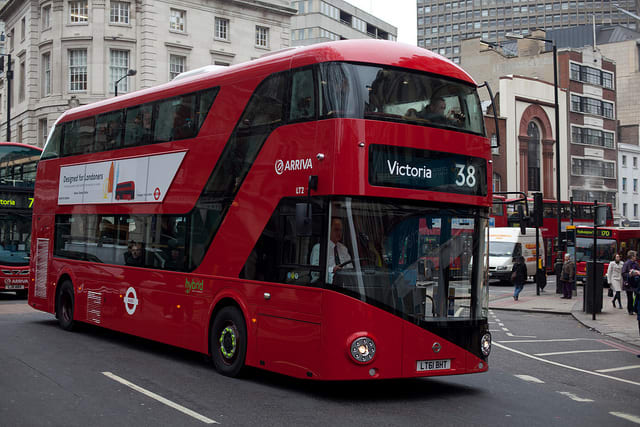
One of Transport for London's current Routemaster's from 2012.
Transport for London
One of Transport for London's current Routemaster's from 2012.
Transport for London
The world's first hydrogen double-decker buses will be introduced on three London bus routes next year, helping tackle the capital's air quality crisis.
Transport for London (TfL) ordered 20 of these green buses — which produce no pollution from their exhausts — as part of its drive to make London's transport zero-emission. It follows the introduction of the world's first Ultra Low Emission Zone last month.
The environment-friendly vehicles will be introduced on three routes, with people traveling to Wembley Stadium, or from west London to the West End, able to hop on the new green buses for a smoother and quieter journey. The new, modern buses will also enhance the customer experience, with on-board USB charging points making bus travel even more attractive.
TfL is investing $15 million in the new buses and the fuelling infrastructure. Wrightbus in Northern Ireland will manufacture them, creating new jobs in the region. More than $6 million of funding is being provided by European bodies and $1.3 million from the Office of Low Emission Vehicles.
To encourage the take-up of this trailblazing technology in other cities in the UK and Europe, TfL is leading procurement within the "Joint Initiative for hydrogen Vehicles across Europe" (JIVE) project. JIVE aims to bring down the cost of the vehicles by buying in bulk with other authorities — helping put the price per bus on a par with the other cleanest fuels.
Greening transport in the capital will require using a range of clean power sources. Hydrogen buses can store more energy on board than equivalent buses, meaning they can be deployed on longer routes. They only need to be refuelled once a day for five minutes, making them much quicker to power up when compared with conventional battery-electric buses.
The double-decker hydrogen buses will expand TfL's growing number of zero-emission buses. There are currently a total of 165 zero-emission buses, with a further 68 electric double-deckers on the roads by the summer. TfL has also recently announced that the route 323 will become fully electric next year, along with two further routes, which will be announced later this month.
More Bus

Report: Transit Bus Manufacturing Supports 34,100 Jobs, $5.1B in GDP
The “Buses Mean Business” report examines the transit bus manufacturing industry’s economic footprint, supply chain, and rising demand for vehicle replacements.
Read More →
Biz Briefs: New Flyer Delivers in Columbus, Houston, Beep and Freebee Merge, and More
In this edition of Biz Briefs, we spotlight the latest developments shaping the future of mobility.
Read More →
People Movement: Dan Dipert Coaches Adds Third-Generation Leader, Keolis Names New Valley Metro VP/GM, and More
In this edition, we also cover recent appointments and announcements at the Wabtec, SilverRide, HNTB, and more, showcasing the individuals helping to shape the future of transportation.
Read More →
New York MTA Plans Largest Bus Fleet Upgrade in More Than a Decade
The agency is seeking manufacturers for 650 new CNG buses to replace aging vehicles, improve reliability, and advance its broader fleet modernization strategy.
Read More →
Building a Flexible Path to Transit Electrification
John Hroncich discusses BAE Systems’ modular and scalable approach, lessons learned from decades of real-world operations, and how agencies can identify electrification strategies that fit their fleets.
Read More →
Bus Tech Talk: Keeping Transit Technicians Ahead of the Technology Curve
LA Metro’s Obed Mejia discusses technician training, evolving maintenance technology, fleet replacement, and strategies for getting the most out of today’s transit fleets.
Read More →
Biz Briefs: RIPTA Unveils New Frontrunners, Clevland RTA Adds New Siemens, and More
In METRO's latest installment, we take a look at recent news from Siemens, Prevost, Dodge, and more partnerships making headlines across the transportation sector.
Read More →
People Movement: Holly Arnold Joins Transdev and More
In this edition, we also cover recent appointments and announcements at Pace, CamTran, MCI, and more, showcasing the individuals helping to shape the future of transportation.
Read More →
The High Cost of Transit Buses: Industry Leaders Look to Procurement Reform
Transit leaders and policymakers examine how standardized bus designs, streamlined procurement, and predictable funding could help agencies stretch budgets and deliver better service.
Read More →
The Business Voice Behind Public Transportation
As chair of APTA’s Business Members Board of Governors, Ray Melleady explains how more than 850 business members are partnering with transit agencies to advance funding, innovation, and industry-wide collaboration.
Read More →