



Transit, rideshare partnerships may rise in post-pandemic era, new study argues
The uncertainties created by coronavirus crisis, the authors maintain, have made it more important than ever for agencies to explore the potential of partnerships.

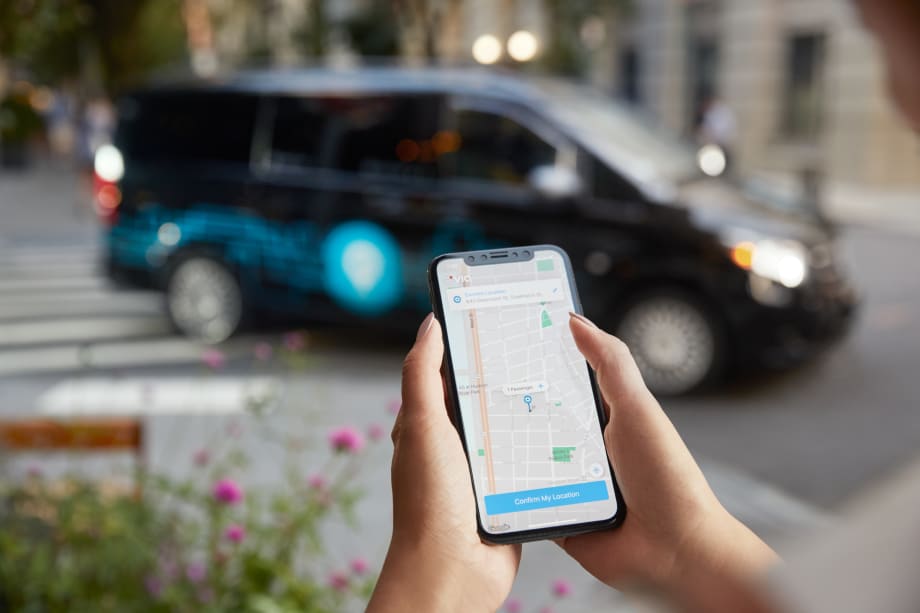
On-demand transportation are on the rise across the nation, with transit agencies often partnering with providers like Lyft and Via.
Via
On-demand transportation are on the rise across the nation, with transit agencies often partnering with providers like Lyft and Via.
Via
A new study points to key takeaways from partnerships for on-demand service between public transit providers and rideshare operators around the U.S. Prepared by DePaul University, with support from the Shared-Used Mobility Center, it offers a detailed look at on-demand service, which involves schedules and routes that dynamically change to meet customer demand. The uncertainties created by coronavirus crisis, the authors maintain, have made it more important than ever for agencies to explore the potential of partnerships with Lyft, Uber, Via, and other providers. “With so much change on the horizon, agencies need to explore innovative ways to expand their customer base, and collaborations with rideshare providers should be among the options they explore,” notes Mallory Livingston Shurna, a co-author of the study.
The study, “21 Key Takeaways from Partnerships between Public Transit Providers and Transportation Network Companies in the United States,” draws upon the experiences of 10 public agencies that have rolled out on-demand programs. Among others, it explores the experiences of a Greater Dayton Regional Transit Authority Connect On-Demand program with Lyft and Uber, the City of Detroit’s Night Shift program with Lyft, and St. Petersburg, Fla.’s Pinellas Suncoast Transit Authority Direct Connect program with Uber.
Such partnerships can serve a variety of purposes. Some provide first/last mile service, i.e., closing the gap between bus stops or train stations and the traveler’s origin and/or final destination. Charlotte Area Transit System’s program, offering discounted Lyft rides to/from select transit stations near the city’s central business district, falls into this category. Other programs, such as Dayton’s initiative, fill gaps emerged from reductions in fixed-route service. Still others focus on improving mobility for seniors and/or people with disabilities. Yet, some start with a single goal and end up having several. “Agencies are finding creative ways to stretch their budgets and expand their impact as they move up the learning curve,” notes Joe Schwieterman, another co-author.
In pursuing these innovative programs, agencies must grapple with difficult choices that can affect administrative complexity. Some programs are relatively straightforward, such as the fixed $7 discount for short-hop rides to and from certain transit stops during off-peak hours offered by Detroit’s NightShift program. Others, such as some partnerships involving Via, are more multifaceted, often requiring agencies to make payments based on vehicle-service hours provided rather than the number of trips made. The City of Austin, Texas’s On-Demand Rideshare Pilot Program, offering $1.25 rides on Via, uses this approach. Most contracts of this kind stipulate the provider operate a specified number of dedicated vehicles in a designated area and require vehicles in service only be used by the program’s customers.
The number of partnerships appears poised to grow. The authors predict that on-demand programs will become more prevalent in rural and suburban areas where existing transit service is poor. Budgeting for such programs can nonetheless be tricky due to the fact that on-demand trips in these areas can be more expensive than those in urban areas, due to lower demand and longer trip lengths; however, some agencies found that providing discounts for on-demand service in less densely-populated areas can be less costly than providing fixed-route bus service in those same areas. “Payment integration,” allowing users to pay for combined rideshare trip and public transit trip on a single smartphone app, is another emerging trend. Dayton is among the metropolitan regions seeking such integration.
The authors stress the need for planners to do their homework: “Transit agencies must resist the temptation to pursue on-demand partnerships primarily for the purpose of demonstrating that they are at the forefront of innovative programming,” they maintain. Such programs, they argue, are often quietly dropped after less-than-stellar rollouts. Rideshare companies, they add, seek to be part of programs that are successful, and critically, are renewed following the end of a pilot.
A free webinar on the study will be hosted by DePaul University at 12 p.m. CT on Thursday April 16. The presenters include Livingston Shurna and officials from the Connect program of California’s Marin Transit, as well as the Via to Transit program of Seattle’s King County Transit and Sound Transit. Schwieterman, a DePaul University professor, will moderate the discussion.
To register or to reach the study team, email chaddick@depaul.edu. A link to download the study is here.
More New Mobility

From Hardware to Digital Partner: Luminator Charts Its Next Chapter
CEO Magnus Friberg discusses Luminator’s shift toward becoming a digital partner, the growing importance of software and interoperability, and how AI can help agencies improve operations and passenger experience.
Read More →
Biz Briefs: Alstom Lands Canadian Contract, LYT to Supply California TSP, and More
In METRO's latest installment, we take a look at recent news from Complete Coach Works, Beep, FlixBus, and more partnerships making headlines across the transportation sector.
Read More →
CharterUP’s Armir Harris on Technology, AI, and the Future of Group Mobility
In a recent episode of METROspectives, CharterUP Founder/CEO Armir Harris discussed the company’s evolution from an online charter bus marketplace into a technology platform supporting public- and private-sector mobility and much more.
Read More →
Jacksonville’s NAVI Project Charts a New Course for Autonomous Public Transportation
Through its NAVI program, JTA is showing how autonomous vehicles, intelligent infrastructure, and coordinated operations can work together to deliver everyday public transportation.
Read More →
Biz Briefs: Luminator Marks Milestone and More
From manufacturers and suppliers to transit agencies and motorcoach operators, these updates offer a snapshot of the projects, partnerships and business moves driving the industry forward.
Read More →
New Tricks for Old Bureaucracies: Joshua Schank on Making Transit Innovation Stick
Former LA Metro Chief Innovation Officer Joshua Schank discusses why good ideas aren't enough, how transit agencies can overcome resistance to change, and why today's challenges demand more innovation.
Read More →
How DART's GoPass Is Redefining Regional Mobility
Serving 14 transit agencies, GoPass simplifies multimodal travel by allowing riders to plan, pay for, and manage an entire trip through one app.
Read More →
Biz Briefs: OCTA Taps Clean Energy for Hydrogen Station, Stadler to Supply Via Rail Vehicles, and More
From manufacturers and suppliers to transit agencies and motorcoach operators, these updates offer a snapshot of the projects, partnerships and business moves driving the industry forward.
Read More →CharterUP Expands Into New Mobility and Autonomous Transportation
Vice President of New Mobility Stephen Joos discusses how CharterUP is leveraging its nationwide transportation network, technology platform, and autonomous vehicle partnerships to expand into workforce mobility, campus shuttles, and transit solutions.
Read More →
METRO Magazine Announces 2026 Innovative Solutions Awards Winners
Projects Recognized for Advancing Mobility Through Technology, Accessibility, Workforce Innovation, and Operational Excellence
Read More →