



U.S. infrastructure receives near failing grade again
ASCE evaluated 16 categories of infrastructure in the 2017 Report Card, with grades ranging from a “B” for Rail to a “D-” for Transit.

Screenshot via ASCE
Screenshot via ASCE
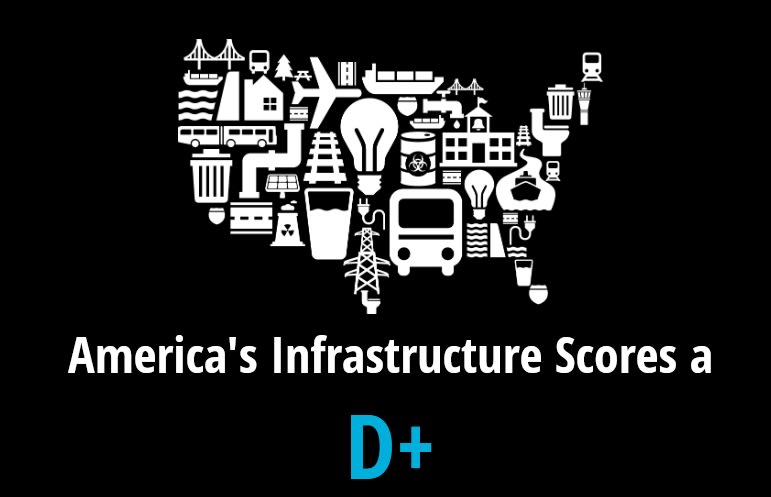
The American Society of Civil Engineers (ASCE) released its 2017 Infrastructure Report Card, the quadrennial assessment of the nation’s infrastructure. The 2017 Report Card found the national grade for infrastructure remains at a “D+” — the same grade the U.S. received in 2013 — suggesting only incremental progress was made over the last four years toward restoring America’s infrastructure.
ASCE evaluated 16 categories of infrastructure in the 2017 Report Card, with grades ranging from a “B” for Rail to a “D-” for Transit. While the overall grade did not improve, seven categories did see progress. These improvements can be attributed to strong leadership, thoughtful policymaking, and investments that garnered measurable results.
“While our nation’s infrastructure problems are significant, they are solvable,” said ASCE President Dr. Norma Jean Mattei, P.E. “We need our elected leaders — those who pledged to rebuild our infrastructure while on the campaign trail — to follow through on those promises with investment and innovative solutions that will ensure our infrastructure is built for the future.”
ASCE recommends the following solutions to raise the grades:
Sustained infrastructure investment, increasing investment from all levels of government and the private sector from 2.5% to 3.5% of U.S. Gross Domestic Product (GDP) by 2025;
Bold leadership from officials at all levels of government and the private sector to ensure that investment is spent wisely, including planning for the costs of building, operating, and maintaining the infrastructure for its entire lifespan; and
Preparation for the needs of the future, to ensure infrastructure is more resilient and sustainable, with clear economic, social, and environmental benefits.
The 2017 Report Card also highlights the projected total investment required to bring current infrastructure to a grade of a “B” — what ASCE considers to be an adequate grade. ASCE estimates that by 2025 a total investment of $4.59 trillion is required to improve the nation’s infrastructure. After projecting current funding levels, the estimated funding shortfall totals slightly more than $2 trillion. If the U.S. continues on this trajectory and fails to invest, the nation will face serious economic consequences, including $3.9 trillion in losses to U.S. GDP and more than 2.5 million American jobs lost in 2025, according to ASCE officials.
“Our infrastructure bill is overdue and our inaction is costing American's $3400 per year in lost disposal income,” said Greg DiLoreto, P.E., a past ASCE president and the current chair of the ASCE Committee on America’s Infrastructure, which prepared the Report Card. “While Congress and states have made some effort to improve infrastructure, it’s not enough. To see real progress, we need to make long-term infrastructure investment a priority. Investing now will create economic opportunity, enhance quality of life, and ensure public health and safety.”
About the ASCE Report Card
Using a simple A to F school report card format, ASCE’s Infrastructure Report Card provides a comprehensive assessment of current infrastructure conditions and needs, assigning grades and making recommendations to raise them. The ASCE Committee on America’s Infrastructure, made up of dedicated civil engineers from across the country with decades of expertise in all categories, prepares the Report Card, assessing all relevant data and reports, consulting with technical and industry experts, and assigning grades using the following criteria: capacity, condition, funding, future need, operation and maintenance, public safety, resilience, and innovation. Since 1998, the grades have been near failing, averaging only Ds, due to delayed maintenance and underinvestment across most categories.
In addition to the national Report Card, ASCE’s sections and branches prepare state and regional Infrastructure Report Cards on a rolling basis.
More Management

METRO Opens Submissions for 2026 Motorcoach Awards
Nominations are now being accepted for METRO Magazine’s Operator of the Year and Innovative Operator of the Year awards.
Read More →
New York MTA Advances Final Contract for Second Avenue Subway Expansion
Contract Four is the largest in the Second Avenue Subway Phase 2 project and includes construction of station infrastructure, tracks, and signals for the subway expansion, MTA officials said. Work on Contract Four will begin in 2027.
Read More →
Transit Agencies Highlight Safety Gains at National Summit
Leaders from 15 major transit systems shared crime-reduction results and safety initiatives while discussing the role of continued federal support.
Read More →

NITA Names New Leadership, Expands Reduced-Fare Program at First Board Meeting
The new regional transit authority appointed its first board chair and interim executive director while extending reduced fares across CTA, Metra, and Pace for eligible riders.
Read More →
Beyond the Checklist: A Structured Approach to Transit Maintenance
Reliability-Centered Maintenance helps transit agencies move beyond routine checklists to focus limited resources on the assets and failures that have the greatest impact on safety, reliability, and service.
Read More →
APTA 2026 Nominating Committee Selects Leadership Slate, Names Chair and Vice Chair Nominees
Leadership changes will help shape the association’s priorities and its representation of the transportation industry during the 2026–2027 term.
Read More →
DART Launches Major Security, Fare Enforcement Initiative
The 90-day demonstration will deploy coordinated security teams at five light rail stations while testing controlled access and gathering data to guide future investments.
Read More →
Advancing Fare Collection Through Technology and Innovation
Learn about delivering 1300 gates at 91 stations while managing fare evasion. Explore the large scale deployment, solution customization and real-world results that affect the region. Prepare for deployment in your region now.
Read More →
Game Day in Motion: Moving Millions During the 2026 World Cup
Between packed transit stations and team motorcoaches, see how agencies and operators across North America tackled the transportation demands of the 2026 FIFA World Cup.
Read More →
Surface Transportation Extension Averts Shutdown, Leaves Transit Funding Gap
The stopgap keeps federal transportation programs moving, but missing advance funding could complicate the transit and rail projects agencies are planning next.
Read More →