




RELATED: U. of Ga. losing 70 student drivers due to graduation
UConn changing bus operations to meet new driving rules
The FMCSA recently established comprehensive national minimum training standards for entry-level commercial bus operators to obtain a CDL or certain endorsements, which go into effect on Feb. 6, 2017.
January 5, 2017

View of the UConn Nation transportation bus on Jan. 7, 2016. (Sean Flynn/UConn Photo)
5 min to read
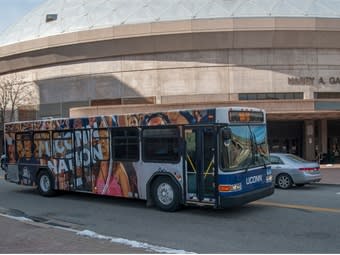
View of the UConn Nation transportation bus on Jan. 7, 2016. (Sean Flynn/UConn Photo)
The University of Connecticut (UConn) is changing some of its transportation procedures to ensure that it complies with updated federal training requirements for bus drivers, while still being able to provide students with part-time jobs.
The University’s Department of Transportation Services, which operates the Storrs campus bus and shuttle system among its duties, recently posted a request for proposals (RFP) from companies that want to operate the fixed bus routes on and near campus.
Those 10 routes are all served by the University’s fleet of large transit buses. They historically have been driven by students and temporary employees working part-time, all of whom are required by federal law to have commercial driver’s licenses.
The U.S. DOT's Federal Motor Carrier Safety Administration (FMCSA) recently established comprehensive national minimum training standards for entry-level commercial truck and bus operators to obtain a commercial driver’s license or certain endorsements. Those training standards go into effect on Feb. 6, 2017.
With no training facility on campus, UConn cannot meet the new training requirements on its own. That means the number of student drivers holding commercial driver’s licenses will decrease each year as they graduate, while very few are entering UConn with the certification already in hand.
When a contractor is selected from among responses to UConn’s RFP, that company will operate the fixed-route bus lines with its own commercial driver’s license-certified drivers. However, UConn students will continue to have access to other jobs with the transportation department.
“Even with this change, we’re still going to have a large presence of student workers because we will need them for many other jobs, such as driving shuttle vans, dispatching, and cleaning buses,” says William Wendt, director of UConn’s Office of Logistics Administration, which includes the transportation department. “Students have been an important part of our workforce, and that isn’t changing.”
UConn operates several regular fixed-route lines on and near the Storrs campus, plus a variety of shuttles and vans during some late-night periods, on demand for disabled passengers, to and from UConn Health in Farmington, and to and from Bradley Airport and other transit hubs.
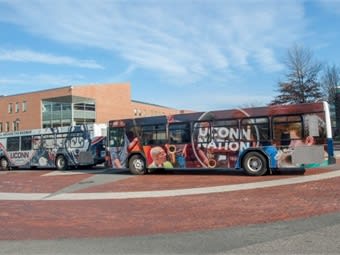
UConn will take delivery this spring of 10 new heavy-duty buses built by New Flyers, similar to the UConn Nation transportation buses and the Icebus currently in use at the Storrs campus. (Sean Flynn/UConn Photo)
Companies that want to bid on providing drivers for the fixed-route lines with the large buses must do so by early February, and the company that is selected will take over those routes with its own commercial driver’s license-certified drivers during summer 2017. Students who wish to become commercial driver’s license-certified, and drive buses will be encouraged to apply for training and jobs through the new vendor.
The RFP includes numerous requirements that the company and its drivers must meet, including regular review of each operator’s driving record; immediate dismissal of any driver who tests positive for using a controlled substance; clean background checks at least every two years; and several other safety-related requirements.
William Wendt and Dennis Solensky, UConn’s general manager of transportation and fleet services, say they anticipate that current drivers with good records and on-campus experience — including students who hold commercial driver’s licenses — could be strong candidates to be hired by whichever company takes over the fixed-route service.
“Our goal is to take care of our student population here with jobs, both as a way for them to earn money and for experience if they’re considering the transportation field as a career,” Wendt says, noting that the RFP was specifically limited to the fixed-route services so that students could still get jobs driving the smaller vans and shuttles.
Solensky says they also anticipate being able to provide part-time jobs and internships for students in marketing, social media, and related work, to help support and promote the bus system.
UConn Transportation and Fleet Services also employs 31 student drivers who operate vans and shuttles and do not have a commercial driver’s license, plus eight alumni with commercial driver’s licenses who drove buses as students and were offered temporary part-time spots to help fill staffing gaps as previous commercial driver’s license-holding students graduated.
In addition, UConn employs 19 temporary bus drivers who are not students and are eligible to work up to full time, although their employment ends when each semester concludes and they must apply to be re-hired for the next semester.
That is not the only way employing temporary drivers has proven complicated: It also has budget implications, because UConn must pay a certain percentage of the drivers’ salaries to the state for benefits, even though as temporary or “seasonal” employees, they do not qualify to receive benefits. And as seasonal employees, their services are not needed during academic breaks and the summer.
Almost all other public transportation systems in Connecticut are operated with contracted drivers, such as CT Transit and Yale University. It is increasingly common for colleges and universities nationwide to transition to the use of contractors for their fixed-route lines as their seasonal needs require, as is now the case at UConn.
Industry observers say the trend is likely to continue in light of the new licensing requirements, given that many campuses such as UConn do not have their own onsite training facilities for students to meet the updated regulations for entry-level commercial driver’s license certifications.
The change comes at the same time that UConn is working with the state Department of Transportation and the Windham Regional Transit District (WRTD) to discuss ways to upgrade transit throughout the region.
The University has strongly supported the state’s plan to extend its CTfastrak service east to Storrs, and has authorized a student fee that will help cover the cost of providing service for UConn students on any public bus statewide. That fee will only be charged to Storrs students once the state extends the CTfastrak service, which would link Storrs with a network of bus lines throughout central Connecticut.
“It’s important to have good public transit in the Storrs area to provide access to housing nearby for our students, especially graduate students,” says Wendt, “and for recruiting potential employees who live elsewhere in the state but would be good candidates to work at UConn if they had transportation.”
UConn also will take delivery this spring of 10 new heavy-duty buses known as “New Flyers,” the same class of large transit buses currently on campus that are decorated with UConn scenes and logos, including the popular “Ice Bus.”
The 10 “New Flyer” buses will display a new UConn branding. They will include modern features that make the seating more comfortable, the operation more reliable, and the entrances more readily accessible for disabled passengers. The accessible feature uses “kneeling” technology, in which an on-board system lowers the height of the bus so passengers can easily access it from ground level.
More Bus

New York MTA Plans Largest Bus Fleet Upgrade in More Than a Decade
The agency is seeking manufacturers for 650 new CNG buses to replace aging vehicles, improve reliability, and advance its broader fleet modernization strategy.
Read More →
Building a Flexible Path to Transit Electrification
John Hroncich discusses BAE Systems’ modular and scalable approach, lessons learned from decades of real-world operations, and how agencies can identify electrification strategies that fit their fleets.
Read More →
Bus Tech Talk: Keeping Transit Technicians Ahead of the Technology Curve
LA Metro’s Obed Mejia discusses technician training, evolving maintenance technology, fleet replacement, and strategies for getting the most out of today’s transit fleets.
Read More →
Biz Briefs: RIPTA Unveils New Frontrunners, Clevland RTA Adds New Siemens, and More
In METRO's latest installment, we take a look at recent news from Siemens, Prevost, Dodge, and more partnerships making headlines across the transportation sector.
Read More →
People Movement: Holly Arnold Joins Transdev and More
In this edition, we also cover recent appointments and announcements at Pace, CamTran, MCI, and more, showcasing the individuals helping to shape the future of transportation.
Read More →
The High Cost of Transit Buses: Industry Leaders Look to Procurement Reform
Transit leaders and policymakers examine how standardized bus designs, streamlined procurement, and predictable funding could help agencies stretch budgets and deliver better service.
Read More →
The Business Voice Behind Public Transportation
As chair of APTA’s Business Members Board of Governors, Ray Melleady explains how more than 850 business members are partnering with transit agencies to advance funding, innovation, and industry-wide collaboration.
Read More →
From Surviving to Thriving: Building Stronger Transportation Organizations
Bus Business Consultants founder Brian Dickson shares lessons on leadership, organizational health, and creating options for long-term success in a changing transportation industry.
Read More →
Finding the ‘Happy Medium’: Optimizing Maintenance Without Sacrificing Reliability
The key to maintenance optimization isn’t doing less work—it’s doing the right work at the right time on the right assets.
Read More →
LA Metro, City of West Hollywood, and Partners Advance Smarter Bus Lane Enforcement
The award-winning partnership combines AI-powered detection with human oversight to improve bus reliability, accessibility, and enforcement efficiency.
Read More →