



Washington set to focus on 5 megatrends as APTA chair
Adding to his long list of accomplishments at Denver RTD, Washington has been named the new chair of APTA, ceremoniously taking the gavel from outgoing chair Peter Varga at EXPO on Monday. METRO spoke to Washington about his success at RTD and his new role as chair.

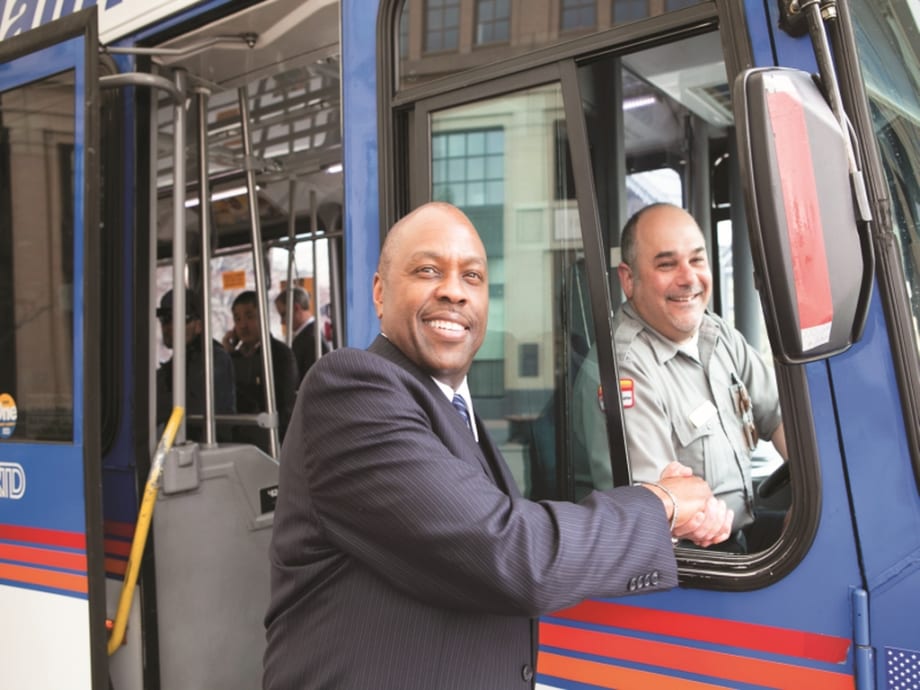
Adding to his long list of accomplishments at Denver RTD, Washington will succeed Peter Varga as APTA’s chair.
Adding to his long list of accomplishments at Denver RTD, Washington will succeed Peter Varga as APTA’s chair.
With the Denver Regional Transportation District (RTD) for 14 years, including four as GM/CEO, Phillip A. Washington has undertaken a number of innovative cost-effective and customer-focused initiatives to build projects and improve service to the public.
Perhaps the most visible is RTD’s FasTracks Program, which is building 122 miles of new commuter rail and light rail, 18 miles of bus rapid transit service, adding 21,000 new parking spaces and redeveloping Union Station.
The W Line, RTD’s first FasTracks-funded rail line, opened in 2013 eight months ahead of schedule and within adopted budget — adding 12 miles of light rail for an RTD system-wide total of 47 rail miles.
Facing challenges to keep the program funded and moving, Washington challenged staff to create innovative approaches, such as partnering with the private sector on the Eagle P3 — a $2.2 billion project that includes the East Rail Line to Denver International Airport, the Gold Rail Line, a segment of Northwest Rail, the commuter rail maintenance facility and rail fleet. The project is set to open in 2016.
Adding to his long list of accomplishments, Washington has been named the new chair of APTA, ceremoniously taking the gavel from outgoing chair Peter Varga at EXPO on Monday. METRO spoke to Washington about his success at RTD and his new role as chair.
Discuss some of the reasons Denver RTD has been able to find so much success over the last several years?
First of all, the team we have put together is second to none. The other big piece is our stakeholder partners in the region — the mayors, the business community, the chambers of commerce, developers, small and minority businesses — it really is a partnership that we have put together where everyone is on the same sheet of music, if you will, and everyone is actually pulling in the same direction. I think those two things have led to our success with both our day-to-day base system operations, which is over 1,000 buses and 170 light rail vehicles, as well as our FasTracks expansion, where we are moving forward with the implementation of that program, and, despite the recent recession we have experienced in the region, delivering those projects on time and on budget.
With so many entities involved, how are you able to get all those different stakeholders on board to buy in?
One of the things that was, has been and still is important for us is, in the case of expansion, for example, is showing the economic benefit of our FasTracks program. Those economic benefits have included job creation, small business inclusion, livability, walkability, mobility... and so being able to convey and articulate that to the general public as well as all of our stakeholders has been huge. Most importantly, though, is not just conveying that, but actually doing it.
I have often said that everything we thought would happen back in 2002-2003, when we went to the voters for a sales tax increase, is actually happening right now.
We said there would be 10,000 jobs created, and we are up to 10,300. We said transit oriented development communities would pop up around our stations, and now, you can’t pick up a newspaper without reading about a groundbreaking of residential or commercial developments around our stations.
We also said we would inject $2.7 billion in our local economy, and we are at $3.3 billion. So, everything we said would happen, in terms of economic benefit, over 10 years ago, is actually happening. I can’t help but think that the same thing can happen in other regions of the country, if they are just bold enough to start this investment in infrastructure like we have.
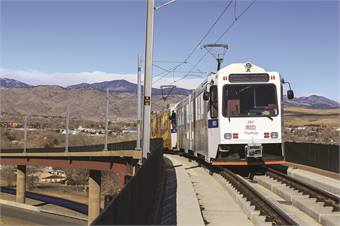
The West Line light rail system, the first portion of RTD’s ambitious FasTracks program, debuted in April 2013 eight months ahead of schedule.
Discuss your feelings on being named APTA Chair?
I like to view it as being the chief transportation servant for APTA. That’s how I look at this role. It is a serving role, and so, I am serving the industry. I see this as an opportunity to continue to advocate for everything that APTA stands for. I don’t see this as some type of huge personal achievement, one can say it is, but I don’t see it that way. I see it as serving the industry and doing my part to advocate for the industry, infrastructure build out, rebuilding our infrastructure and doing some nation building in this country.
What are some of your initiatives as chair?
I am looking at initiatives that I think are the initiatives the industry will be facing for the next five years. So, I am not just looking at one year. In looking at those strategic initiatives or objectives, the first thing that I’ve been looking at is what type of environment will we be in in the next five years? What type of environment will that be? In looking at that, and trying to answer that question, I think there are five top-level drivers, or megatrends, that we will be faced with.
The first one is accelerating technological innovation. Technology innovation is rapidly accelerating, so we need to figure out how we are going to address that.
The second is changing customer demographics and lifestyles. We know we are in the midst of a changing customer demographic and the lifestyle that comes with that, and so, that is who we are servicing. We are faced with that over the next five years.
The third one is shifting workforce demographics. Millennials are now working from home. You have reverse commute. You have all kinds of things going on that are shifting workforce demographics. How are we going to deal with that?
The fourth big piece is evolving environments for financial resources. We are going to have to depend less and less on the federal government. There was a time where you could do a project and got 80 percent from the government — that is not going to happen anymore. We have this evolving environment for financial resources. We see it now with no long-term transportation funding bill. I think that is going to be the new normal as our federal government has not come to grips with the fact that we need to build and rebuild the infrastructure in this country.
The fifth megatrend, or environment the industry will be working in, is this increasing expectation for improved safety and security. And, many of these things are going to be unfunded mandates. When you look at positive train control, for instance, it is largely an unfunded mandate for commuter rail agencies to implement the technology.
These five megatrends I see as sort of my five platform issues to try and address. My hope is that these five megatrends continue to be addressed long past my tenure, but I am going to start it off during my term. And, these five strategic objectives will probably show up in APTA’s Strategic Plan next year.
How do you see these megatrends playing out over the next five years?
First of all, these trends will be the environment the industry will be working under for the foreseeable future. What we need to do at APTA is develop goals for each of these five things. Then, I envision us putting together a tactical plan for each one of them and having some performance metrics attached to each one of them to see how we are doing over the next five years. That is how I see this working.
The other piece is, I see a great need, and am going to make the call for, a national day of advocacy for infrastructure in this country. What this looks like in my mind is one day where public transportation agencies would be the catalyst in having press conferences, if you will, in every city, definitely the major cities, to bring awareness to the need to build and rebuild our infrastructure. I envision this in the spring of next year, prior to the end of this current MAP-21 extension we are working under, which ends in May of next year. I see this national day of infrastructure awareness in the March/April time frame to bring attention to the public and our elected officials that we have to take this seriously. We need the folks on Capitol Hill to understand that they have to give us a long-term transportation funding bill in order for us to have some certainty, in regards to building our nation’s infrastructure.
More Bus

New York MTA Plans Largest Bus Fleet Upgrade in More Than a Decade
The agency is seeking manufacturers for 650 new CNG buses to replace aging vehicles, improve reliability, and advance its broader fleet modernization strategy.
Read More →
Building a Flexible Path to Transit Electrification
John Hroncich discusses BAE Systems’ modular and scalable approach, lessons learned from decades of real-world operations, and how agencies can identify electrification strategies that fit their fleets.
Read More →
Bus Tech Talk: Keeping Transit Technicians Ahead of the Technology Curve
LA Metro’s Obed Mejia discusses technician training, evolving maintenance technology, fleet replacement, and strategies for getting the most out of today’s transit fleets.
Read More →
Biz Briefs: RIPTA Unveils New Frontrunners, Clevland RTA Adds New Siemens, and More
In METRO's latest installment, we take a look at recent news from Siemens, Prevost, Dodge, and more partnerships making headlines across the transportation sector.
Read More →
People Movement: Holly Arnold Joins Transdev and More
In this edition, we also cover recent appointments and announcements at Pace, CamTran, MCI, and more, showcasing the individuals helping to shape the future of transportation.
Read More →
The High Cost of Transit Buses: Industry Leaders Look to Procurement Reform
Transit leaders and policymakers examine how standardized bus designs, streamlined procurement, and predictable funding could help agencies stretch budgets and deliver better service.
Read More →
The Business Voice Behind Public Transportation
As chair of APTA’s Business Members Board of Governors, Ray Melleady explains how more than 850 business members are partnering with transit agencies to advance funding, innovation, and industry-wide collaboration.
Read More →
From Surviving to Thriving: Building Stronger Transportation Organizations
Bus Business Consultants founder Brian Dickson shares lessons on leadership, organizational health, and creating options for long-term success in a changing transportation industry.
Read More →
Finding the ‘Happy Medium’: Optimizing Maintenance Without Sacrificing Reliability
The key to maintenance optimization isn’t doing less work—it’s doing the right work at the right time on the right assets.
Read More →
LA Metro, City of West Hollywood, and Partners Advance Smarter Bus Lane Enforcement
The award-winning partnership combines AI-powered detection with human oversight to improve bus reliability, accessibility, and enforcement efficiency.
Read More →