



RELATED: Red, Purple Line extension plan lands $1B fed investment
Rebuilt Rail Hub is 'Economic Catalyst' for Chicago Community
The $203 million reconstruction of the CTA’s Wilson Red Line station included replacing century-old track structure.
by Rick Purnell
November 28, 2018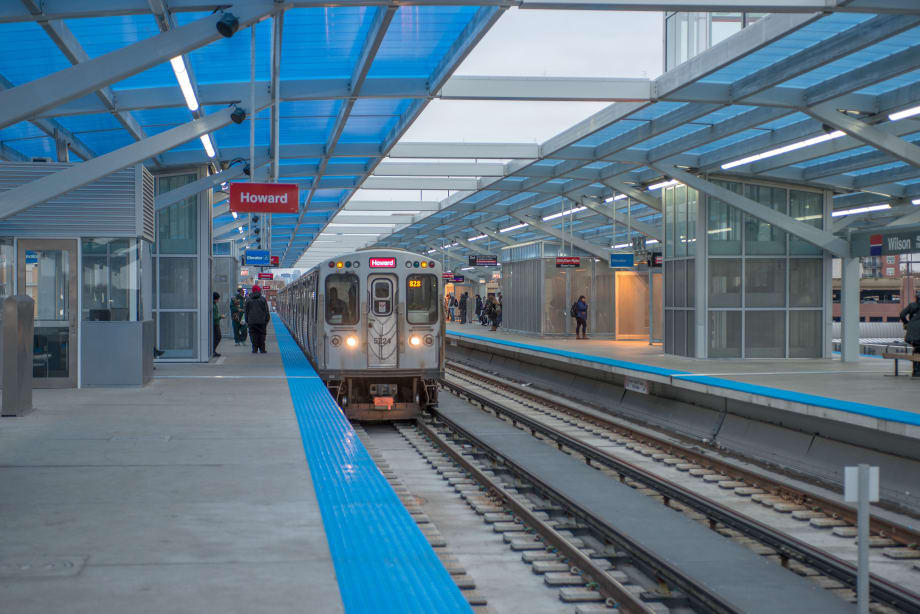
All Photos Courtesy Trey Cambern courtesy of HNTB
5 min to read
All Photos Courtesy Trey Cambern courtesy of HNTB
While many cities focused on building new transit systems, the Chicago Transit Authority (CTA) has been intensely focused on modernizing and improving its bus and rail system across Chicago. Since 2011, the CTA has announced, begun, or completed more than $8 billion in projects, a level of investment unprecedented in CTA history.
One of the signature projects in that effort has been a $203 million reconstruction of the CTA’s Wilson Red Line station on the city’s North Side, which replaced century-old track structure, built a brand new stationhouse, and created a new rail transfer point.
With the signature project nearly completed by the end of 2017, the CTA in the Fall of 2017 opened its new, modern, and fully accessible Wilson stationhouse, a bright, airy station.
“This modern, spacious new entrance to Wilson gives CTA customers a more pleasant commuting experience and increased accessibility to the CTA system,” said CTA President Dorval R. Carter Jr. “The reconstructed station is already an economic catalyst for the historic Uptown neighborhood of Chicago by providing convenient access to this vibrant, historic neighborhood while attracting new businesses and stimulating job growth.”
The Wilson renovation is one of the CTA’s signature projects and part of Chicago Mayor Rahm Emanuel’s $8 billion transit investment, which includes the “Red Ahead” program. Red Ahead is a series of investments in the Red Line, the CTA’s busiest rail line that runs 24/7.
The CTA hired Walsh/II-In-One JV as the project’s general contractor, Arcadis as the construction manager, and HNTB as the designer of record. Major project construction began in 2014 and was largely completed by the end of 2017, with full completion anticipated in January 2018.
Project scope
The Wilson station had fallen into a state of disrepair over the years, so much so that a Chicago newspaper once declared it the “crustiest station” in Chicago.
The new $203 million station has pre-served the historic character of Wilson and, at the same time, provided a completely modern, accessible facility for transit riders.
Components of the Wilson project included:
New, larger main stationhouse on Wilson Avenue with elevators to make station fully accessible.
Creation of a new rail transfer point between the Red Line and the Purple Line Express and new, wider platforms that provide easy cross-platform access for rail line transfers. Previously, only the Red Line stopped at Wilson.
Two auxiliary entrances on Wilson (across from main station entrance) and on Sunnyside Avenue, which has an ADA-compliant ramp.
Complete reconstruction of century-old four-track structure and relocation of track structure, which reduced the number of columns in the roadway below by two-thirds, improving motorists’ safety, sightlines and the overall streetscape.
New, one-of-a-kind artwork, “Arpeggio,” by internationally acclaimed artist and engineer Cecil Balmond, who is known for his large-scale public art installations around the world.
Additional features include numerous security cameras throughout the station and platforms, CTA Train Tracker displays, wider stairwells, new escalators, and other improvements.
Restoration of the historic Gerber Building, constructed in 1923. The building had been partially closed for years and had fallen into disrepair. The completely restored building is expected to house a retail business or businesses once it’s completed in early 2018.
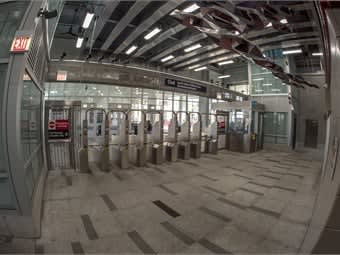
Station features include numerous security cameras throughout, platforms, CTA Train Tracker displays, wider stairwells, new escalators and other improvements.
Innovative planning
To ensure schedule reliability, CTA required three of the four tracks remain in operation 24/7 throughout construction to allow Red and Purple Line Express service to continue for customers.
By breaking construction into five stages — one for replacing each of the four tracks — while the other three remained in service, construction crews managed to minimize travel delays for commuters. Stages one through four demolished existing structures, added new supporting elements, and restored the Gerber Building. Stage five removed all temporary railroad infrastructure installed to support operations in the first four stages.
All users were considered in the design. The new station includes back-of-the-house areas for janitors, space for electrical and communications rooms, and space for the city’s bike-share program, Divvy, outside the main stationhouse.
At the opening of the new main stationhouse, the Wilson station was delivered within the promised construction timeframe and budget parameters. Remaining work — the opening of the Gerber Building — will be completed in early 2018.
Rebuilding the 100-year-old track structure gave CTA the opportunity to build dual-block track, which provides a smoother ride for passengers and reduces vibration for buildings in the surrounding community. To facilitate the inaugural installation of the new track, HNTB partnered on a mockup system to identify best practices, including design mixes and methods of placement.
The new track alignment with fewer curves allows trains to travel faster than before. The structure has a more open feel as the tracks are four feet higher than they used to be. The noisy rumble of the ’L’ is reduced. A concrete deck for tracks and specially designed caissons channel sound vibrations into the ground.
Community benefits
The Wilson project began generating economic benefits well before construction was to be completed. The project created approximately 560 direct construction jobs and nearly 2,700 indirect jobs for project consultants, material providers, inspectors, and other trades.
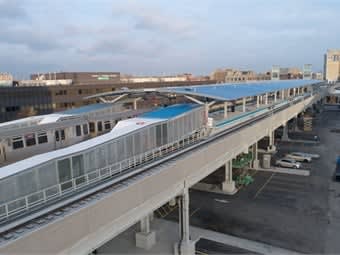
The Wilson project began generating economic benefits well before construction was to be completed.
The community benefits don’t stop there. At least 30 new business licenses have been issued within a half-mile of the station since project work began.
Demonstrating that quality transit stations encourage development, 11 new multi-family housing development projects, totaling more than 1,300 units, have been announced, approved, or built since Wilson station construction began in late 2014.
Officials expect growth to continue. There were 1.8 million entries into the station in 2016. In fact, Wilson is the ninth busiest of 19 stations on the north side of Chicago.
It serves as a gateway to the fast-growing Uptown neighborhood that includes a popular and historic entertainment district, Truman College (part of the City Colleges of Chicago), and nearby Montrose Harbor on Lake Michigan among other destinations.
The Red Line includes other stations like Wilson — built decades ago, without elevators and accessibility features and cramped by today’s standards. That’s why the CTA launched its Red and Purple Modernization program, and will begin Phase One of the project in the next couple of years — rebuilding four Red Line stations to the north of Wilson and reconstructing all of the adjacent track structure.
Rick Purnell is a freelance writer based in Palm Springs, Calif.
Subscribe to Our Newsletter
More Rail

New York MTA Advances Final Contract for Second Avenue Subway Expansion
Contract Four is the largest in the Second Avenue Subway Phase 2 project and includes construction of station infrastructure, tracks, and signals for the subway expansion, MTA officials said. Work on Contract Four will begin in 2027.
Read More →
San Diego MTS Breaks Monthly Trolley Ridership Record
Agency officials said July’s ridership indicates MTS’s continued recovery from the pandemic.
Read More →
Report Examines NJ TRANSIT Reliability, Funding Challenges
The Garden State Initiative analysis examines the roles of Amtrak infrastructure, fleet management, and agency operations while recommending a more performance-based approach to improving reliability.
Read More →
Stadler, CapMetro Sign Long-Term Rail Fleet Support Agreement
Beginning in 2027, Stadler will provide on-site technical expertise, spare parts support, training, and obsolescence management to help extend the reliability and longevity of CapMetro’s GTW fleet.
Read More →
Biz Briefs: Alstom Lands Canadian Contract, LYT to Supply California TSP, and More
In METRO's latest installment, we take a look at recent news from Complete Coach Works, Beep, FlixBus, and more partnerships making headlines across the transportation sector.
Read More →
CATS Gold Line Marks 5 Years of Service, 2.8M Passenger Trips
With a six-mile expansion planned, the Charlotte streetcar is positioned to connect more neighborhoods and major transit hubs across the region.
Read More →
Why Simulating Pedestrian Movement Has Become Essential for Modern Rail Stations
Pedestrian microsimulation is helping rail planners identify bottlenecks, test station designs, and prepare complex transit hubs for growing passenger volumes.
Read More →
Amtrak Begins Major Construction at New York’s Sunnyside Yard
The new maintenance facility will support Amtrak’s Airo trainsets while improving maintenance efficiency and turnaround times in New York.
Read More →
Chicago Leaders Unveil Plans for O’Hare Airport Express Train
The privately developed project would offer a 15-minute trip between downtown and O’Hare’s Terminal 2, with trains operating every 15 minutes on a dedicated track. The service would use battery-electric trains and three existing freight rail rights-of-way.
Read More →
OCTA Maps Out 30-Year Strategy to Protect Coastal Rail Corridor
The draft feasibility report identifies strategies to protect the coastal rail line for decades as the agency continues near-term stabilization and sand placement efforts.
Read More →