



Second Avenue Subway Phase 2 Advances into Major Construction Stage
New York Governor Kathy Hochul joined leadership from the MTA, elected officials, and Harlem community leaders to break ground on the major construction stage of the transformative Second Avenue Subway Phase 2 project.

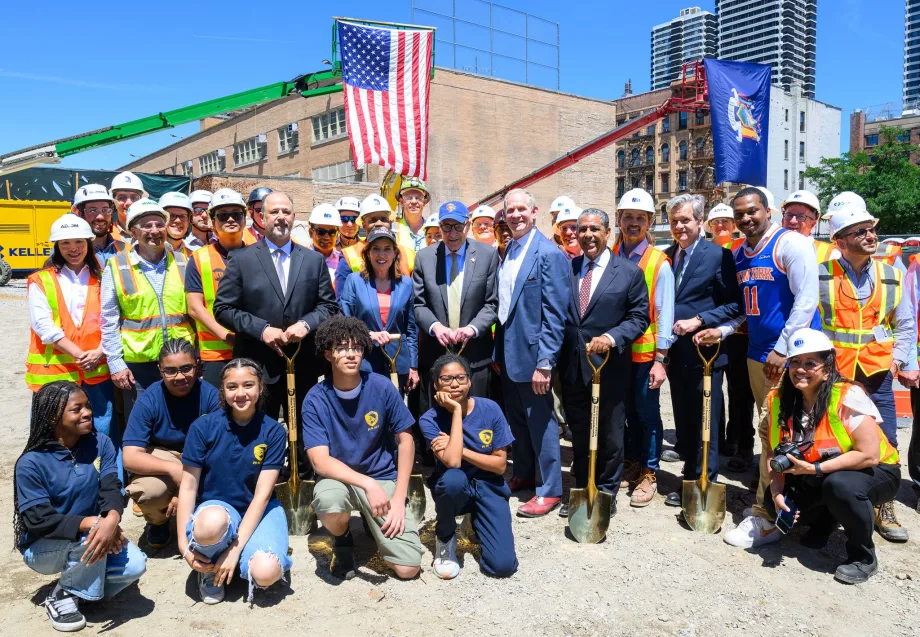
The state-of-the-art variable-density Tunnel Boring Machines will be delivered early next year. Weighing more than 1.5 million pounds, the machines are equipped with 23-foot tungsten carbide cutter heads.
Susan Watts/Office of Governor Kathy Hochul
- New York Governor Kathy Hochul and MTA officials marked the start of major construction on the Second Avenue Subway Phase 2, set to extend from 120 Street and 2nd Avenue to 125 Street and Malcolm X Boulevard.
- A tunnel-boring machine will be employed in 2027 to facilitate the new subway tunnels, while a separate contract has been awarded for constructing the final tunnel section from 105 Street to 110 Street using the "cut and cover" method.
- The MTA is implementing strategies from Phase 1 to achieve cost savings exceeding $1 billion and aims to complete utility relocations ahead of schedule.
*Summarized by AI
New York Governor Kathy Hochul joined leadership from the Metropolitan Transportation Authority (MTA), elected officials, and Harlem community leaders to break ground on the major construction stage of the transformative Second Avenue Subway Phase 2 project.
The groundbreaking occurred at the location where, in early 2027, the state-of-the-art tunnel-boring machine (TBM) will be lowered into the ground and begin mining the new subway tunnels from 120 Street and 2nd Avenue to 125 Street and Malcolm X Boulevard.
The governor also announced that, following the resumption of federal funding to the project in April, the MTA has awarded the next major contract to construct the final tunnel section of this phase from 105 Street to 110 Street, including the future 106 St Station, using a “cut and cover” approach.
The MTA is applying lessons from Phase 1 of the project to deliver more than $1 billion in savings and is on track to complete advanced utility relocations early, allowing pending work on this project to start six months faster than originally scheduled.
“The Second Avenue Subway will change everything for East Harlem, saving people precious time and making possible opportunities that have for too long been out of reach for too many,” Governor Hochul said. “The last groundbreaking for a Second Avenue Subway in East Harlem was 54 years ago, only for the project to be abandoned and this community left behind.”
MTA’s Tunnel Boring Machines
The state-of-the-art variable-density Tunnel Boring Machines will be delivered early next year. Weighing more than 1.5 million pounds, the machines are equipped with 23-foot tungsten carbide cutter heads. The TBM can adjust its methods depending on the material it encounters, switching between one drill for hard rock and another for soft soil or sand.
The TBM also reinforces the tunnel lining it leaves behind as it travels beneath Harlem. The TBM will launch from the 120 Street site and travel to 125 Street and Malcolm X Boulevard.
Concurrent to today's milestone on the Phase 2 project, Governor Hochul and the MTA are already scoping and designing a potential next phase of the Q train westward across 125th St to Broadway with three new stations and more than 160,000 daily riders.
Following the completion of an MTA feasibility study announced by the governor in 2024, this year’s FY27 enacted state budget secured $25 million to conduct preliminary engineering and design for a tunnel extension and to approve an efficient environmental review process. If the project is advanced, work on the tunnel could continue seamlessly, using much of the same equipment as in phase 2, saving time and money.
Second Avenue Subway Phase 2 is divided into four contracts — compared to 10 in Phase 1 — to increase project efficiency and minimize complicated contractor coordination. The tunnel boring is part of Contract 2, valued at $1.97 billion, which includes shaft excavation for the TBM, controlled blasting for future stations, and asbestos and lead abatement in the existing 1970s tunnels.
MTA Awards Third Contract
At the groundbreaking, the MTA and Governor Hochul announced progress on another major component of Phase 2: the award of Contract 3.
Contract 3 will construct the structural shells of the new 106 St Station and associated tunneling, connecting the existing tunnels north and south of the station, and is expected to begin work in the coming months. The entire Second Avenue Subway Phase 2 project is budgeted at $6.968 billion and is on track for revenue service in 2032.
"The new MTA is delivering on the longstanding promise to bring subway service to the East Harlem community,” said President of MTA Construction & Development Jamie Torres-Springer. “By applying lessons learned from Phase 1, we’re delivering this project better, faster, and cheaper — with more than $1 billion in savings to date."
Using Cost Containment Strategies Learned During Phase 1
Phase 2
As part of the MTA's commitment to delivering key infrastructure projects better, faster, and more cheaply, the contracts for Phase 2 incorporate lessons learned from the Second Avenue Subway Phase 1.
Addressing utility relocation requirements upfront reduces the risk of unexpected costs or delays later as construction progresses — especially in New York City, which has one of the most complex underground utility networks in the world, most of which is unmapped.
Additional cost containment initiatives in Phase 2 include: reuse of a tunnel segment that was built in the 1970s from 110 Street to 120 Street along Second Avenue, early real estate acquisition, adoption of innovative contract structures such as best-value, performance-based contracts, design-build, close coordination of contracts, and the reduction in back-of-house, ancillary spaces, and station sizes.
All told, these initiatives have saved more than $1 billion, according to officials.
The Second Avenue Subway Phase 2 project will create thousands of jobs, including union-wage construction jobs. A 20% local hiring goal for the project will create good-paying job opportunities for hundreds of East Harlem residents, officials said.
Quick Answers
The recent milestone was the groundbreaking for the major construction stage of the Second Avenue Subway Phase 2 project in Harlem.
*Summarized by AI
More Rail

CATS Gold Line Marks 5 Years of Service, 2.8M Passenger Trips
With a six-mile expansion planned, the Charlotte streetcar is positioned to connect more neighborhoods and major transit hubs across the region.
Read More →
Why Simulating Pedestrian Movement Has Become Essential for Modern Rail Stations
Pedestrian microsimulation is helping rail planners identify bottlenecks, test station designs, and prepare complex transit hubs for growing passenger volumes.
Read More →
Amtrak Begins Major Construction at New York’s Sunnyside Yard
The new maintenance facility will support Amtrak’s Airo trainsets while improving maintenance efficiency and turnaround times in New York.
Read More →
Chicago Leaders Unveil Plans for O’Hare Airport Express Train
The privately developed project would offer a 15-minute trip between downtown and O’Hare’s Terminal 2, with trains operating every 15 minutes on a dedicated track. The service would use battery-electric trains and three existing freight rail rights-of-way.
Read More →
OCTA Maps Out 30-Year Strategy to Protect Coastal Rail Corridor
The draft feasibility report identifies strategies to protect the coastal rail line for decades as the agency continues near-term stabilization and sand placement efforts.
Read More →
The Business Voice Behind Public Transportation
As chair of APTA’s Business Members Board of Governors, Ray Melleady explains how more than 850 business members are partnering with transit agencies to advance funding, innovation, and industry-wide collaboration.
Read More →
FRA Announces $5.3B in Rail Investments, Including $2B for Amtrak
Funding will support grade-crossing improvements, infrastructure upgrades, and new Amtrak equipment in 23 states.
Read More →
Finding the ‘Happy Medium’: Optimizing Maintenance Without Sacrificing Reliability
The key to maintenance optimization isn’t doing less work—it’s doing the right work at the right time on the right assets.
Read More →
OKC Streetcar Makes Zero-Fare Service Permanent
Ridership increased an average of 71% compared with the same period a year earlier during the fare-free pilot.
Read More →
DART Customer Satisfaction Reaches Six-Year High
Overall satisfaction rose to 74.9%, while the agency’s Net Promoter Score reached a record 33.7.
Read More →