



LIRR rolls out newest fleet of railcars
The new cars incorporate and improve upon the most successful and popular features of the MTA’s two recent electric car fleets.

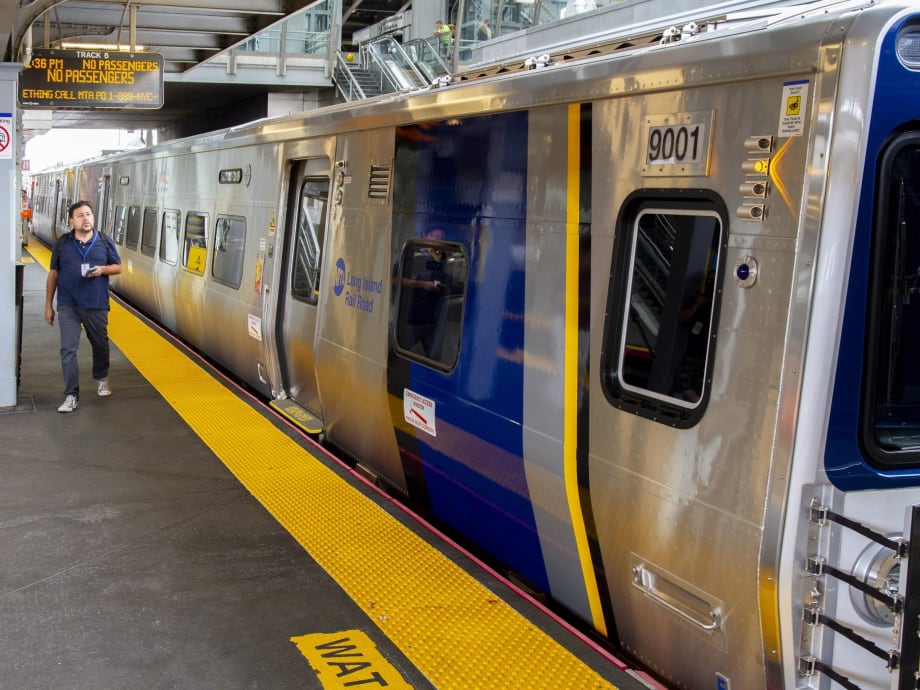
The cars are designed and manufactured by Kawasaki Rail Car, based in Yonkers, N.Y.
LIRR
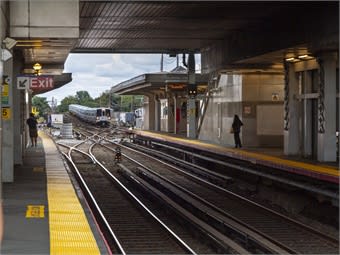
The cars have exterior destination signs on the front of cars that are visible to passengers as the train approaches the station, similar to the new cars on Metro-North’s New Haven Line.
LIRR
Long Island Rail Road (LIRR) introduced its next fleet of railcars, known as the “M9” cars, into passenger service on Wednesday.
The new cars incorporate and improve upon the most successful and popular features of the MTA’s two recent electric car fleets, the LIRR’s familiar M7s electric cars, and the M8 cars serving Metro-North’s New Haven Line, and will enhance safety.
The fleet will consist of 202 cars, the last of which are expected to begin passenger service in March 2021.
The cars have exterior destination signs on the front of cars that are visible to passengers as the train approaches the station, similar to the new cars on Metro-North’s New Haven Line. They also feature electrical outlets on both sides of the car in each row of seats, and closed loop armrests that won’t tear garments or catch bag straps.
The cars are designed and manufactured by Kawasaki Rail Car, based in Yonkers, N.Y.
LIRR
The cars will feature an innovation that is new for the first time in the region: an electronic display that will let passengers know what car within the train they are seated (for example, “Car 3 of 10”), which will be of help to customers exiting at stations where not every car will meet the platform.
Walking from car to car will become easier because between every other car there will be a door that operates at the push of a button. The seats in the cars will be slightly wider than the seats on the M7 cars, and the cars will seat more people than the M7 cars, with up to 6 additional seats in each pair of cars, according to LIRR.
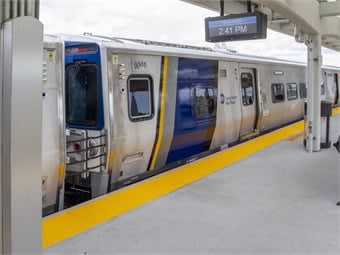
The fleet will consist of 202 cars, the last of which are expected to begin passenger service in March 2021.
LIRR
The cars also have cameras in the train engineer’s cab, facing into the cab to monitor the engineer’s alertness and facing forward to show the tracks ahead, and cameras in the passenger area of the cars to serve as a deterrent to criminal activity.
The cars are designed and manufactured by Kawasaki Rail Car, based in Yonkers, N.Y. The first 14 pilot cars were built in Japan, with these first eight aggressively tested in Pueblo, Colo., before further aggressive testing on the tracks of the LIRR. The remaining 188 cars are being manufactured in Lincoln, Neb., with final assembly taking place in Yonkers.
More Rail
Amtrak, CN Reach Agreements to Strengthen Passenger Rail Service, Safety
The agreement resolves a more than decade-long proceeding before the Surface Transportation Board concerning the terms and conditions for Amtrak services, such as the City of New Orleans, Illini/Saluki, and Wolverine.
Read More →
New York MTA Advances Final Contract for Second Avenue Subway Expansion
Contract Four is the largest in the Second Avenue Subway Phase 2 project and includes construction of station infrastructure, tracks, and signals for the subway expansion, MTA officials said. Work on Contract Four will begin in 2027.
Read More →
San Diego MTS Breaks Monthly Trolley Ridership Record
Agency officials said July’s ridership indicates MTS’s continued recovery from the pandemic.
Read More →
Report Examines NJ TRANSIT Reliability, Funding Challenges
The Garden State Initiative analysis examines the roles of Amtrak infrastructure, fleet management, and agency operations while recommending a more performance-based approach to improving reliability.
Read More →
Stadler, CapMetro Sign Long-Term Rail Fleet Support Agreement
Beginning in 2027, Stadler will provide on-site technical expertise, spare parts support, training, and obsolescence management to help extend the reliability and longevity of CapMetro’s GTW fleet.
Read More →
Biz Briefs: Alstom Lands Canadian Contract, LYT to Supply California TSP, and More
In METRO's latest installment, we take a look at recent news from Complete Coach Works, Beep, FlixBus, and more partnerships making headlines across the transportation sector.
Read More →
CATS Gold Line Marks 5 Years of Service, 2.8M Passenger Trips
With a six-mile expansion planned, the Charlotte streetcar is positioned to connect more neighborhoods and major transit hubs across the region.
Read More →
Why Simulating Pedestrian Movement Has Become Essential for Modern Rail Stations
Pedestrian microsimulation is helping rail planners identify bottlenecks, test station designs, and prepare complex transit hubs for growing passenger volumes.
Read More →
Amtrak Begins Major Construction at New York’s Sunnyside Yard
The new maintenance facility will support Amtrak’s Airo trainsets while improving maintenance efficiency and turnaround times in New York.
Read More →
Chicago Leaders Unveil Plans for O’Hare Airport Express Train
The privately developed project would offer a 15-minute trip between downtown and O’Hare’s Terminal 2, with trains operating every 15 minutes on a dedicated track. The service would use battery-electric trains and three existing freight rail rights-of-way.
Read More →