



BLOGS: Bus bunching, diffusing conflict, congestion charging, etc.
2019's Cities with the Best (and Worst) Public Transportation
Ranks 100 U.S. cities across three key dimensions: Accessibility; Convenience; Safety; Reliability; and Public Transit Resources.
by Adam McCann
January 2, 2020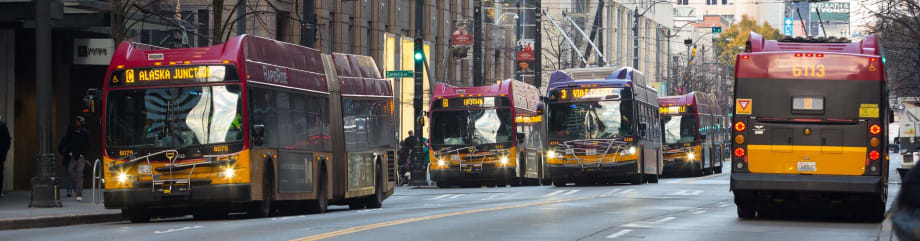
Seattle ranked as the "best" city for public transportation in the U.S. in a new report from WalletHub.
Photo: King County Metro
7 min to read
Public transportation may be a simple convenience or an absolute daily necessity, depending on the city and the size of its population. The scope of public transportation in giant metropolises like New York City can be massive.
According to the MTA, the New York City subway has over 665 mainland track miles and transports over 1.75 billion passengers per year. That’s not to mention the city’s 5,700 buses that carry over 760 million passengers per year.
There are many benefits to using public transportation over personal vehicles. The first is economic growth. According to the American Public Transportation Association, “every $1 invested in public transportation generates $4 in economic returns.” In addition, the APTA states that taking public transportation is cheaper in the long run than buying a vehicle and paying for its upkeep and gas costs. Public transportation also has drastically lower odds of an accident than driving a personal vehicle and helps to cut down pollution from emissions.
But not all cities have the same quality of public transportation. To find out where passengers will fare best during their daily commute, WalletHub compared 100 cities across 17 key metrics. Our data set ranges from share of commuters who use public transit and average age of the fleet to number of injuries and peak hours spent in congestion.
Main Findings
Cities with the Best Public Transportation
Overall Rank (1=Best) | City | Total Score | ‘Accessibility & Convenience’ Rank | ‘Safety & Reliability’ Rank | ‘Public Transit Resources’ Rank |
|---|---|---|---|---|---|
1 | Seattle, WA | 77.97 | 7 | 6 | 3 |
2 | Boston, MA | 77.84 | 2 | 34 | 10 |
3 | San Francisco, CA | 75.21 | 1 | 27 | 80 |
4 | Washington, DC | 71.23 | 3 | 48 | 52 |
5 | Madison, WI | 71.06 | 46 | 1 | 4 |
6 | Jersey City, NJ | 69.05 | 4 | 22 | 97 |
7 | New York, NY | 68.87 | 5 | 22 | 97 |
8 | Reno, NV | 68.13 | 76 | 8 | 1 |
9 | Honolulu, HI | 67.85 | 30 | 13 | 12 |
10 | Portland, OR | 66.82 | 13 | 31 | 29 |
11 | Minneapolis, MN | 66.72 | 8 | 51 | 31 |
12 | Denver, CO | 65.98 | 14 | 25 | 27 |
13 | Oakland, CA | 65.68 | 10 | 27 | 80 |
14 | Los Angeles, CA | 64.79 | 15 | 15 | 60 |
15 | San Jose, CA | 64.47 | 21 | 21 | 35 |
16 | Boise, ID | 64.45 | 82 | 3 | 37 |
17 | Lubbock, TX | 64.33 | 92 | 14 | 5 |
18 | Milwaukee, WI | 64.18 | 42 | 4 | 18 |
19 | San Diego, CA | 64.13 | 32 | 11 | 15 |
20 | Austin, TX | 63.66 | 19 | 68 | 2 |
21 | Baltimore, MD | 63.50 | 12 | 35 | 79 |
22 | Chicago, IL | 63.33 | 6 | 71 | 59 |
23 | Lincoln, NE | 63.10 | 24 | 20 | 46 |
24 | Chula Vista, CA | 62.46 | 89 | 11 | 15 |
25 | Laredo, TX | 61.52 | 99 | 5 | 43 |
26 | Santa Ana, CA | 61.48 | 35 | 15 | 60 |
27 | Long Beach, CA | 61.25 | 38 | 15 | 60 |
28 | Omaha, NE | 60.93 | 69 | 1 | 93 |
29 | Wichita, KS | 60.76 | 66 | 7 | 30 |
30 | Newark, NJ | 60.17 | 16 | 22 | 97 |
31 | Memphis, TN | 60.14 | 58 | 10 | 87 |
32 | St. Paul, MN | 59.00 | 27 | 51 | 31 |
33 | Pittsburgh, PA | 58.96 | 39 | 53 | 33 |
34 | El Paso, TX | 58.51 | 61 | 40 | 45 |
35 | Fremont, CA | 58.29 | 43 | 27 | 80 |
36 | Greensboro, NC | 58.21 | 57 | 43 | 36 |
37 | Cincinnati, OH | 58.17 | 37 | 42 | 40 |
38 | Irvine, CA | 57.88 | 70 | 15 | 60 |
39 | Toledo, OH | 57.77 | 77 | 58 | 7 |
40 | Albuquerque, NM | 57.67 | 11 | 88 | 19 |
41 | San Antonio, TX | 57.63 | 49 | 55 | 6 |
42 | Aurora, CO | 57.60 | 81 | 25 | 27 |
43 | Corpus Christi, TX | 57.43 | 54 | 67 | 8 |
44 | Anaheim, CA | 57.16 | 74 | 15 | 60 |
45 | San Bernardino, CA | 56.94 | 60 | 32 | 49 |
46 | Cleveland, OH | 56.65 | 18 | 73 | 53 |
47 | Atlanta, GA | 56.47 | 22 | 41 | 96 |
48 | Riverside, CA | 56.37 | 65 | 32 | 49 |
49 | Birmingham, AL | 56.15 | 97 | 30 | 44 |
50 | Durham, NC | 56.06 | 36 | 49 | 66 |
51 | Las Vegas, NV | 56.06 | 44 | 37 | 76 |
52 | Miami, FL | 55.86 | 20 | 45 | 94 |
53 | Tucson, AZ | 55.85 | 33 | 57 | 41 |
54 | Detroit, MI | 55.47 | 52 | 47 | 73 |
55 | Phoenix, AZ | 55.39 | 26 | 61 | 67 |
56 | Orlando, FL | 55.07 | 25 | 78 | 38 |
57 | Lexington-Fayette, KY | 54.96 | 63 | 77 | 11 |
58 | Anchorage, AK | 54.88 | 50 | 54 | 42 |
59 | Fort Wayne, IN | 54.85 | 88 | 50 | 55 |
60 | Colorado Springs, CO | 54.66 | 79 | 72 | 9 |
61 | Jacksonville, FL | 54.16 | 62 | 36 | 83 |
62 | Columbus, OH | 54.13 | 45 | 59 | 54 |
63 | Buffalo, NY | 53.91 | 40 | 56 | 75 |
64 | Stockton, CA | 53.82 | 90 | 9 | 84 |
65 | Dallas, TX | 53.78 | 29 | 79 | 20 |
66 | Nashville, TN | 53.73 | 31 | 60 | 85 |
67 | Scottsdale, AZ | 53.32 | 68 | 61 | 67 |
68 | Houston, TX | 53.32 | 34 | 70 | 65 |
69 | North Las Vegas, NV | 52.72 | 94 | 37 | 76 |
70 | Sacramento, CA | 52.09 | 51 | 44 | 90 |
71 | Virginia Beach, VA | 51.99 | 47 | 74 | 56 |
72 | Winston-Salem, NC | 51.63 | 85 | 69 | 14 |
73 | Raleigh, NC | 51.42 | 41 | 89 | 13 |
74 | Norfolk, VA | 51.18 | 48 | 74 | 56 |
75 | Irving, TX | 51.12 | 56 | 79 | 20 |
76 | Glendale, AZ | 50.84 | 98 | 61 | 67 |
77 | Garland, TX | 50.38 | 84 | 79 | 20 |
78 | Hialeah, FL | 50.28 | 83 | 45 | 94 |
79 | Fresno, CA | 50.22 | 71 | 87 | 26 |
80 | Henderson, NV | 50.09 | 95 | 37 | 76 |
81 | Louisville, KY | 49.83 | 64 | 85 | 47 |
82 | Chandler, AZ | 49.55 | 80 | 61 | 67 |
83 | Chesapeake, VA | 49.38 | 93 | 74 | 56 |
84 | Fort Worth, TX | 49.26 | 75 | 79 | 20 |
85 | Plano, TX | 49.13 | 78 | 79 | 20 |
86 | Mesa, AZ | 49.00 | 86 | 61 | 67 |
87 | Bakersfield, CA | 48.98 | 59 | 86 | 74 |
88 | Kansas City, MO | 48.76 | 23 | 93 | 34 |
89 | Philadelphia, PA | 48.73 | 9 | 97 | 86 |
90 | Gilbert, AZ | 48.52 | 100 | 61 | 67 |
91 | St. Louis, MO | 46.51 | 17 | 96 | 51 |
92 | Baton Rouge, LA | 46.26 | 91 | 91 | 17 |
93 | Arlington, TX | 45.70 | 96 | 79 | 20 |
94 | Oklahoma City, OK | 45.64 | 55 | 90 | 89 |
95 | Tulsa, OK | 43.02 | 72 | 94 | 48 |
96 | New Orleans, LA | 42.43 | 28 | 92 | 100 |
97 | Charlotte, NC | 40.67 | 53 | 95 | 88 |
98 | Tampa, FL | 24.69 | 67 | 98 | 91 |
99 | St. Petersburg, FL | 24.03 | 73 | 98 | 91 |
100 | Indianapolis, IN | 21.13 | 87 | 100 | 39 |
Survey Methodology
To determine the cities with the best and worst public transportation systems, WalletHub compared a sample of 100 U.S. cities across three key dimensions: 1) Accessibility & Convenience, 2) Safety & Reliability and 3) Public Transit Resources.
We evaluated those dimensions using 17 relevant metrics, which are listed below with their corresponding weights. Each metric was graded on a 100-point scale, with a score of 100 representing the most favorable living conditions.
Finally, we determined each city’s weighted average across all metrics to calculate its overall score and used the resulting scores to rank-order the cities in our sample. Our sample considers only the city proper in each case and excludes cities in the surrounding metro area.
Accessibility & Convenience – Total Points: 40
Share of Commuters Who Use Public Transit: Double Weight (~6.15 Points)
Average Commute Time for Transit Users: Full Weight (~3.08 Points)
Average Car Commute Time as Share of Average Public Transport Commute Time: Double Weight (~6.15 Points)
Transit Connectivity Index: Full Weight (~3.08 Points) Note: The TCI is a measure of how connected the average household member is to the availability of a transit ride.
Jobs Accessible Within a 30 Minute Transit Commute per 100 Civilian Employed Residents: Full Weight (~3.08 Points)
Peak Hours Spent in Congestion: Full Weight (~3.08 Points) Note: The total number of hours lost in congestion during peak commute periods compared to free-flow periods on a per capita basis. Peak corresponds to the absolute worst portion of the morning and afternoon commute, while free-flow is the best performance experienced over 24 hours.
Annual Public Transport Cost as Share of Median Annual Household Income: Double Weight (~6.15 Points)
Share of Commuters Who Prefer Public Transport: Full Weight (~3.08 Points) Note: This refers to commuters that choose public transportation even if they have one or more vehicles available.
Presence of Dedicated Rapid Bus & Rail Transport: Full Weight (~3.08 Points) Note: This binary metric measures the presence or absence of dedicated rapid bus and rail systems in a city.
Airport Accessibility by Public Transit: Full Weight (~3.08 Points) Note: This binary metric measures the presence or absence of a direct fixed-guideway access to an airport terminal or free bus shuttle access from rail station to an airport terminal.
Safety & Reliability – Total Points: 40
Public Transit Safety and Security Events per Passenger Miles Traveled: Full Weight (~10.00 Points) Note: Events include the following: collision, derailment, fire, security and not otherwise classified events.
Public Transit Injuries per Passenger Miles Traveled: Full Weight (~10.00 Points)
Public Transit Fatalities per Passenger Miles Traveled: Double Weight (~20.00 Points)
Public Transit Resources – Total Points: 20
Public Transport System Total Fixed Guideway Directional Route Miles per Urbanized Area Population: Full Weight (~4.00 Points) Note: The mileage in each direction over which public transportation vehicles travel while in revenue service.
Total Public Transit Vehicles Operated in Annual Maximum Service per Service Area Population: Double Weight (~8.00 Points) Note: The number of revenue vehicles operated to meet the annual maximum service requirement.
Average Age of Public Transit Fleet: Full Weight (~4.00 Points)
Average Lifetime Miles per Active Vehicles: Full Weight (~4.00 Points) Note: The total miles accumulated on all active vehicles since date of manufacture divided by the number of active vehicles.
Article, originally posted Sept.10, 2019, reprinted with permission from WalletHub.com
More Management

Brian Dickson on Building Stronger, More Resilient Transportation Organizations
Bus Business Consultants Founder Brian Dickson discusses the leadership principles, operational discipline, and strategic planning that separate transportation companies positioned for long-term success from those stuck in survival mode.
Read More →
LA Metro Breaks Ground on Vermont BRT Project
The 12.4-mile corridor is projected to serve 66,200 daily riders, reduce travel times by up to 24%, and create the nation's busiest bus rapid transit corridor.
Read More →
Building Stronger Leaders, More Resilient Transit Teams
Dr. Carol Parker Walsh discusses leadership development, employee retention, workplace culture, and preparing transit’s workforce for AI and automation.
Read More →
Roman Cornell on ABC Companies’ Evolution and the Future of Passenger Transportation
The company’s CEO discusses carrying forward a third-generation family legacy, ABC’s continued evolution in passenger transportation, support for increasingly complex fleets, and how technology and continued investment could help operators improve uptime.
Read More →
CATS Launches West Charlotte Microtransit Zone, Expands Transit Services
The new microtransit zone connects residents to key destinations as Charlotte Area Transit System rolls out the first phase of its 2055 Transit System Plan.
Read More →
VIA Bus Ridership Grows 10.1% Through August 2026
San Antonio's VIA Metropolitan Transit reported the highest bus ridership growth among major Texas transit systems. Federal Transit Administration data ranked it second among the nation's 50 largest transit systems.
Read More →
CSA Group Releases Climate Resilience Standard for Transit, Passenger Rail
Developed with support from the Standards Council of Canada, CSA D700 guides assessing climate-related risks and planning adaptation measures for transit and passenger rail systems.
Read More →
ETA CEO John Maglio on Transit Technology, Innovation, and Building Agency Trust
ETA founder and CEO John Maglio explores the evolution of transit technology, the importance of reliable systems, and how stronger partnerships can help agencies improve operations and the passenger experience.
Read More →
COTA Launches First Customer Experience Action Plan to Improve Transit Service
The new plan outlines improvements to service reliability, accessibility, communication, and the overall rider experience across Central Ohio's transit system.
Read More →
LA Metro September Ridership Climbs 3.9%, Led by Rail Growth
The agency recorded more than 27.2 million boardings, with rail ridership increasing 12.4% year over year and the D Line posting the largest gains.
Read More →