During the last fiscal year (July 2023 – June 2024), the transit agency logged 75,663,343 passenger trips, a 10.4% increase over Fiscal Year 2023 (68,511,363).
The public transit agency is experiencing an upswing in its ridership, consistently reaching 85% to 90% of pre-pandemic ridership, thanks to agency-wide efforts to attract more riders.
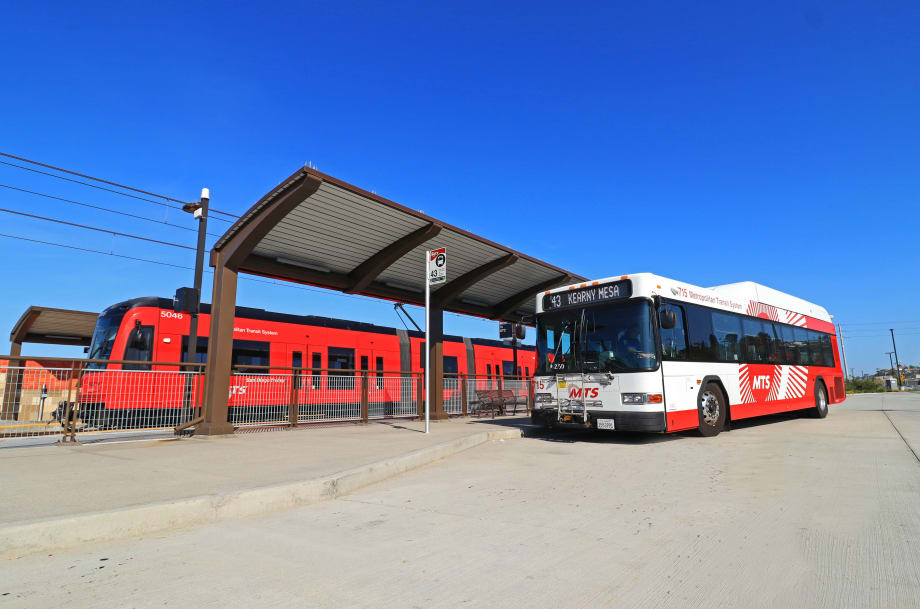
Photo: MTS
2 min to read
The San Diego Metropolitan Transit System (MTS) announced ridership increased more than 10% over the past year as more and more residents opt to use the transit system to get around.
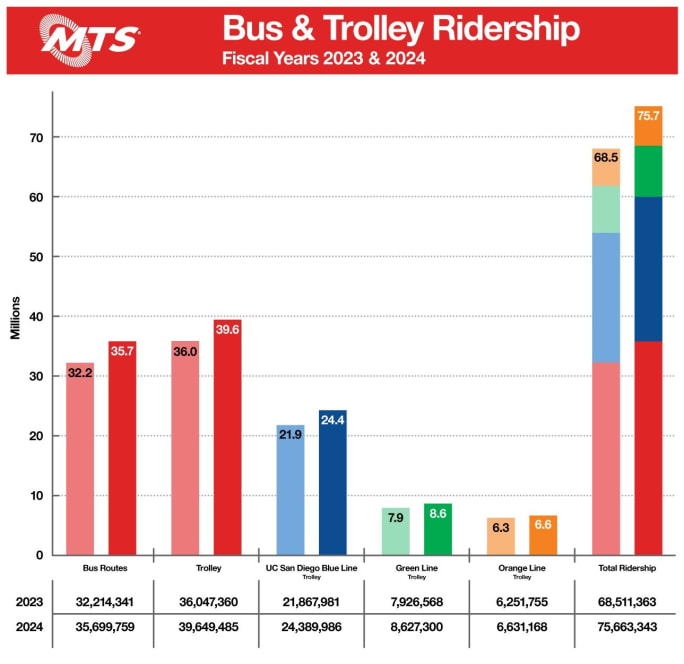
During the last fiscal year (July 2023 – June 2024), the transit agency logged 75,663,343 passenger trips, a 10.4% increase over Fiscal Year 2023 (68,511,363).
Ad Loading...
“We believe the increase in ridership is due to a number of factors,” said MTS CEO Sharon Cooney. “People are working from home less often or not at all, MTS provides a reliable alternative to driving a car, and taking transit is much more affordable than driving. With inflation, rising costs of housing, and strained pocketbooks, residents are looking for any way they can to save money. Taking transit is a great way to do that.”
MTS ridership totals for Fiscal Years 2023 and 2024, broken down by bus service and Trolley service. MTS Access [paratransit] totals are not broken down in the chart above but are included in the total ridership column. Paratransit ridership is 249,662 for 2023 and 314,099 for 2024, a 25.8% increase.
Youth ridership increased by 22.7% over the previous year, logging 6,839,876 passenger trips from its more than 113,000 youth riders who use a Youth Opportunity Pass.
Thirteen bus routes experienced increases of 20% or higher.
Eight bus routes surpassed the million-trip mark.
The highest ridership month in Fiscal Year 2024 was October 2023, with 6,929,191 passenger trips.
The agency also shared that in May it experienced a week with an average of 271,000 passengers per day, the highest week on record since the onset of the pandemic.
Snapping Back Post Pandemic
During the pandemic, MTS experienced a steep decline in ridership as hundreds of thousands of San Diegans stayed home.
Ad Loading...
Due to the loss in ridership, and because approximately 25% of MTS’s system operation is supported by fare revenue, the agency is experiencing a multi-million-dollar structural budget deficit.
But now, the public transit agency is experiencing an upswing in its ridership, consistently reaching 85% to 90% of pre-pandemic ridership, thanks to agency-wide efforts to attract more riders.
Other factors that contribute to growing ridership are workers returning to the office, students returning to school, housing density, special events, and more.
During the pandemic, MTS experienced a steep decline in ridership as hundreds of thousands of San Diegans stayed home.
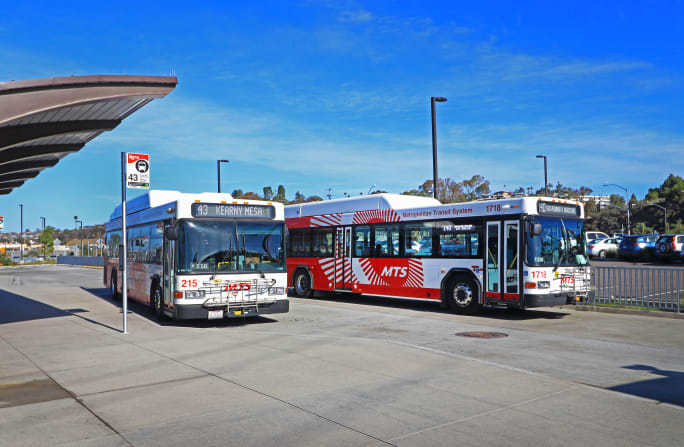
Photo: MTS
More Positive Changes on the Way
The agency also plans to continue implementing improvements in the coming years to make transit more reliable and accessible.
Ad Loading...
The improvements include an overnight express bus service between the border and downtown San Diego, increased bus and Trolley frequencies, infrastructure rehabilitation on the Orange Line Trolley, and charging infrastructure for the zero-emissions transition.
The improvements will be funded in part by state funding secured by Senate Bill 125 and implemented once the funds are delivered to MTS.
Contract Four is the largest in the Second Avenue Subway Phase 2 project and includes construction of station infrastructure, tracks, and signals for the subway expansion, MTA officials said. Work on Contract Four will begin in 2027.
The new regional transit authority appointed its first board chair and interim executive director while extending reduced fares across CTA, Metra, and Pace for eligible riders.
Reliability-Centered Maintenance helps transit agencies move beyond routine checklists to focus limited resources on the assets and failures that have the greatest impact on safety, reliability, and service.
The 90-day demonstration will deploy coordinated security teams at five light rail stations while testing controlled access and gathering data to guide future investments.
Learn about delivering 1300 gates at 91 stations while managing fare evasion. Explore the large scale deployment, solution customization and real-world results that affect the region. Prepare for deployment in your region now.
Between packed transit stations and team motorcoaches, see how agencies and operators across North America tackled the transportation demands of the 2026 FIFA World Cup.
The stopgap keeps federal transportation programs moving, but missing advance funding could complicate the transit and rail projects agencies are planning next.