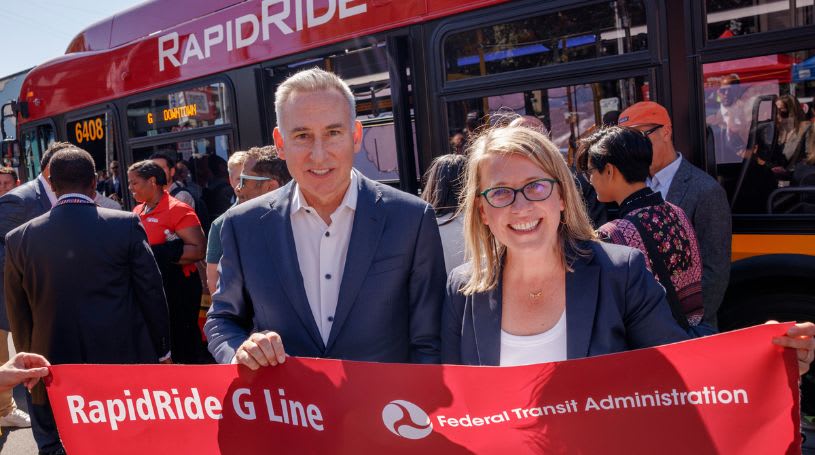
County Executive Dow Constantine and Metro GM Michelle Allison with a piece of the ribbon at the RapidRide G Line ribbon cutting celebration
Photo: KC Metro
3 min to read
King County Executive Dow Constantine joined city, county, federal, and community leaders to celebrate the completion of major construction on the RapidRide G Line project, King County Metro’s eighth RapidRide line.
The ribbon-cutting ceremony in Capitol Hill paves the way for the start of service.
Ad Loading...
Metro’s RapidRide G Line
The new RapidRide G Line adds miles of red bus lanes, along with extensive upgrades and improvements to Madison St.
The line will connect Downtown Seattle with First Hill, Capitol Hill, Central District, and Madison Valley, providing a vital link between these key areas and offering the highest quality bus service in the region.
The redesigned Madison St. will improve safety around schools, small businesses, libraries, and hospitals, and the project also included sidewalk repairs, new walk and bike signals, and rebuilt utilities.
“Seattle has many reasons to celebrate this robust new transit line and the wide array of safety, accessibility, and connectivity improvements through some of our most vibrant neighborhoods,” said Seattle Mayor Bruce Harrell. “This upgrade and new six-minute service has been long anticipated for neighborhoods like the Central District, Capitol Hill, Downtown, and Madison Valley, and will bring real benefits.”
The Project
The $144.3 million RapidRide G Line project was funded through a combination of $80.5 million in federal grants, with additional contributions coming from Sound Transit ($35.8 million), the Levy to Move Seattle ($19.7 million), King County Metro ($3.5 million), WSDOT grants ($2.5 million), and other City of Seattle transportation sources ($2.3 million).
Ad Loading...
The federal grants included $59.9 million from the Federal Transit Administration’s (FTA) Small Starts program and $10.9 million from President Biden’s American Rescue Plan.
“The RapidRide network has become a critical economic and personal asset for millions of riders throughout the Puget Sound region,” said FTA Acting Administrator Veronica Vanterpool. “Adding this service to Madison Street will help connect families to each other, patients to healthcare, students to education, and get everyone where they need to go faster, safer, and more frequently. Thank you to everyone who made this investment a reality.”
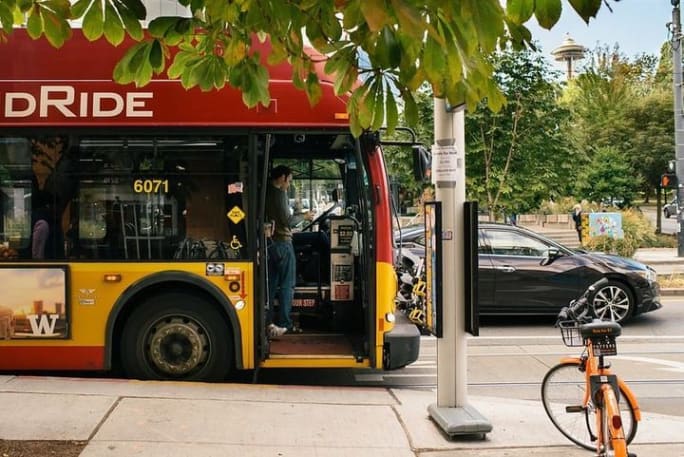
The RapidRide G Line will offer frequent service with new 60-foot, five-door buses arriving every six minutes most of the day to ensure reliable and efficient travel.
Photo: SDOT
Highlight of the RapidRide G Line
The RapidRide G Line will offer frequent service with new 60-foot, five-door buses arriving every six minutes most of the day to ensure reliable and efficient travel.
Dedicated bus lanes and faster boarding with center-running bus stations will reduce commute times and enhance ridership, while new curb ramps, crosswalks, and sidewalks improve accessibility.
Additionally, the project also included significant infrastructure upgrades like replacing a 120-year-old water main to improve drainage and wastewater systems and upgrading street lighting and power distribution.
Ad Loading...
“The new RapidRide G Line will deliver frequent and reliable service across Madison Valley, Capitol Hill, the Central District, First Hill, and downtown Seattle,” said Metro GM Michelle Allison. “This collaborative, regional effort serving some of Seattle’s oldest neighborhoods will improve lives, help local businesses, and expand access to opportunity.”
Bus Business Consultants founder Brian Dickson shares lessons on leadership, organizational health, and creating options for long-term success in a changing transportation industry.
The proposed agreement calls for a 50% increase in bus service in Everett, a new microtransit zone, continued paratransit service, and the transfer of Everett Transit operations to Community Transit.
The plan outlines investments in trolley modernization, new Metro and Regional Rail vehicles, accessible stations, and more frequent bus and rail service.
The “Buses Mean Business” report examines the transit bus manufacturing industry’s economic footprint, supply chain, and rising demand for vehicle replacements.
In this edition, we also cover recent appointments and announcements at the Wabtec, SilverRide, HNTB, and more, showcasing the individuals helping to shape the future of transportation.
The agency is seeking manufacturers for 650 new CNG buses to replace aging vehicles, improve reliability, and advance its broader fleet modernization strategy.
John Hroncich discusses BAE Systems’ modular and scalable approach, lessons learned from decades of real-world operations, and how agencies can identify electrification strategies that fit their fleets.
LA Metro’s Obed Mejia discusses technician training, evolving maintenance technology, fleet replacement, and strategies for getting the most out of today’s transit fleets.