




Check out more from New York: Baseball Fans Take Nostalgic Trains to Ballpark
NY MTA Announces Details of Queens Bus Network Redesign
As the Queens Bus Network Redesign approaches, the New York MTA has released the implementation dates of the two-phase project that will increase the number of routes in the area from 113 to 124.
April 9, 2025
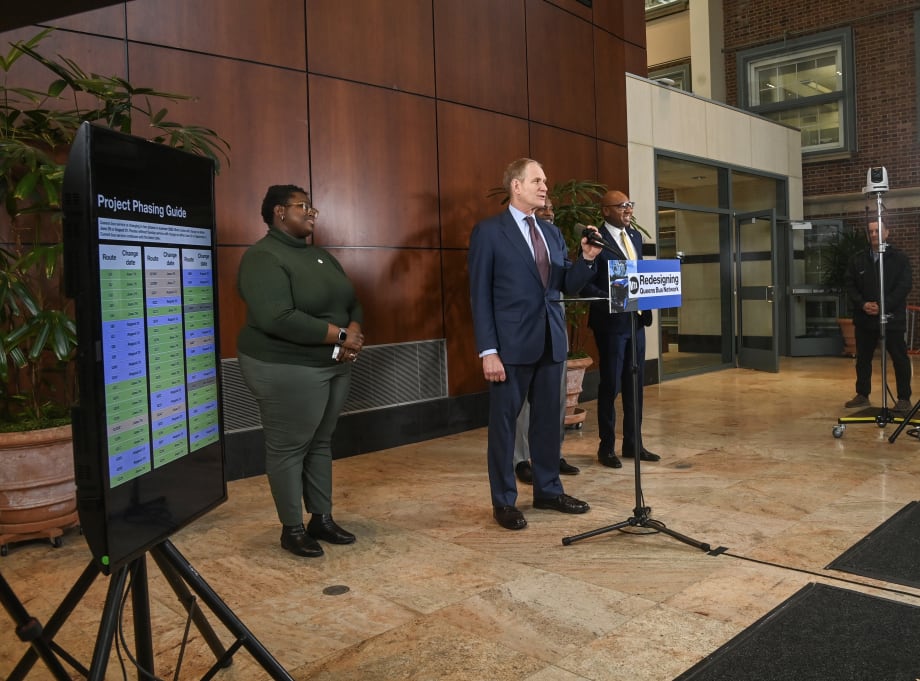
MTA Chair & CEO Janno Lieber, NYCT President Demetrius Crichlow, Queens Borough President Donovan Richards, and NYC DOT Assistant Commissioner Diniece Mendes announcing the two-phase implementation of the Queens Bus Network Redesign. Details on what routes are changing can be found on the MTA's website.
Photo: Mark A. Herman/MTA
3 min to read
The New York Metropolitan Transportation Authority (MTA) recently announced the specific dates that the Queens Bus Network Redesign will be implemented. Over the summer, each Queens bus route slated to change due to the redesign will have its changes implemented.
MTA has also released a tool for customers that outlines when each change will be implemented, what the new routes will look like, and the latest information on each specific route.
“800,000 Queens residents depend on our buses daily, and we owe it to them to find new ways to speed service,” said MTA Chair and CEO Janno Lieber. “No matter what else is going on in New York right now, the new MTA is listening to our customers and delivering bus speed improvements – whether it’s by transformative redesign of the bus network, Automated Camera Enforcement, or congestion pricing.”
Implementing the Redesigned Bus Network
The network redesign will be implemented in two phases, on June 29 and August 31, which align with the regular seasonal timetable changes.
In phase one, 16 new routes will launch, 67 will be changed, and five will be discontinued. Phase two features one new route, 37 additional routes being changed, and a second route discontinued.
The final redesign includes 124 routes, up from the existing 113, with 94 local routes and 30 express routes.
Tools to Keep Track of the Changes
MTA’s new route lookup tool is compatible with Google Translate, enabling customers to read information about their specific routes in their preferred language.
Customers can visit MTA’s website to preview the new network with Remix, an interactive web-based mapping tool that lets riders see if and how routes are being changed.
The Future Trip Planner offers a more personalized approach, enabling the input of a start and ending location and seeing trip options for when the network redesign is completed in August of this year.
“Now all Queens bus riders have the tools necessary to plan for their trip on the new network designed to provide faster and better bus service,” said New York City Transit President Demetrius Crichlow. “As implementation dates near, we’ll ramp up the outreach efforts to make sure everyone’s aware about the upcoming changes. In the meantime, we strongly encourage bus riders to take advantage of the online tools which provide the best-customized approach to learn more about how your trip can change.”
Getting Ready for New Bus Routes
The NYC DOT is continuing to change physical signage at bus stops throughout the spring in order to prepare for the redesign's launch dates.
All Queens redesign-related service changes will take place on June 29 and August 31, 2025. During this time, the MTA app and Bus Time will provide the most accurate service information.
Signage is also being installed to alert customers of the upcoming changes in permanent Guide-A-Ride boxes on most bus stop poles. The signage will highlight specific changes being made to that location.
and modern bus network, holistically designed for the future, not the past,” said NYC Department of Transportation Commissioner Ydanis Rodriguez. “We are proud to support the implementation of this redesign in partnership with the MTA to deliver enhanced bus service and bus stops for Queens riders, and we will continue to develop and implement bus priority projects that complement the Network Redesign service changes.
A public education campaign was launched on February 20. It includes onboard bus announcements and additional digital and print signage to be installed across bus stops, buses, and the subway system this spring.
The project team plans to promote the phasing information and present it to Queens community boards in April and May.
Popup outreach events will also be announced as the first implementation date approaches. More details about the planned Customer Ambassador Program will also be shared closer to June 29.
MTA will keep customers informed before, during, and after each phase of implementation via social media, paid advertising, and email and SMS alerts.
More Bus

New York MTA Plans Largest Bus Fleet Upgrade in More Than a Decade
The agency is seeking manufacturers for 650 new CNG buses to replace aging vehicles, improve reliability, and advance its broader fleet modernization strategy.
Read More →
Building a Flexible Path to Transit Electrification
John Hroncich discusses BAE Systems’ modular and scalable approach, lessons learned from decades of real-world operations, and how agencies can identify electrification strategies that fit their fleets.
Read More →
Bus Tech Talk: Keeping Transit Technicians Ahead of the Technology Curve
LA Metro’s Obed Mejia discusses technician training, evolving maintenance technology, fleet replacement, and strategies for getting the most out of today’s transit fleets.
Read More →
Biz Briefs: RIPTA Unveils New Frontrunners, Clevland RTA Adds New Siemens, and More
In METRO's latest installment, we take a look at recent news from Siemens, Prevost, Dodge, and more partnerships making headlines across the transportation sector.
Read More →
People Movement: Holly Arnold Joins Transdev and More
In this edition, we also cover recent appointments and announcements at Pace, CamTran, MCI, and more, showcasing the individuals helping to shape the future of transportation.
Read More →
The High Cost of Transit Buses: Industry Leaders Look to Procurement Reform
Transit leaders and policymakers examine how standardized bus designs, streamlined procurement, and predictable funding could help agencies stretch budgets and deliver better service.
Read More →
The Business Voice Behind Public Transportation
As chair of APTA’s Business Members Board of Governors, Ray Melleady explains how more than 850 business members are partnering with transit agencies to advance funding, innovation, and industry-wide collaboration.
Read More →
From Surviving to Thriving: Building Stronger Transportation Organizations
Bus Business Consultants founder Brian Dickson shares lessons on leadership, organizational health, and creating options for long-term success in a changing transportation industry.
Read More →
Finding the ‘Happy Medium’: Optimizing Maintenance Without Sacrificing Reliability
The key to maintenance optimization isn’t doing less work—it’s doing the right work at the right time on the right assets.
Read More →
LA Metro, City of West Hollywood, and Partners Advance Smarter Bus Lane Enforcement
The award-winning partnership combines AI-powered detection with human oversight to improve bus reliability, accessibility, and enforcement efficiency.
Read More →