



Innovation Showcase: Autonomous Buses Are on the Horizon
Autonomous vehicle technology has advanced dramatically and will likely reach mass markets in 2027. We examine how the technology is developed and what it means for public transportation systems and driverless buses.

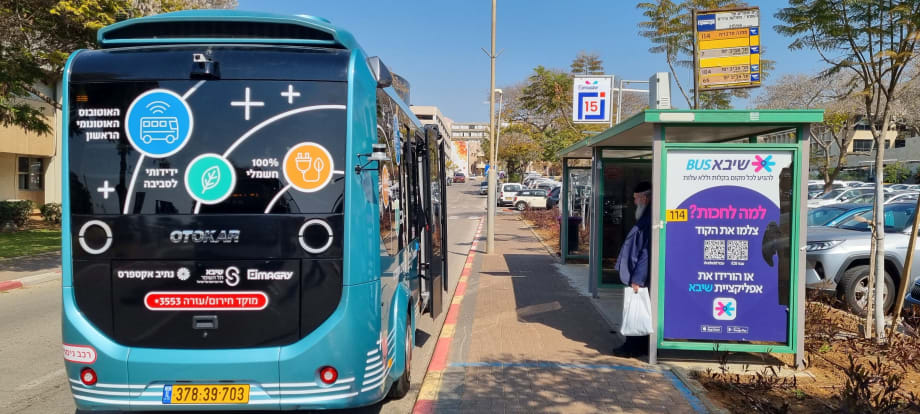
In the near future, it may be possible that when a bus picks you up, there will not be a driver on board to greet you.
Photo: Imagry
- Autonomous vehicle technology is expected to become widely accessible by 2027.
- The article explores the development process of this technology and its implications for public transportation.
- Driverless buses represent a potential shift in public transit systems with this advancement.
*Summarized by AI
Autonomous vehicles are on the rise as companies continue to pursue the vision of driverless cars. This technology is also being looked at for incorporation into public transit through robotaxis and fully autonomous buses.
The principles behind autonomous buses are the same as those behind other autonomous vehicles. They provide a transportation solution that uses computer systems to drive the vehicle rather than a human.
Imagry is one company looking to make driverless transit a reality with its fully autonomous buses.
HD Maps or Mapless Autonomous Driving
For autonomous vehicles to operate, they must understand their surroundings and where things are.
When implemented in a smaller, controlled area, a high-definition map that is accurate down to five centimeters can be uploaded to the vehicle. However, there are some downsides to using maps like this.
HD maps require significant storage and the ability to send large amounts of data to the vehicle quickly. Due to their required accuracy, they are also expensive to create.
The maps also require high computing power to process, which can be challenging to put on board a moving vehicle. Finally, cyberattacks can be leveraged against cars that rely on maps by constantly accessing the open ports needed to receive map data.
These factors make them an unrealistic option when implementing autonomous vehicles on public roads, especially in countries like the U.S., where massive road networks must be mapped.
With these considerations in mind, Imagry is developing a mapless driving system. Mapless systems offer greater flexibility and adaptability, enabling autonomous vehicles to operate more effectively in urban environments where road conditions can change quickly.
“Autonomous driving won’t happen if you need to send HD maps into autonomous vehicles,” said Eran Ofir, CEO of Imagry. “You see them get stuck because what they see doesn’t fit what they have on the map. HD maps are costly and very complicated to update continuously.”
Developing Autonomous Vehicles
Whether an autonomous vehicle uses HD maps or mapless navigation, a lot of computing power will be required to run the AI systems that enable it to navigate. Until recently, it was impossible to put computers capable of running AI systems in moving vehicles.
Recent developments from chip companies have enabled autonomous vehicle research to move forward. With the new chips coming to market, equipping vehicles with autonomous driving systems is becoming easier.
The most basic forms of autonomous systems are available now, with features like parallel parking assist. The following features will likely be introduced to the market: autonomous parking and traffic jam assist.
As these features become more advanced, fully autonomous vehicles will become more common. Autonomous vehicles are already on the road, but still require driver intervention in unpredictable situations.
“I typically say we will have autonomous vehicles on the mass market around 2027,” said Ofir. “Most OEMs and teams we are working with intend to launch Software Defined Vehicles around early 2027. Many new vehicles will have entry-level autonomous driving features.”
Software-defined vehicles are not fully autonomous or driverless, but are essentially computers on wheels. They are the first step to truly driverless vehicles, including buses.
Another requirement for autonomous buses is a drive system compatible with computer systems. Sending turning directions and steering the bus directly becomes easier for AI systems.
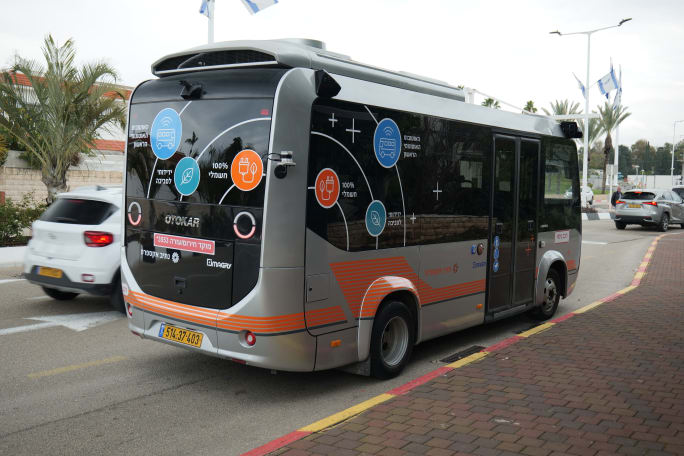
Imagry predicts it will launch its first driverless autonomous bus on public roads by the end of the year, marking a major step forward in autonomous vehicle technology.
Photo: Imagry
Regulations and Deployment of Autonomous Buses
Government regulations play an important role in deploying autonomous vehicles. Currently, most autonomous vehicles on the road are level three vehicles that still require a driver to take over if necessary.
Level three vehicles perform best in smaller, controlled zones accommodating self-driving cars.
Level four autonomous vehicles are completely driverless and have also started to appear as small transportation vehicles, such as robotaxis. Imagry hopes to lead the development of autonomous vehicles by deploying level four buses on city streets overseas.
These full-sized autonomous buses undergo rigorous testing in controlled facilities to demonstrate their ability to navigate urban environments safely. The tests simulate a pedestrian suddenly jumping in front of the bus and other possible traffic conditions.
Another aspect that the buses will be tested on is their cybersecurity features. When a truly driverless vehicle is deployed, the threat of a remote takeover could lead to dangerous situations.
After completing all of these tests and meeting other regulations set forth by local authorities, the buses can be deployed on the field with safety drivers.
When selecting locations to test the technology, Imagry searched for places with few regulations for autonomous vehicles. This would allow them to conduct their tests more easily while meeting the benchmarks set by other, more stringent parts of the world.
The U.S. allowed for the construction of testing and development facilities in California, Nevada, and Arizona to help them establish a technological baseline.
Israel is also a location Imagry uses for testing due to the presence of an autonomous vehicle development center and progress in autonomous bus technology; however, their requirements differ from those of the other locations, and both areas requested Imagry’s involvement.
The final factor when deciding where to test the buses is the weather. The technology can be refined more easily by choosing sunny locations without snow and ice regulations.
Selection of Deployment Locations
So far, Imagry has been working on autonomous bus projects in Israel, Japan, and Portugal, and proposals are under consideration in several other European countries.
These locations are being selected in part due to local laws and regulations regarding autonomous vehicles. Developing rules is key to deploying autonomous buses on regular city streets.
Driving on normal roads is a key part of Imagry’s projects. While some autonomous vehicle systems are given dedicated driving lanes, Imagry’s buses will be driving alongside everyone else.
Even with all the controlled tests, one final test must be conducted to prove that the vehicles can operate without drivers.
The final test varies depending on where the deployment is; however, for most European countries, the bus must travel 100,000 kilometers (approximately 63,000 miles) without human intervention or incident with a safety driver present.
Once the final proof that the autonomous bus can navigate the area is provided, the safety driver can be removed from the vehicle. Imagry expects to be the first company worldwide to meet these requirements and to have a fully autonomous bus on the road by September 2025.
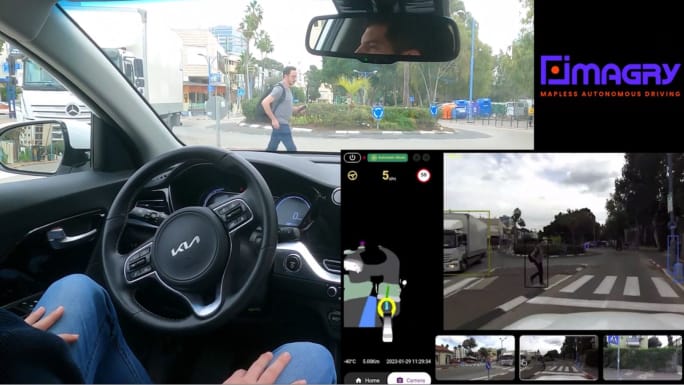
This car is equipped with Imagery's self-driving technology, which uses cameras and AI to determine obstacles and find a route to its destination.
Photo: Imagry
Global Deployment and Market Opportunities
The current markets that Imagry is looking to deploy in have the highest potential for autonomous buses.
One factor that supports the deployment of autonomous buses is the global bus driver shortage. With driverless buses, transit agencies can deploy more routes while saving on driver costs due to the high driver shortage.
Concerns about job displacement have been raised, but Imagry is working with local public transit operators and unions to address them in every situation where it plans to deploy its autonomous buses.
Autonomous buses are also more likely to be widely adopted by younger generations, as older riders who have tried the technology have expressed greater caution about driverless buses.
The biggest question regarding autonomous buses is when they will become widely available. Legally deploying an autonomous bus in certain areas may take some time.
The U.S., specifically, is likely to take longer due to its current state of autonomous vehicle regulation. In addition, the electric buses currently in the country are often unsuitable for conversion into autonomous buses.
“There is no regulation, no legislation, federal or state, for autonomous mass transportation,” said Ofir. “No one is dealing with it yet. I have been to DC a few times and spoken with Congress members, and they’re still thinking about robot taxis that drive one or two passengers at a time. They don’t think about autonomous buses.”
If lawmakers address the regulatory gap and provide incentives for autonomous electric buses, they could soon be used in public transit systems.
Driverless vehicles have been on the horizon for several years now, and thanks to recent technological advancements in computer hardware, they are closer to reality than ever. The ability to create self-driving cars exists; however, significant regulatory and safety work remains to be done.
With the first fully autonomous buses predicted to hit the road at the end of the year and Japan’s lofty goals of transitioning its public transit systems completely to autonomous vehicles, it may not be long before we can step onto a bus without a driver.
Quick Answers
Autonomous vehicle technology has seen significant advancements, allowing for the development of driverless systems capable of safe and efficient operation. These include improved sensors, machine learning algorithms, and regulatory frameworks that support testing and deployment.
*Summarized by AI
More Technology

From Hardware to Digital Partner: Luminator Charts Its Next Chapter
CEO Magnus Friberg discusses Luminator’s shift toward becoming a digital partner, the growing importance of software and interoperability, and how AI can help agencies improve operations and passenger experience.
Read More →
Beyond the Checklist: A Structured Approach to Transit Maintenance
Reliability-Centered Maintenance helps transit agencies move beyond routine checklists to focus limited resources on the assets and failures that have the greatest impact on safety, reliability, and service.
Read More →
NJ TRANSIT Advances Bus Technology Upgrades Across Statewide Fleet
More than 1,500 buses now feature upgraded technology designed to improve arrival predictions and provide free Wi-Fi, with deployment expected to reach nearly 2,000 buses by the end of 2026.
Read More →

Building a Flexible Path to Transit Electrification
John Hroncich discusses BAE Systems’ modular and scalable approach, lessons learned from decades of real-world operations, and how agencies can identify electrification strategies that fit their fleets.
Read More →
Biz Briefs: Alstom Lands Canadian Contract, LYT to Supply California TSP, and More
In METRO's latest installment, we take a look at recent news from Complete Coach Works, Beep, FlixBus, and more partnerships making headlines across the transportation sector.
Read More →
From Legacy Silos to Conversational Intelligence
What if transit leaders could ask any operational question and get a trusted answer in seconds? Conversational AI is transforming how agencies use their data.
Read More →
USDOT Announces Rail Vehicle Replacement Grants, Chattanooga AV Shuttle Funding
More than $191 million in federal funding will help three transit agencies replace aging rail vehicles and support a new autonomous shuttle service in Chattanooga.
Read More →
Bus Tech Talk: Keeping Transit Technicians Ahead of the Technology Curve
LA Metro’s Obed Mejia discusses technician training, evolving maintenance technology, fleet replacement, and strategies for getting the most out of today’s transit fleets.
Read More →
Biz Briefs: RIPTA Unveils New Frontrunners, Clevland RTA Adds New Siemens, and More
In METRO's latest installment, we take a look at recent news from Siemens, Prevost, Dodge, and more partnerships making headlines across the transportation sector.
Read More →
Why Simulating Pedestrian Movement Has Become Essential for Modern Rail Stations
Pedestrian microsimulation is helping rail planners identify bottlenecks, test station designs, and prepare complex transit hubs for growing passenger volumes.
Read More →