



Inside Look: LYT Redesigns Platform for Smarter Transit Management
METRO Executive Editor Alex Roman recently had the opportunity to speak with LYT’s Founder and CEO, Timothy Menard, about how the company’s updated product came about and its potential impact on the public transit industry.


LYT runs in the cloud, connects with existing signal infrastructure, and reduces the need for roadside hardware and ongoing field maintenance.
Photo: METRO
- METRO Executive Editor Alex Roman interviewed Timothy Menard, the Founder and CEO of LYT, to discuss the company's platform redesign.
- The updated product from LYT aims to enhance transit management by integrating smarter solutions.
- The conversation explored the potential influence of LYT's redesign on the public transit sector.
*Summarized by AI
At this year’s American Public Transportation Association (APTA) TRANSform Conference in Boston, LYT unveiled a more streamlined and intuitive approach for agencies to manage traffic flow, enhance transit performance, and address community needs, leveraging its software platform.
LYT runs in the cloud, connects with existing signal infrastructure, and reduces the need for roadside hardware and ongoing field maintenance.
The updated product is a result of LYT working closely with its public transit industry partners across the country, who expressed a desire for data tools that are easier to use, provide more accurate real-time information, and consolidate operations in one place.
Findings and the Resulting Updates
A recent nationwide survey of transit professionals found:
39% said their current dashboards are “only moderately user-friendly with frustrations.”
31% described their dashboards as “somewhat challenging.”
43% cited a “lack of real-time data accuracy” and the need to “manually combine data from one system to another” as their biggest frustrations.
44% said fragmented information “moderately” limits their view of operations, while 29% called it a “significant” barrier.
53% said they are “very likely” to consider a new dashboard that makes accessing and sharing data easier.
58% believe a more connected, user-friendly solution would “significantly” improve their ability to respond to emergencies.
As a result of those findings, highlights of LYT’s updated platform include:
One connected platform. Transit, public safety, and public works teams can now manage bus priority, emergency response, and snowplow operations in one place.
Simpler design. A clean interface with clear menus, updated visuals, and a more intuitive map view enables staff to find and act on information more quickly.
Real-time visibility and reporting. Teams can track vehicles, signals, and priority events in real-time, and quickly generate route- and intersection-level insights without additional manual work.
METRO Executive Editor Alex Roman recently had the opportunity to speak with LYT’s Founder and CEO, Timothy Menard, about how the company’s updated product came about and its potential impact on the public transit industry.

LYT’s Founder and CEO Timothy Menard on the show floor at APTA TRANSform in Boston in September.
Photo: METRO
Feedback Leading to New Features and More
Can you explain how you engaged with customers and how that feedback cycles back into the product?
Our product team is in constant contact with existing clients and often gets involved with potential clients in the later stages as well. For this report, we also conducted a nationwide survey to capture broader perspectives — what’s working, what issues are most pressing.
What we consistently heard was that customers are happy to see all their data in one place, finally. Still, now they want help identifying the one to two percent of data points that actually signal a real problem. That has become a major driver of our product development, as we highlighted in the demo here.
How data-savvy are transit agencies today? Are they requesting more complex information, or are they still seeking simplified reporting?
There’s definitely a spectrum. Some users are actual power users — they know tools like Tableau and want raw data so they can run their own analyses. We’ve learned a lot by observing those sessions.
On the other hand, there’s still a large group that wants confidence in the outputs: ‘Show me how you validated this so I can trust it and move forward.’ And, of course, plenty of people fall in between.
How quickly were you able to revamp the product based on this feedback?
We took a ‘measure twice, cut once’ approach. Customer outreach lasted approximately six months to refine priorities effectively. Then, in the following three months, we built wireframes, mocked up concepts, and started testing with the community. That phased approach ensured we were delivering what customers actually needed.
Is there anything else you’d like to add?
I believe the industry is moving toward greater interoperability between systems. Agencies might be using Swiftly, Remix, ours, or others — and the expectation is that these platforms will ‘play nicely together.’ That kind of collaboration, that ability to integrate across tools, is what’s going to drive the industry forward by leaps and bounds.
Quick Answers
METRO Executive Editor Alex Roman spoke with LYT’s Founder and CEO, Timothy Menard.
*Summarized by AI
More Technology

New York MTA Launches Historic $1.9B Signal, Track Modernization Project
Funded in part by congestion pricing revenue, the project will replace nearly century-old signals along the A and C lines in Brooklyn and Queens.
Read More →
Biz Briefs: New Electric Offering from Alexander Dennis/Volvo, Transdev in Boston, and More
In METRO's latest installment, we also take a look at recent news from STV, WSP, Prevost, and more partnerships making headlines across the transportation sector.
Read More →
Roman Cornell on ABC Companies’ Evolution and the Future of Passenger Transportation
The company’s CEO discusses carrying forward a third-generation family legacy, ABC’s continued evolution in passenger transportation, support for increasingly complex fleets, and how technology and continued investment could help operators improve uptime.
Read More →
ETA CEO John Maglio on Transit Technology, Innovation, and Building Agency Trust
ETA founder and CEO John Maglio explores the evolution of transit technology, the importance of reliable systems, and how stronger partnerships can help agencies improve operations and the passenger experience.
Read More →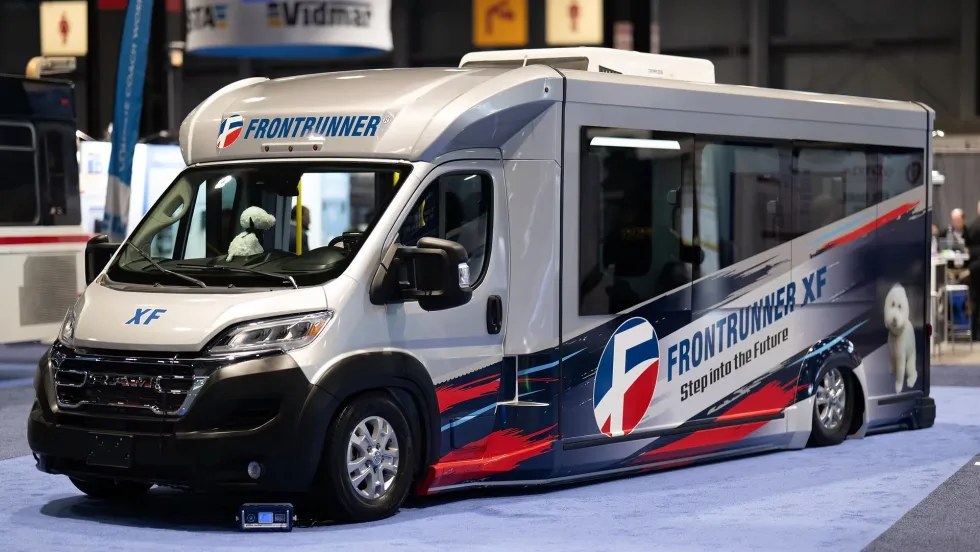
Frontrunner Bus Group Introduces XF Low-Floor Bus with Enhanced Accessibility
The new mid-sized bus features a full flat-floor design, eight-inch curbside step-in height, and zero-entry rear ramp to improve passenger access and operational flexibility.
Read More →
Building a Flexible Path to Transit Electrification with BAE's John Hroncich
John Hroncich discusses BAE Systems’ modular and scalable approach, lessons learned from decades of real-world operations, and how agencies can identify electrification strategies that fit their fleets.
Read More →
Scenes from APTA TRANSform & EXPO 2026
Transit leaders, manufacturers, and industry professionals gathered in Chicago to explore new technologies, share ideas, and discuss the future of public transportation.
Read More →
Biz Briefs: New Flyer Secures Additional 100-Bus Order from WMATA and More
In METRO's latest installment, we also take a look at recent news from Masabi, MCI, Samsara, and more partnerships making headlines across the transportation sector.
Read More →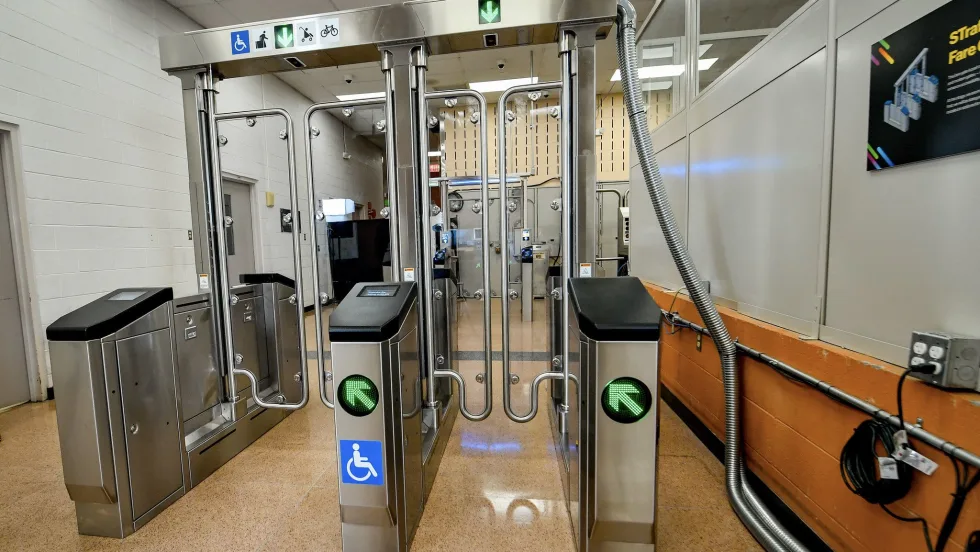
MTA Fare Gate Pilot Reduces Fare Evasion by 35%
Following a 20-station pilot, the agency plans to install new fare gates at 20 additional subway stations as part of a $1.1 billion modernization initiative.
Read More →
California Law Extends AC Transit’s Bus Lane Camera Enforcement
The new law allows AC Transit to continue using forward-facing bus cameras to enforce parking violations in bus-only lanes and at bus stops.
Read More →